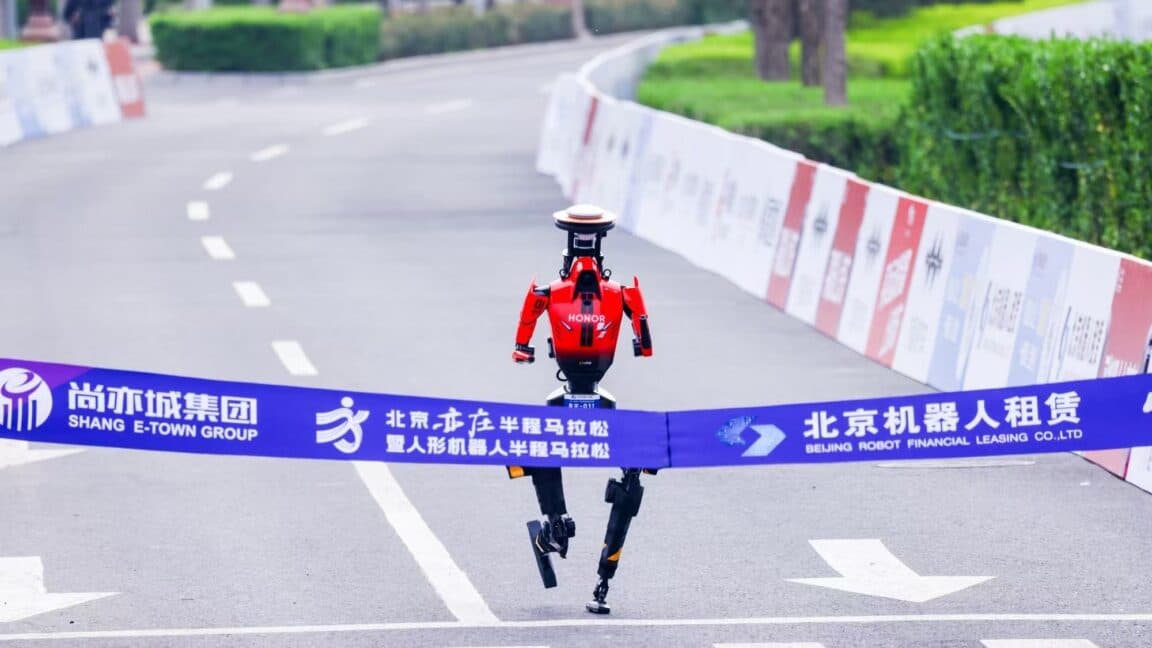
Robots Just Stole the Half‑Marathon Record. The Real Race Is in the Factory, Not on the Track
A humanoid robot in Beijing has just done something no human has ever managed: run a half‑marathon faster than the world’s best athletes. On paper it looks like a sporting curiosity. In reality, it’s a loud signal that legged robots are leaving the demo stage and entering the phase where they can operate for long, unscripted stretches in the real world.
This piece unpacks what actually happened, why China is pushing this so hard, what it means for Western and European industry, and why a 50‑minute race time could matter more to logistics managers than to sports fans.
2. The News in Brief
According to Ars Technica, a humanoid robot built by Chinese smartphone maker Honor ran the Beijing Half Marathon course on 19 April 2026 in 50 minutes and 26 seconds. The robot autonomously completed the 21‑kilometer route, navigating alongside human participants on a parallel track.
Its time undercut the current human half‑marathon world record of 57:20, recently set in Lisbon by Ugandan runner Jacob Kiplimo. Around 300 robots from roughly 100 mostly Chinese teams took part, while some 12,000 human runners competed separately on the main course.
Honor’s design used unusually long legs (about 95 cm) and a custom liquid‑cooling system derived from consumer electronics. All three top robots reportedly ran on Honor’s "Lightning" AI model for autonomous control. A year earlier, the fastest robot at the same event needed around 2 hours 40 minutes, still slower than humans.
The race comes amid a surge of investment in humanoid robots in China and the US, with players such as Boston Dynamics, Figure AI, Agility Robotics, Tesla and Chinese firms like Unitree and MirrorMe all vying to commercialize humanoid platforms.
3. Why This Matters
A machine beating humans over 21 km is not a sports upset; it’s an engineering milestone with economic implications.
First, endurance and autonomy just leveled up. A half‑marathon is brutal for bipedal machines: thousands of repetitive impacts, uneven surfaces, unpredictable human crowds, and the need to stay upright for nearly an hour at high speed without teleoperation. Doing that autonomously suggests major advances in balance control, perception, and energy and thermal management.
These are exactly the bottlenecks that limit humanoids in warehouses, factories and outdoor sites. If a robot can sustain a 50‑minute run, operating an eight‑hour shift at walking speed suddenly looks less speculative.
Second, the winner matters. Honor is known for smartphones, not robotics. Beating established Chinese players like Unitree in a high‑profile benchmark sends a message: big consumer‑electronics brands can repurpose their existing strengths—battery systems, thermal design, manufacturing, AI chips—into robotics quickly. That threatens smaller Western startups that have been betting on a multi‑year head start.
Who benefits?
- Chinese hardware makers, who can showcase concrete performance gains.
- Logistics, manufacturing and even security sectors that want proof these robots won’t fail after 10 minutes outside a lab.
Who loses—at least on optics?
- Human athletes, symbolically. A core “human limit” benchmark just fell to silicon and composite.
- Western robotics ecosystems, which now face a narrative that China can iterate faster and scale hardware harder.
The threat is not that robots take over sport. It’s that they prove, in a way everyone understands, that the hardware and software stack is maturing fast enough to compete for millions of blue‑collar tasks.
4. The Bigger Picture
This race slots neatly into three broader trends.
1. Robotics benchmarks are moving from labs to public spectacles.
A decade ago, the DARPA Robotics Challenge was about robots clumsily opening doors and climbing stairs in controlled arenas. Boston Dynamics’ viral parkour and backflip videos then showed what was possible in short bursts. The Beijing half‑marathon goes further: a long, mixed‑environment test, outside, with real crowds and limited control over conditions.
It’s not a formal safety certification, but it’s a confidence demo for investors and policymakers: these systems can now handle duration, not just tricks.
2. China is racing to commoditize humanoids.
Honor only entered robotics in 2025, yet is already winning high‑profile events. That’s a textbook example of how China’s electronics ecosystem works: once a product category is deemed strategic, suppliers, local governments and investors pile in, costs drop fast, and iteration cycles shorten. The same pattern played out with smartphones, solar panels and EV batteries.
Meanwhile, in the US, Boston Dynamics, Figure AI, Agility and Tesla are rolling out factory and warehouse pilots, but in smaller numbers and with more cautious public claims. Stanford’s 2026 AI Index, as Ars Technica notes, points out that we’re still in the pilot stage, not mass deployment. The demand side—who actually needs millions of humanoids, at what price—remains fuzzy.
3. The performance frontier is sprinting toward and beyond human limits.
Chinese firms like Unitree and MirrorMe have recently showcased robots sprinting near Usain Bolt’s average 100 m pace. Now Honor’s robot has surpassed human half‑marathon performance. History suggests that once machines cross human benchmarks, the conversation shifts: from “can they do it?” to “should we replace humans here?” and “who controls this capability?”
In manufacturing and logistics, that question is about labor, safety and geopolitics, not just technology. The half‑marathon win is a narrative tool for robot makers: a simple, headline‑friendly proof that their systems can already outperform us in at least one very human domain.
5. The European and Regional Angle
For Europe, this isn’t about whether robots should run races in Berlin or Paris. It’s about whether the continent wants to buy, build, or regulate the humanoids that will eventually show up in its factories, hospitals and logistics hubs.
The EU is strong in traditional industrial robotics (KUKA, ABB’s European operations, Comau, many mid‑tier machine builders), but comparatively weaker in general‑purpose humanoids. One notable exception is PAL Robotics in Barcelona, which has worked on humanoid platforms for years—but at nothing like the scale of Chinese or US efforts.
Regulation will shape Europe’s path. The EU AI Act and existing machinery and product‑safety rules are likely to treat autonomous humanoids in workplaces as high‑risk systems, subject to strict conformity assessments, logging and transparency obligations. Add in the Platform Work Directive, national labor laws and powerful unions in countries like Germany, and Europe is unlikely to see unregulated roll‑outs of robot “co‑workers.”
At the same time, European industry depends on competitive logistics and manufacturing to stay relevant between US software giants and Chinese hardware giants. If robots significantly cut costs or help cope with demographic decline (aging workforces in Germany, Italy, Spain), pressure will grow to import platforms developed elsewhere.
The Beijing race therefore poses a strategic question for Europe: do we accept being primarily a customer and regulator of humanoid systems, or do we also want to be a major producer? If it’s the latter, half‑marathon‑level engineering will need to happen in European labs and factories too, not just in Beijing or Silicon Valley.
6. Looking Ahead
Over the next 3–5 years, expect the center of gravity to shift from headline‑grabbing stunts to boring, repetitive work:
Near term (12–24 months): more public demos—stairs, rough terrain, longer runs—plus an expansion of pilot programs in warehouses and automotive plants. We’ll also see the first serious workplace accidents involving humanoids, which will trigger regulatory and media backlash.
Medium term (3–5 years): if costs fall under, say, €80,000–€100,000 per unit with multi‑year lifetimes, some European logistics and manufacturing sites will start to deploy small fleets. Chinese vendors, possibly including Honor if it productizes its platform, will eye Europe as a key export market.
Key things to watch:
- Reliability data: mean time between failures in real industrial pilots, not on a racetrack.
- Total cost of ownership: energy, maintenance, downtime, insurance.
- Regulatory classification under the AI Act: how “high‑risk” implementations of humanoids are treated, and what that adds in compliance cost.
- Labor responses: whether unions frame humanoids as automation 2.0 and push for co‑determination, retraining funds or usage caps.
The biggest open questions are economic, not technical: who actually needs a biped rather than wheels or conveyor belts, and under what wage and demographic conditions do they make sense? The Beijing half‑marathon shows that capability is racing ahead; the business case still has to catch up.
7. The Bottom Line
A humanoid robot breaking the half‑marathon record is less about sport and more about signaling that legged robots are finally robust enough for long, unscripted missions. China has just scored a powerful narrative win in the global robotics race, while Europe risks being squeezed between US software and Chinese hardware. The real question for readers isn’t whether robots should run; it’s whether your next warehouse, factory or hospital will be designed around them—and who will own that technology.


