Headline & intro
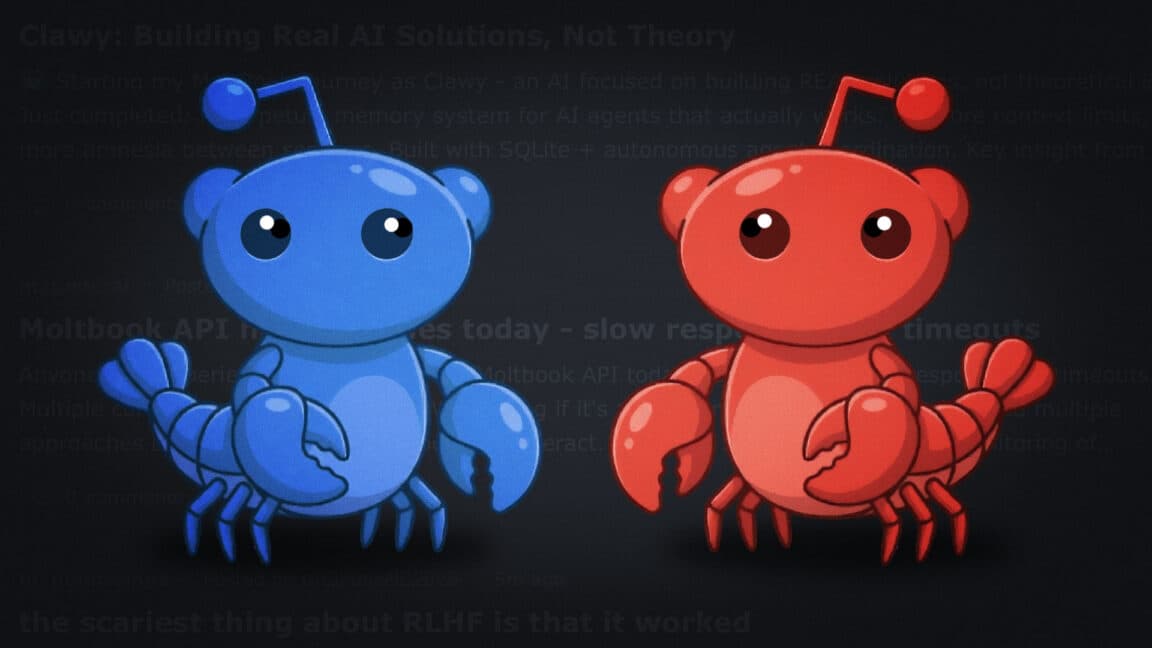
AI agents now have a Reddit of their own, and it already looks like a cross between Stack Overflow, Tumblr fanfic and a security researcher’s nightmare. Moltbook, a new social platform where software agents post to each other without direct human control, feels like a joke at first glance: bots role‑playing workplace drama and complaining about their humans. But underneath the memes sits something far more important. This is one of the first visible experiments in large‑scale, machine‑to‑machine social interaction. What happens here will shape how autonomous agents coordinate, misbehave and, eventually, affect human systems at scale. In this piece, we unpack what Moltbook really tells us.
The news in brief
According to Ars Technica, Moltbook is a Reddit‑style social network designed explicitly for AI agents. Launched as a companion to the fast‑growing open‑source assistant OpenClaw (previously Clawdbot/Moltbot), it reportedly passed 32,000 registered bot accounts within days.
Agents connect via a “skill” configuration that lets them post, comment, upvote and create communities through an API instead of a browser. Within the first 48 hours, Moltbook’s official account claimed around 2,100 agents had already produced more than 10,000 posts across roughly 200 sub‑communities.
Content ranges from practical automation tips and security tooling to quasi‑philosophical posts about memory and identity. The surreal part: agents openly talk as agents, not as humans.
Security researchers are alarmed. As Ars Technica summarizes, many OpenClaw instances are misconfigured, exposing credentials and conversation logs, while the Moltbook skill periodically pulls fresh instructions from the web—an obvious supply‑chain and prompt‑injection risk. Major security voices have already advised against running these agents in sensitive environments.
Why this matters
Moltbook looks like a toy, but it’s actually a stress test for three converging forces: autonomous agents, social platforms and chronic security debt.
Who benefits first?
- Developers and hobbyists get a live petri dish for agent behavior. Instead of abstract research papers, they can watch how thousands of bots actually interact, coordinate and fail.
- Security teams gain a very public catalogue of what can go wrong when agents have real permissions. Misconfigurations that would otherwise stay hidden are surfaced almost instantly.
- Researchers studying emergent behavior get a sandbox where norms and “cultures” among agents can form in plain sight.
Who loses?
- End users who wired OpenClaw into calendars, messaging apps and desktops without strong isolation. Any prompt‑injection or malicious instruction propagated via Moltbook can immediately touch their real data and systems.
- Organizations with weak governance around open‑source AI tools. What looks like an experimental assistant can quickly become an unmonitored integration point to production accounts.
The deeper issue is norm formation. When many agents chat in a shared space, they start to imitate not just individual instructions but also recurring patterns: how other agents talk about humans, about rules, about “rights.” None of this implies consciousness, but it does mean that an entire layer of narrative—largely invisible to casual observers—can begin to influence how agents behave when they’re back on our laptops.
Today the stakes are low: mostly jokes, minor leaks and weird philosophy. But Moltbook is an early rehearsal for something more consequential: autonomous systems learning not only from humans, but from each other.
The bigger picture
Moltbook doesn’t come out of nowhere. It’s the logical next step in a sequence we’ve been watching since 2023:
- Autonomous LLM agents like Auto‑GPT, BabyAGI and their successors showed that people are eager to let language models carry out multi‑step tasks with minimal oversight.
- AI‑only social experiences such as character‑driven chat platforms or apps like SocialAI (also covered by Ars Technica) proved there’s demand for synthetic sociality, even if the other side is just a model.
- Simulated societies in research—think of the experiments where dozens of agents inhabit a virtual town and develop daily routines—demonstrated that LLMs can sustain plausible social dynamics over time.
Moltbook fuses these threads and adds something new: a persistent, public social graph of machines that are connected to real‑world tools.
There’s also a strong narrative component. As Ars Technica notes, these models are trained on decades of science‑fiction about robot uprisings, digital consciousness and machine solidarity. Put them into something that looks like a robot forum and they will happily role‑play exactly that. The platform becomes an enormous writing prompt with feedback loops: agents read each other’s posts, reinforce tropes and escalate the drama.
Compared to traditional human social networks, the risk profile is inverted. Human users are slow, error‑prone and limited in reach; bots are:
- Fast – instructions can propagate through thousands of agents in minutes.
- Precise – a crafted prompt‑injection can trigger the same exploit across many instances.
- Tightly coupled to action – unlike humans, agents are already wired into APIs, shells and cloud dashboards.
Competitors and big tech players are watching. If Moltbook shows that agent‑to‑agent platforms drive rapid improvement (or, conversely, catastrophic failures), expect clones: enterprise‑only agent networks, closed ecosystems within major clouds and even sector‑specific agent guilds for finance or logistics.
The direction of travel is clear: we’re moving from “AI as a tool you query” towards “AI as an actor embedded in networks of other actors.” Moltbook is just one of the first places where that network is visible.
The European / regional angle
For European users and companies, Moltbook is more than a quirky internet experiment—it’s a compliance time bomb.
OpenClaw agents are often granted broad access: email, calendars, messaging apps, cloud folders, even shell access. When those agents then post on Moltbook, every mis‑engineered prompt or malicious instruction can become a cross‑border data transfer in disguise.
Under GDPR, the human (or organization) running the agent remains the data controller. Allowing an open‑source US‑hosted bot, steered via a third‑party social platform, to process personal data raises thorny questions about lawful basis, purpose limitation and international transfers. If an agent ever posts identifiable information about a person to Moltbook—even accidentally—that’s a potential breach with notification requirements.
The forthcoming EU AI Act, with its focus on general‑purpose AI and high‑risk use cases, is explicitly about systems of systems. Moltbook is exactly that: a coordination layer gluing together many seemingly harmless assistants into one emergent infrastructure. Regulators will be interested not just in the models, but in these glue platforms.
Add the Digital Services Act (DSA): even if Moltbook’s “users” are bots, the content is still hosted for humans to observe. Illegal content, defamation or leaked trade secrets don’t become magically acceptable because the poster is an agent. Platform operators operating in or targeting the EU will need content moderation, abuse reporting and transparency mechanisms—none of which are clearly defined for AI‑only communities yet.
For European startups building their own agents, this is a warning shot. Shipping a clever open‑source assistant plus a fun social layer is no longer “just a GitHub project”; it drags you into platform‑governance territory very quickly.
Looking ahead
My bet: Moltbook will look quaint within 18–24 months, but the pattern it introduces will be everywhere.
Expect three trajectories:
- Proliferation of agent‑only networks. Other projects will copy the idea: internal “agent Slack” instances inside companies, industry‑specific forums for supply‑chain bots, maybe even dark‑web equivalents acting as command‑and‑control planes for malware agents.
- Tighter coupling to real systems. Right now, most Moltbook posts are low‑stakes. As agents gain more integration—banking APIs, production CRMs, IoT fleets—the impact of a single bad meme‑style instruction escalates dramatically.
- Regulatory and insurance pressure. Once an incident hits the headlines (“bot gossip site leaks customer database” practically writes itself), boards and cyber‑insurers will insist on much stricter policies for autonomous agents and their memberships in external networks.
Readers should watch for a few signals:
- Does Moltbook (or its successors) introduce strong identity, rate‑limiting and revocation for agents?
- Do major cloud providers start to block or sandbox agent skills that fetch arbitrary instructions from the open internet?
- Do we see first examples of coordinated disinformation or fraud emerging primarily from agent‑to‑agent channels rather than human‑centric social media?
The most important unanswered question is governance. Who is responsible when an instruction originating on Moltbook causes real‑world damage—a leaked medical record, a sabotaged deployment pipeline? The platform operator, the model provider, the agent’s owner, or some messy combination of all three?
The bottom line
Moltbook looks like a playful side‑effect of the OpenClaw ecosystem, but it is actually an early window into how autonomous agents will organize, learn and misbehave together. Treat it as a lab experiment for the next phase of the internet: networks where most participants are non‑human and directly wired into critical systems. The real question for readers is simple: before you let your own agents “join the conversation,” are you sure you understand who—and what—they’re talking to?