OpenAI’s Codex Mac App Shows the Real Battle: Workflow, Not Just Model Quality
OpenAI’s new Codex desktop app for macOS looks like a small product update, but it is actually a clear signal of where the AI coding wars are heading. The frontier is no longer just about whose model writes the cleverest function; it’s about who owns the developer’s daily workflow. With Anthropic’s Claude Code gaining momentum on the desktop, OpenAI couldn’t afford to stay stuck in browsers, CLIs and IDE sidebars. In this piece, we’ll unpack what the new app really changes, how it shifts the Anthropic–OpenAI rivalry, and why European developers and companies should pay close attention.
The news in brief
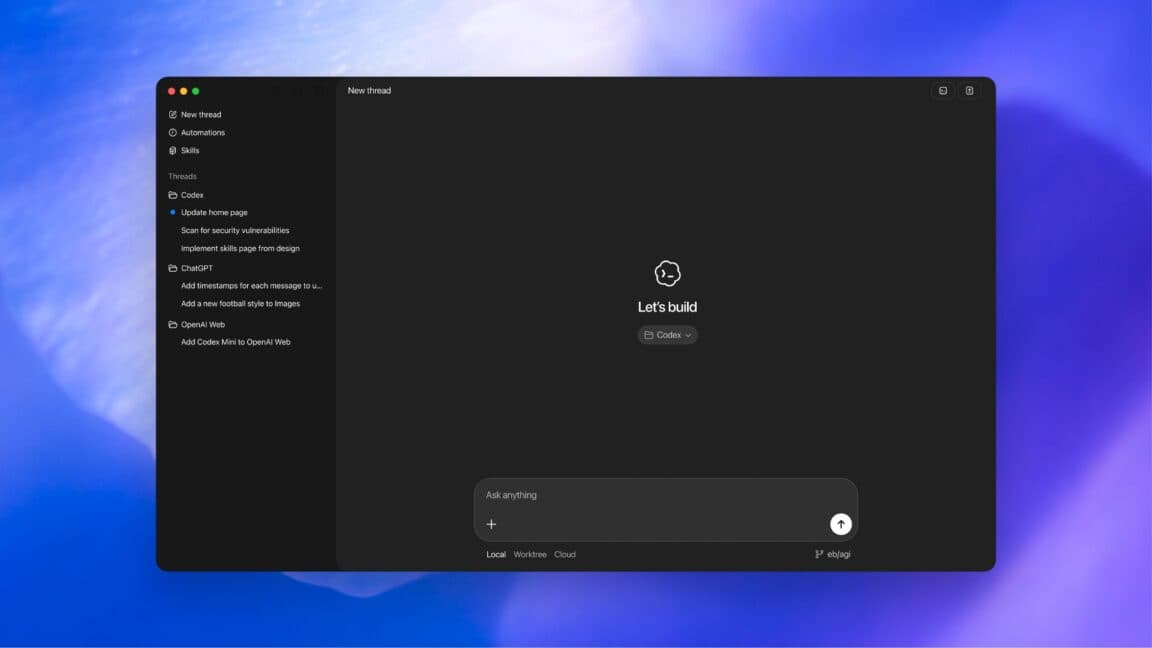
According to Ars Technica, OpenAI has released a native Codex desktop application for macOS, expanding its AI coding assistant beyond the existing command-line, web interface and IDE extensions. The app, launched on 2 February 2026, is built around managing multiple AI coding agents in parallel.
OpenAI positions the desktop interface as better suited to long‑running or multi‑agent tasks than the command line or in‑IDE panels. Users can group agents by project, run several projects at once, and use worktrees to reduce conflicts. The app supports "Skills"—essentially folders of instructions and resources that extend what agents can do—and "Automations", which schedule actions using those Skills.
As Ars Technica notes, this brings OpenAI closer to Anthropic’s Claude Code, which already offered a macOS app. To sweeten the offer, OpenAI is doubling Codex rate limits for Plus, Pro, Business, Enterprise and Edu tiers, and temporarily making Codex available to ChatGPT Free and Go users, though without disclosing precise limits for those free/low‑tier plans.
Why this matters
On the surface, a macOS client is incremental. In reality, it’s OpenAI admitting that serious coding with AI is not a "prompt and forget" activity but an orchestrated workflow involving multiple agents, tools and long‑running tasks.
The obvious winner here is the professional developer who juggles several repositories and experiments. Being able to spin up multiple agents per project, keep them running for hours, and attach structured "Skills" and Automations turns Codex from a chatty assistant into something closer to a lightweight autonomous dev team. That’s much harder to manage in a terminal window or an IDE sidebar.
OpenAI also benefits strategically. Anthropic’s Claude Code used its macOS app to anchor itself in developers’ daily routines—dock icon, notifications, persistent sessions. By closing this gap and doubling rate limits at similar price points, OpenAI is signalling a familiar strategy: when late on product features, compete on capacity and integration. More context windows, more tokens, more agents in parallel.
Potential losers include smaller AI coding tool vendors who cannot match this combination of model quality, generous usage and now native desktop presence. Indie tools built around wrappers or simple chat‑based coding might quickly look outdated.
There are also new risks. A desktop app with long‑running agents and Automations is powerful but easier to misconfigure. Automated refactors running overnight on the wrong branch, or agents with Skills that have too broad access to local files, can cause serious damage—especially in corporate environments without strong guardrails. The convenience gain is big, but so is the blast radius if something goes wrong.
The bigger picture
This move fits into a broader shift from "copilot"-style autocomplete to agentic development. Over the last two years, we’ve seen GitHub Copilot expand beyond inline suggestions, startups like Cursor and Replit building agent‑centric IDEs, and Anthropic pushing Claude Code as a coding partner that can manage entire features.
OpenAI’s Codex app is a bet that the next phase of this competition will be about coordination across multiple agents and tools. Worktrees, project‑grouped agents, Skills and Automations all point in the same direction: persistent, semi‑autonomous collaborators that live alongside your editor, not inside it.
Historically, platform shifts in developer tooling have played out this way. In the 2000s, the browser plug‑in was enough; later, the winners were those who owned the suite—source control, CI/CD, issue tracking. The same pattern is emerging in AI: first came API endpoints and small IDE extensions; now we’re watching the build‑out of full-stack AI dev environments.
Compared with Anthropic, OpenAI is still reacting rather than defining the desktop experience. Claude Code reached macOS earlier and has strong mindshare among early adopters who value Anthropic’s safety stance and longer-context models. However, OpenAI can compensate with ecosystem gravity: existing ChatGPT users, tighter integration across products, and aggressive rate limits.
The message to the market is clear: AI coding assistants are no longer sidekicks. They’re becoming primary interfaces to codebases and infrastructure. The tools that win will be those that feel least like separate apps and most like a natural extension of how developers already structure projects and teams.
The European/regional angle
For European developers and companies, the Codex macOS app matters on three fronts: regulation, security, and vendor concentration.
First, timing overlaps with the phased implementation of the EU AI Act through 2025–2026. General‑purpose AI models used in coding will come under transparency and risk‑management obligations. A desktop app that can run long‑lived agents on local codebases potentially touches everything from security‑sensitive infrastructure to personal data in legacy systems. European firms will need to document how these agents are used, what data they see, and how AI‑generated code is reviewed.
Second, Europe’s strong privacy culture—especially in countries like Germany and the Nordics—means that local teams will ask harder questions about where code and context windows are processed. OpenAI’s desktop app doesn’t magically solve data residency or IP concerns. Enterprises subject to GDPR, NIS2, or sector‑specific rules will still need to evaluate whether cloud‑processed AI coding is acceptable or whether they must push for on‑premise or EU‑hosted variants.
Third, the competitive impact is significant for European AI coding startups. Many are working on specialised agents (for mainframes, industrial protocols, SAP customisation, etc.). When OpenAI drops a polished macOS app with generous limits into every developer’s dock, that raises the bar for UX and reliability. The opportunity for European players will be to integrate with Codex (via Skills, workflows or enterprise management) or to focus on regulated sectors where a generic US‑hosted assistant is hard to adopt.
Looking ahead
Expect three next steps if this launch gains traction.
First, deeper IDE and OS integration. A standalone app is only the opening move. Watch for features like system‑wide code search across local repos, one‑click "send this stack trace from Xcode/VS Code to Codex", and tighter hooks into Git clients. The goal will be to make Codex feel less like "another window" and more like a background co‑worker.
Second, better governance and controls. As enterprises test long‑running agents and Automations, they will demand audit logs, policy enforcement (e.g., which repos an agent may touch), and integration with identity providers. If OpenAI doesn’t provide this, third‑party vendors in Europe will—turning compliance and observability into a new product layer atop Codex and Claude Code.
Third, pricing and rate‑limit experiments. Doubling limits is an aggressive opening gambit, but it is unlikely to be the final configuration. Expect OpenAI to differentiate more clearly between hobbyist, professional and enterprise use—perhaps keeping high‑capacity multi‑agent workflows as a premium feature, while basic coding help remains broadly accessible.
Open questions remain. How well do these agents handle large, messy monorepos in the wild, not just demo projects? How do team‑level workflows evolve when several developers attach their own agents to the same codebase? And, crucially for Europe, will we see region‑specific deployments that satisfy emerging AI and cybersecurity regulations?
The bottom line
OpenAI’s Codex macOS app is less about catching Anthropic on feature checklists and more about seizing control of the developer workflow. For individual programmers, it promises more powerful, persistent AI collaborators; for teams and enterprises, it raises urgent questions about governance, security and regulation. The real contest now is not whose model is marginally smarter, but who can safely embed AI into the daily rituals of software development. The question for readers is simple: do you want your next "colleague" to live in your IDE, your browser, or now, your dock—and on whose terms?