Headline & intro
The eye‑catching number is $54 billion for drones, but the real story is that the US military is quietly rewriting how wars are fought: as a software problem. The Pentagon’s latest budget proposal isn’t just about more flying robots; it is about turning autonomy, swarming, and AI-enabled coordination into a core doctrine on a scale no other country can currently match. For Europe and the rest of the world, this isn’t a distant American procurement saga. It’s a forcing function: either adapt to software‑defined warfare or become strategically irrelevant.
The news in brief
According to Ars Technica, the US Department of Defense has requested a total budget of about $1.5 trillion for the 2027 fiscal year, with what officials describe as the largest single push for drone and counter‑drone systems in US history.
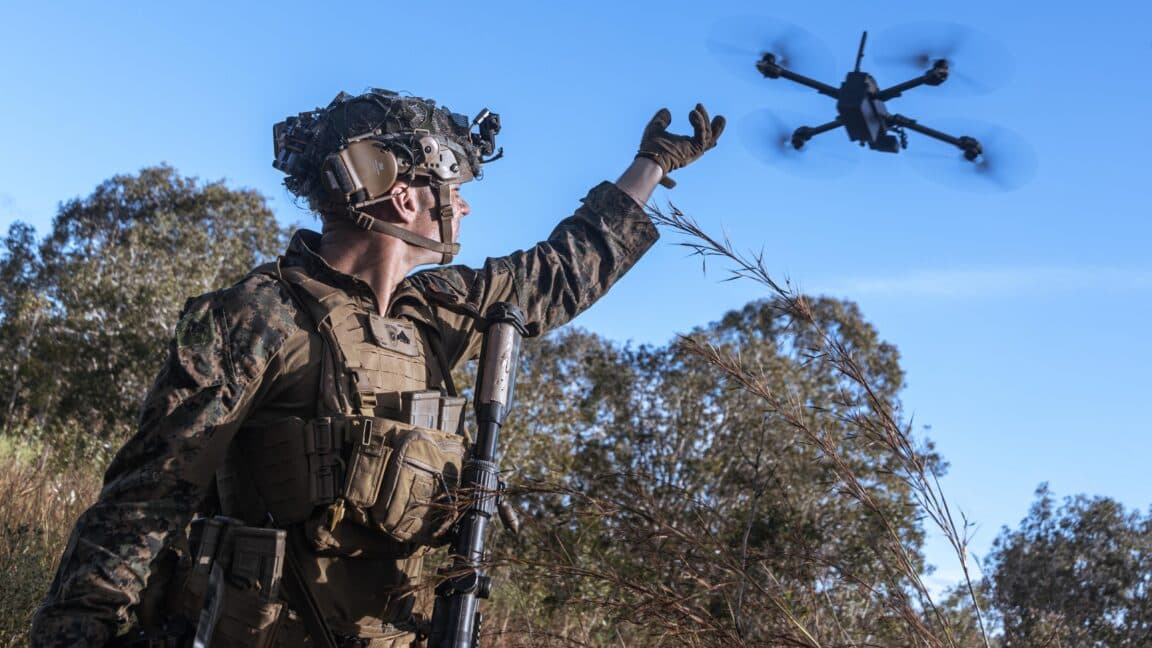
Roughly $53.6 billion would be channelled through the newly created Defense Autonomous Warfare Group (DAWG). The money covers buying drones, training operators, building logistics to sustain large‑scale drone deployments, and expanding defensive systems against hostile drones. DAWG’s budget would explode from about $226 million in FY2026 to tens of billions in FY2027.
Ars Technica reports that a further $20.6 billion is earmarked for one‑way attack drones and the Air Force’s Collaborative Combat Aircraft programme, which pairs autonomous aircraft with crewed fighters, as well as the Navy’s MQ‑25 refuelling drone and counter‑small‑drone capabilities.
A Pentagon official stressed that around $70 billion is targeted at systems that already exist, not speculative R&D. The overall defence request, Reuters has noted, would be the largest year‑on‑year rise in US military spending since World War II, and still needs approval from Congress.
Why this matters
The most obvious winners are US defence primes, drone manufacturers, and AI/middleware companies that can orchestrate swarms and autonomy. But the more important winner is a doctrine: the idea that mass‑produced, semi‑expendable, software‑defined systems matter more than a small fleet of exquisite, manned platforms.
The drone budget rivals or exceeds the entire defence spending of many countries. That sends a blunt message to mid‑sized powers: if you are still optimising for a handful of jets, tanks, and ships rather than for thousands of cheap, networked sensors and shooters, you are optimising for the wrong war.
The Pentagon is also signalling that the bottleneck is no longer just the airframe. Money flows into training operators, establishing logistics for rapid replacement, and building defences against ubiquitous small drones. In other words, drones are being treated as consumables in a long, grinding conflict, not as prestige assets.
There are losers too. Countries that cannot afford this level of automation risk seeing their traditional strengths—heavy armour, legacy air forces—neutralised by swarms of cheap, smart munitions. Human pilots and commanders may also see more decision‑making shifting to algorithmic systems that are faster, but less transparent.
Finally, this scale of spending accelerates an AI arms race. Once the US normalises tens of billions per year for autonomous warfare, rivals like China can point to Washington as justification for their own expansions. Norms and treaties around autonomous weapons are already fragile; this will not make them stronger.
The bigger picture
What the Pentagon is doing here is institutionalising lessons from Ukraine, Syria, and the South Caucasus. On those battlefields, small quadcopters and cheap one‑way attack drones have destroyed armour, disrupted logistics, and forced constant tactical adaptation. Iranian‑made Shahed drones, reportedly costing tens of thousands of dollars each, have shown how mass, not elegance, can overwhelm air defences.
The US has used large drones like the Predator and Reaper for decades, but those were essentially long‑range sniper rifles with wings. The new money is different. It is aimed at scale, speed of iteration, and teaming between humans and machines. The Collaborative Combat Aircraft effort, funded from the same pot, is about turning crewed fighters into the centre of a flock of autonomous “loyal wingmen” that scout, jam, and strike.
Crucially, Pentagon officials, as cited by Ars Technica, highlight how frontline drone tech is evolving in weeks, not in the multi‑year cycles of traditional defence procurement. That is very close to how the commercial software industry operates. The budget is therefore not only about buying drones; it’s about buying the ability to update tactics and algorithms as quickly as your adversary.
Compared with other actors, this is an attempt to out‑spend and out‑software the competition at the same time. China has been public about its interest in AI‑enabled swarms and autonomous vessels; smaller regional powers buy off‑the‑shelf systems or rely on local champions like Turkey’s Baykar. But no one else is putting a figure resembling $70 billion on the table in a single year just for drones and autonomy.
This level of investment tells us where high‑end warfare is heading: continuous, data‑driven optimisation around sensor networks, cheap precision munitions, and AI orchestration, with manned platforms increasingly in the role of command nodes rather than primary shooters.
The European / regional angle
For Europe, this budget is uncomfortable reading. The Pentagon is planning to spend more on drones alone than most EU countries spend on their entire armed forces. Even when you combine recent European rearmament pushes, there is nothing of comparable scale devoted purely to autonomy and swarming.
Regulators in Brussels have focused on civilian AI via the EU AI Act, which deliberately excludes military systems. That leaves a strategic vacuum: Europe is tightly regulating chatbots and recommendation engines while the world’s biggest military power is industrialising autonomous kill chains.
There are pockets of European strength—German sensor companies, Italian and French aerospace, Turkish and some EU‑based drone manufacturers—but they are fragmented. European defence cooperation programmes tend to be slow, politically delicate, and aimed at big, traditional platforms like fighters and tanks.
NATO will of course benefit from US capabilities, but dependence cuts both ways. If drones become central to deterrence and Europe lags in autonomous systems and counter‑drone tech, strategic autonomy becomes even more of a slogan than a reality.
For European tech ecosystems—from Berlin and Paris to Ljubljana and Zagreb—this also opens a controversial opportunity. Dual‑use AI, computer vision, and robotics startups may find growing demand from defence ministries and NATO innovation funds. The ethical debate Europeans prefer to postpone—should we build software that makes killing more efficient?—will become harder to avoid.
Looking ahead
Congress will almost certainly argue about the $1.5 trillion top line, but there are strong political and operational reasons for drone‑related spending to survive relatively intact. Ukraine’s daily use of FPV drones and Russia’s constant missile and drone strikes have become vivid demonstrations for US lawmakers of what happens when you fall behind.
Near‑term, expect three things. First, a surge of procurement contracts for off‑the‑shelf systems, including small quadcopters and loitering munitions. Second, rapid expansion of training pipelines—not just for operators, but for “drone wranglers” who manage swarms and data flows. Third, a more visible push on counter‑drone systems, from jammers to lasers and AI‑based detection.
Medium term, we should watch for how far the Pentagon is willing to let AI into the lethal decision loop. Current doctrine insists on meaningful human control, but the operational pressure to let algorithms pre‑select or even autonomously engage targets will grow as volumes increase.
Internationally, export policy becomes key. Will Washington share advanced autonomous systems with allies, including in Europe and Asia, or keep the most capable swarming tech national? That choice will shape alliance cohesion and industrial policy for years.
For industry and researchers, the opportunity is clear but fraught. There will be money for autonomy, edge AI, resilient communications, and counter‑drone solutions. There will also be reputational risk, regulatory scrutiny, and the very real possibility of escalation if autonomous systems miscalculate.
The bottom line
The Pentagon’s $54 billion drone push is not just more of the same hardware—it is a structural bet that future wars will be won by whoever can deploy and update autonomous systems fastest. For Europe and other mid‑tier powers, the question is no longer whether drones matter, but whether their political, ethical, and industrial frameworks can cope with warfare that increasingly looks like a continuous software rollout. If your country had to make that bet today, which side of the autonomy divide would it land on?


