1. Headline & intro
Donald Trump promised a crash program to blanket the US with AI data centers and “beat China.” Instead, the buildout is colliding with physics, infrastructure, and politics. When almost half of planned facilities are delayed or canceled, this is no longer a project-management glitch—it’s a strategic failure.
In this piece, we’ll unpack what’s actually blocking the US AI buildout, why Trump’s own tariff policies are a central culprit, and how local resistance and looming moratoria could reshape the global AI race. We’ll also look at what this means for Europe, which is watching the US stumble while wrestling with its own energy and AI dilemmas.
2. The news in brief
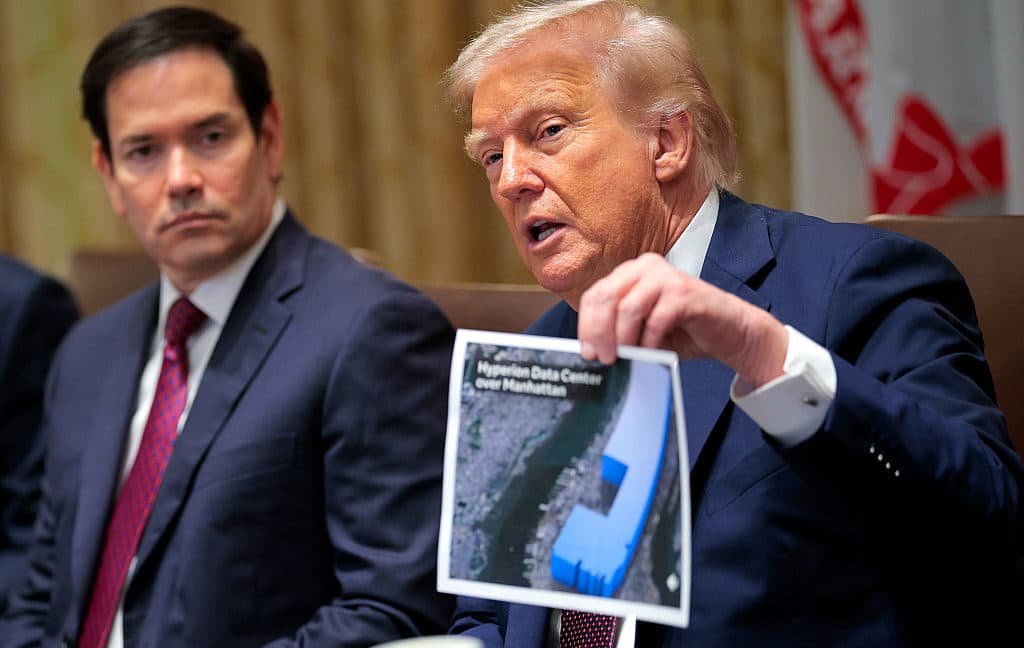
According to Ars Technica, Trump’s push—via a series of 2025 executive orders—to rapidly expand AI data center capacity in the US is faltering on multiple fronts.
Citing Bloomberg, Ars reports that nearly half of US data centers planned for 2026 are expected to be delayed or canceled. The main bottleneck is not GPUs but power infrastructure: large transformers, switchgear, and utility‑scale batteries. For decades, US developers have sourced much of this heavy equipment from China. Lead times that used to be around two to two‑and‑a‑half years have reportedly stretched to as much as five years.
Trump’s steep tariffs on Chinese imports have made it harder and more expensive to close those gaps, while US domestic manufacturing capacity cannot yet meet demand. At the same time, political backlash is growing. A federal bill from Bernie Sanders and Alexandria Ocasio‑Cortez proposes a moratorium on AI data centers, and Maine is close to enacting the first statewide pause. Various cities and smaller municipalities are considering or have already passed temporary bans.
3. Why this matters
The story isn’t just that projects are delayed; it’s why they’re delayed. The US administration is discovering that you cannot wage an industrial AI arms race while simultaneously cutting yourself off from the very industrial base that makes it possible.
The winners so far are… almost no one. Developers are stuck between paying punishing tariffs to import critical grid components from China, or waiting years for limited US manufacturing to catch up. Utilities face pressure to deliver unprecedented power capacity under political scrutiny. Communities bear the environmental and social risks while seeing few local benefits beyond short‑term construction jobs.
Trump’s team framed tariffs as a lever to weaken China and reshore production. In practice, the policy is acting like a brake on the US AI buildout precisely during the narrow window in which the US is estimated to hold a several‑year lead over China in cutting‑edge AI models. Stretching transformer lead times to five years effectively burns that advantage.
Meanwhile, the backlash at state and local levels highlights a deeper miscalculation: data centers have been treated as abstract “cloud” infrastructure, not as industrial facilities that consume vast land, water, and electricity. Residents see heat islands, higher bills, and landscape changes—not national security or innovation.
The immediate implications are clear:
- Big Tech will prioritize locations with ready grid capacity and friendlier politics, concentrating even more power in a few regions.
- The US may be forced back into a reluctant dependence on Chinese power hardware, despite the tariffs, simply to keep projects alive.
- Political narratives around AI will harden: not as a source of prosperity, but as a threat to local quality of life.
This combination of supply‑chain nationalism and local resistance is exactly the opposite of what a fast, coordinated AI infrastructure rollout requires.
4. The bigger picture
Trump’s AI data center troubles sit at the intersection of three broader trends.
1. Industrial policy colliding with supply‑chain reality.
The US has already seen this movie with semiconductors. The CHIPS Act poured billions into domestic fabs, but the ecosystem still depends heavily on Asian supply chains for tools, chemicals, and packaging. With data centers, the missing pieces are transformers, power electronics, and batteries—sectors where China has quietly built overwhelming scale over the past two decades, just as it did in solar and EVs.
Trying to decouple from that dominance overnight guarantees bottlenecks. The US is discovering that "friend‑shoring" doesn’t help if allied countries are themselves dependent on Chinese inputs.
2. The physical limits of the AI hype cycle.
For the last two years, AI narratives have revolved around compute and algorithms: GPUs, model size, model quality. Now the constraints are shifting down the stack to concrete, copper, and grid stability. Even in Silicon Valley, developers are running into zoning fights, water‑use questions, and power‑grid bottlenecks.
We’ve seen regional versions of this in Europe already: Amsterdam and parts of Ireland paused or restricted new hyperscale data centers over grid and land‑use concerns. The US is simply arriving later to the same realization: AI is heavy industry disguised as software.
3. Populist skepticism of “big tech projects.”
The Harvard/MIT poll, reported by Axios, shows that Americans are more anxious about how mega‑projects will transform local life than about line items on their electricity bill. This echoes battles over wind farms, 5G towers, and high‑speed rail. When communities feel projects are rushed and imposed from above, they reach for the bluntest instrument available: moratoria.
Trump has staked political capital on AI nationalism while ignoring the need for transparent, community‑level bargaining over benefits and harms. That creates a vacuum his opponents can fill with calls for sweeping pauses, and it gives local activists a clear narrative: slow down, or stop.
5. The European / regional angle
From a European vantage point, the US struggle is both a warning and an opportunity.
The EU is already further along in regulating AI (through the EU AI Act) and digital infrastructure (via the Digital Services Act and planned Green Deal measures for data‑center efficiency). Several member states—including the Netherlands and Ireland—have learned the hard way that unplanned hyperscale growth can overwhelm local grids and trigger public backlash.
The US hitting the same wall—only at much higher scale—may strengthen European policymakers who argue for strict siting rules, energy‑efficiency requirements, and heat‑reuse obligations for data centers. Germany is already pushing district‑heating integration for new facilities; Nordic countries market themselves as cool‑climate, renewable‑powered data‑center hubs.
Strategically, if US projects are delayed into the late 2020s, Europe and parts of Asia could capture a larger share of AI hosting and training workloads, especially for companies that need legal certainty and stable timelines more than they need to be physically in the continental US.
At the same time, Europe should not be complacent. It is at least as dependent as the US on Chinese‑made transformers, power electronics, and batteries. And European citizens are no less skeptical of massive infrastructure projects in their backyards. The lesson from Trump’s missteps is not “regulate less,” but “plan holistically”: industrial policy, grid planning, and community benefits have to move together, or the entire AI strategy can stall.
6. Looking ahead
Over the next 12–24 months, three dynamics are worth watching.
1. Tariff realism vs. ideological rigidity.
If delays mount and the AI rhetoric stays maximalist, the administration will face a choice: quietly carve out exceptions for critical grid hardware, or double down on tariffs and accept slower deployment. Corporates already appear willing to pay the tariff premium when they can; the question is whether supply from China will be politically tolerated or further restricted.
2. The rise of conditional approvals instead of blanket yes/no.
Maine’s proposed moratorium is framed as a pause to study impacts, but the real battleground will be what comes after the pause: strict caps on energy use? Mandatory renewable sourcing? Requirements to share waste heat or invest in local infrastructure? Cities like Denver and Dallas may gravitate toward frameworks that tie approvals to concrete community benefits rather than simple bans.
3. Consolidation of AI infrastructure power.
As smaller or politically sensitive regions stall projects, the hyperscalers with existing campuses in friendly jurisdictions—think a few US states, some Nordic countries, parts of Canada—will gain even more leverage. That concentration raises its own resilience and competition concerns, but from the operators’ standpoint, it’s easier than fighting hundreds of local battles.
Unanswered questions remain. Will US voters blame Trump for the delays, or will “blame China” remain a sufficient narrative? Will Congress actually pass a national moratorium, or will this remain a patchwork fought at the state and city level? And internationally, will Europe use this moment to position itself as the “responsible” home for AI infrastructure—or will it repeat the same uncoordinated build‑first, plan‑later pattern?
7. The bottom line
Trump tried to run an AI arms race on a foundation of tariffs, underbuilt manufacturing, and neglected local politics. The result is predictable gridlock: delayed projects, nervous communities, and a widening gap between rhetoric and reality.
For Europe and the rest of the world, the US experience is a live stress test of AI industrial policy. The key question now is whether policymakers—on both sides of the Atlantic—treat data centers as mere “cloud” buildings, or as critical, contested infrastructure that must be planned with the grid, the environment, and citizens at the center.