1. Headline & intro
The most important robotics experiment in the world is not happening in Silicon Valley but in the trenches of Eastern Ukraine. Under relentless drone surveillance, Kyiv is quietly rewriting how armies think about manpower, hardware, and software by pushing thousands of ground robots into daily combat use. This is not sci‑fi; it’s messy, failure‑prone and brutally empirical. But it is happening at a scale that will shape how every modern military — and every defense tech startup — plans for the next decade. In this piece, we’ll look beyond the headlines to what Ukraine’s robot surge really signals for warfare, industry, and regulation.
2. The news in brief
According to Ars Technica, Ukrainian president Volodymyr Zelenskyy recently claimed that Ukrainian drones and ground robots had jointly forced Russian soldiers to surrender at a frontline position — a claim not yet independently verified, but supported by Ukrainian military accounts and government videos.
Ars reports that Ukraine says its military robots carried out more than 22,000 missions in the past three months, and that the Defense Ministry counts over 9,000 uncrewed ground vehicle (UGV) missions in March alone — roughly triple the number from five months earlier.
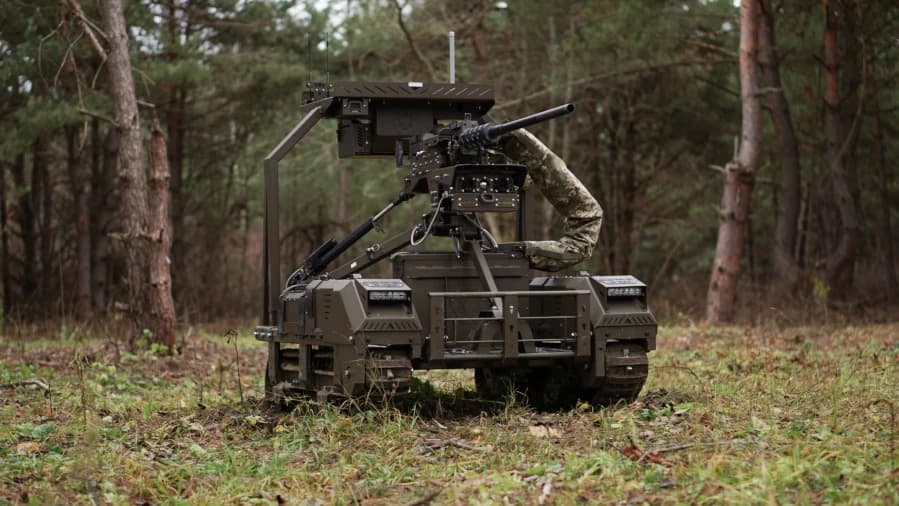
These systems are used for logistics, casualty evacuation, and direct combat. One example highlighted is the Droid TW 12.7, a tracked robot from Ukrainian firm DevDroid, mounting a heavy machine gun and controllable via radio and Starlink.
The push comes as small drones now cause the majority of battlefield casualties and have turned roughly 20 km beyond the front line into a near‑constant kill zone for exposed humans.
3. Why this matters
Ukraine’s robot surge is not just about saving soldiers; it’s about redefining what counts as a “soldier” at all.
At the tactical level, robots are becoming consumables. A UGV that fails four times out of five on casualty evacuation, as Ukrainian officers admit, would be unacceptable if it were a human squad. But if the fifth mission saves a life while sacrificing a €20,000 robot instead of a trained medic, commanders will keep sending them. That reframes procurement logic: resilience comes from numbers, not perfection.
The winners in this shift are:
- Militaries with agile software and manufacturing ecosystems. You need fast iteration, not decade‑long programs. Ukraine is turning its battlefield into a continuous beta test.
- Small robotics startups and dual‑use manufacturers. They can ship often, fail fast, and learn under real combat pressure — an advantage no peacetime lab can replicate.
The losers are:
- Traditional, slow‑cycle defense primes. Gold‑plated, multi‑billion platforms look less relevant when cheap robots and FPV drones are what actually shape the daily fight.
- Soldiers in armies that don’t adapt. Any military that sends infantry across open ground without integrated drones and UGVs is essentially fighting with 20th‑century tactics against 21st‑century sensors.
Crucially, the current generation of robots is still mostly remote‑controlled. But Ukraine is already testing drones with onboard AI that can track and hit targets even under jamming. Ground robots will follow. The line between “tele‑operated tool” and “semi‑autonomous teammate” is going to blur very fast — long before many legal frameworks or ethical debates have caught up.
4. The bigger picture
Ukraine’s robot push plugs into three wider trends that go far beyond this war.
1. The drone‑ification of the battlefield. From Nagorno‑Karabakh to Gaza, cheap sensors and loitering munitions have turned concealment into a luxury. Ukraine shows the logical next step: once the air is saturated with lethal quadcopters, you move risk to ground systems as well. Robots become the only way to operate in persistent surveillance zones without bleeding manpower.
2. Software‑defined lethality. Recent reports from Ukraine and Israel describe AI‑assisted targeting tools that fuse data and nominate strike options faster than humans can. The fact that Ukraine is field‑testing drones that continue to hunt when cut off from operators is a preview of where land robots are headed: more autonomy at the edge, constrained by rules encoded in software rather than radio commands.
Historically, we’ve seen similar inflection points. The First World War industrialized artillery and machine‑gun fire faster than doctrine could adjust, with horrific human cost. Today, the industrialization is in sensing and autonomy. Those who adapt their command structures, training, and logistics to treat code as a weapon system — not a support function — will gain advantage.
3. Democratization of advanced warfare. Ukraine’s ground robots are not exotic. A small company can strap a machine gun to a tracked chassis, bolt on Starlink, and ship to trench units. Russia is doing the same. That means mid‑tier states, or even non‑state actors, can copy the model quickly. We’re heading toward a world where any actor with modest funds can assemble a mixed flock of cheap drones and ground robots with increasing autonomy.
If that sounds like science fiction, remember that off‑the‑shelf FPV drones costing a few hundred dollars already destroy multi‑million‑euro tanks on a weekly basis in Ukraine. Ground robots are just the next logical node in this networked kill chain.
5. The European / regional angle
For Europe, Ukraine’s robot experiment is a mirror and a warning.
On paper, the EU is investing heavily in defense innovation: projects under the European Defence Fund, national initiatives like France’s SCORPION program, and Germany’s slowly accelerating Zeitenwende. Yet much of the industrial base still thinks in terms of tanks, fighters, and frigates — not fleets of attritable robots tied to AI‑driven command systems.
Regulation adds another twist. The EU AI Act explicitly carves out military and national security uses, but that doesn’t make Brussels irrelevant. Many of the enabling technologies — computer vision, navigation, communications — are dual‑use. Export controls, GDPR‑style data governance, and the Digital Services Act will shape how training data, satellite links, and cloud platforms for these systems are run by European providers.
There’s also a competitive angle. Europe actually has a head start in some areas: Estonia’s Milrem Robotics has been fielding the THeMIS UGV with several NATO armies; German and French firms are testing armed and unarmed ground platforms; Central and Eastern European startups are emerging around drone jamming, robotics, and secure comms. Ukraine’s war experience is a live testbed that European industry should be learning from aggressively — not observing politely and then going back to decade‑long procurement cycles.
Finally, public opinion in Europe is more sensitive to autonomous weapons than in many other regions. That will matter when Ukrainian‑style systems start appearing in EU arsenals. Governments will need to be transparent about the level of autonomy they accept, how human oversight is guaranteed, and how exports are controlled, or they risk a public backlash that could freeze useful innovation along with the dangerous parts.
6. Looking ahead
In the next 12–24 months, expect three developments.
1. Robots at scale, not as experiments. Ukrainian commanders are already talking about reducing infantry headcount in units that adopt more robots. If even a fraction of front‑line brigades manage a 20–30% substitution of risky tasks with UGVs, that becomes a de facto template for NATO force planners.
2. A shift from hardware to autonomy stacks. Once basic platforms stabilize, the decisive differentiator will be software: navigation in rubble, target recognition under jamming, swarm coordination. Whoever controls the most robust, adaptable autonomy stack will set de facto standards — and lock in customers.
3. Regulatory and ethical pressure. As soon as a documented case appears of a semi‑autonomous system making a targeting decision that kills civilians — whether in Ukraine or elsewhere — expect renewed calls at the UN and within the EU for tighter limits on “lethal autonomous weapon systems” (LAWS). Ukraine’s necessity‑driven experimentation will collide with a global push for norms.
For readers — whether in tech, policy, or the military — the key signals to watch are: procurement language that moves from “pilot projects” to “standard equipment”; startups advertising "combat‑proven autonomy"; and NATO doctrines that treat robotic losses as a metric, not a failure.
7. The bottom line
Ukraine’s rapid deployment of ground robots is not a sideshow to the drone war; it’s the next phase of turning high‑intensity conflict into a software‑driven, sensor‑saturated contest where humans are pushed further from the line of fire. Europe, in particular, has to decide whether it wants to shape this shift or merely regulate it after the fact. The uncomfortable question is no longer if robots will fight on our behalf, but how much decision‑making we are willing to outsource to them — and who writes that code.


