1. Headline and intro
Apple just turned Xcode into a front row seat for the AI coding wars. By wiring its IDE into the Model Context Protocol (MCP) and officially supporting agentic tools like Codex and Claude, Apple is doing something it rarely does: giving developers real freedom of choice inside a tightly controlled ecosystem. In this piece, we will look at what Xcode 26.3 actually changes, why MCP is a bigger deal than it sounds, how this reshapes the competition with Microsoft and others, and what the move means for European developers who increasingly live between Apple’s hardware and EU regulators.
2. The news in brief
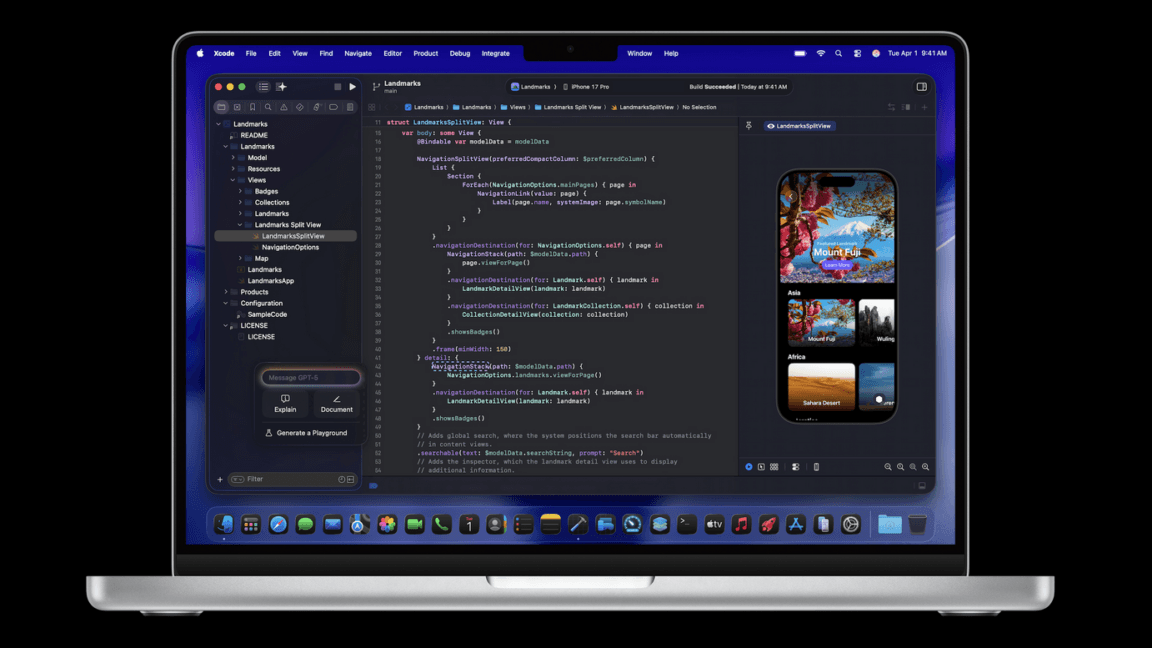
According to Ars Technica, Apple has announced Xcode 26.3, a new version of its IDE for building apps across iOS, macOS, visionOS and other Apple platforms. The key feature: deep integration of so‑called agentic coding tools such as OpenAI’s Codex and Anthropic’s Claude Agent.
This is enabled via Model Context Protocol (MCP), an open protocol that lets AI agents call external tools and operate on structured resources. In Xcode 26.3, the IDE itself acts as an MCP endpoint, exposing interfaces like project file graphs, documentation search and settings to compatible AI tools.
Apple previously added AI code completion using a local model and chat-style integrations with ChatGPT and Claude. The 26.3 release candidate, arriving shortly with a final release to follow, goes further by giving AI agents deeper, programmatic access to Xcode’s internals and providing a side panel to assign tasks and track agent activity.
3. Why this matters
This update quietly shifts Xcode from having AI bolted on to becoming an AI-native IDE. The difference is huge: autocomplete and basic chat are helpful, but agentic tools that can navigate the project graph, modify multiple files and reason across your entire codebase are a different category.
The biggest winners are Apple platform developers. Until now, anyone wanting Copilot‑like agents in Xcode had to rely on awkward plugins or external tools with only partial visibility into the project. Allowing MCP agents to work directly with Xcode’s primitives means tasks like refactoring an entire module, generating tests across a target, or wiring up boilerplate UI and networking can be delegated end‑to‑end.
Apple also benefits strategically. Microsoft has been racing ahead with GitHub Copilot and deeply integrated AI in Visual Studio and VS Code. By embracing MCP instead of a single, proprietary agent, Apple narrows that gap and positions Xcode as a competitive hub that can speak to multiple AI ecosystems at once.
The potential losers are closed, one‑vendor AI stacks. If Xcode developers can plug in Claude, Codex, future local models and niche specialist agents through the same protocol, it becomes harder for any one provider to lock them in purely through IDE integration. It also increases pressure on other IDE vendors to adopt open agent protocols instead of rolling their own islands.
4. The bigger picture
At a higher level, Xcode 26.3 lands in the middle of a clear industry shift: developer tools are moving from assistive AI to operational AI.
GitHub Copilot started with inline suggestions, but Microsoft has since pushed toward Copilot Chat, Copilot Workspace and agents that plan and execute multi‑step changes. JetBrains is rolling out its own AI assistant across IntelliJ‑based IDEs. Replit, Cursor and others are pitching themselves as AI‑first coding environments where the agent is almost a co‑maintainer of your project.
Apple is late, but it is coming in with an interesting twist: instead of inventing its own proprietary agent interface, it is hitching Xcode to MCP, an emerging open protocol originally championed by Anthropic. There is a historical parallel here to the Language Server Protocol (LSP). When Microsoft opened LSP, it dramatically reduced the friction of supporting new languages across editors. MCP aims to do something similar for tools and context.
If MCP gains traction beyond Claude – and Apple’s adoption is a strong signal – we might see a world where any serious IDE must expose an MCP-compatible surface. That would enable portable AI workflows: the same testing agent that works against Xcode could, in theory, operate against VS Code, JetBrains or a browser‑based IDE, as long as they all speak MCP.
In that sense, Apple is not just adding AI features; it is helping legitimize a protocol that could become plumbing for the next generation of developer tooling.
5. The European and regional angle
For European developers, this move lands at the intersection of three forces: Apple’s dominance on mobile, EU regulatory pressure and a growing desire for digital sovereignty.
On the ground, a large share of professional app developers in Europe build for iOS and macOS first. Xcode is not optional; it is the default. Giving those teams first‑class access to MCP agents means EU startups, agencies and enterprise teams can tap into state‑of‑the‑art AI tooling without abandoning their existing workflows.
From a regulatory perspective, the timing is delicate. The EU AI Act is entering its implementation phase, and coding assistants and agents are likely to be treated as general‑purpose AI systems with transparency and logging requirements. Using MCP, Xcode can, in principle, route work to European‑hosted, MCP‑compatible agents that keep source code inside the EU or even on‑prem. That is a big deal for regulated sectors in Germany, France or the Nordics that cannot simply beam sensitive code to US clouds.
It also opens the door for European AI vendors – from Mistral to Aleph Alpha and a wave of smaller tool builders – to plug into an IDE used by millions of Apple developers, as long as they speak MCP. For once, Apple’s design choice could actively lower the barrier for European alternatives instead of raising it.
6. Looking ahead
There are a few things to watch next.
First, Apple’s own role in the agent story. Today, the company leans on OpenAI and Anthropic for chat and agent capabilities, plus a local completion model. It is hard to imagine Apple staying in that dependent position for long. Expect Apple‑branded agents that sit on top of MCP, optimised for Apple frameworks and possibly running partly on‑device to ease privacy and latency concerns.
Second, we should expect a wave of MCP‑compatible tools specifically tailored to Xcode: agents that understand SwiftUI idioms, Interface Builder quirks, App Store submission rules, accessibility guidelines, and perhaps even the unwritten patterns that make an iOS app feel truly native.
Third, governance and safety. Agentic tools that can automatically change codebases introduce real risk: subtle security regressions, performance issues, or simply unreadable auto‑generated code. Under the EU AI Act and broader corporate policies, logging, diff review workflows and approval gates will become crucial. Xcode’s side panel for tracking agent actions is a first step, but enterprises will want policy‑level controls, not just UI niceties.
Timeline‑wise, 2026 is likely the year where AI agents move from experimental to expected inside mainstream IDEs. Apple’s 26.3 release candidate is an early marker; the more interesting story will be how quickly teams actually adopt agents beyond simple autocomplete.
7. The bottom line
By wiring Xcode into MCP and embracing multiple agent providers, Apple is signalling that the future of its IDE is protocol‑driven and multi‑vendor, not a closed, single‑assistant experience. That is good news for developers and for European digital autonomy, but it will also intensify competition around whose agents become the default. The key question now is not whether you will use AI inside Xcode, but whose AI you will trust to edit your most critical code.