1. Headline & intro
Artificial intelligence is no longer just composing emails or generating images – it’s starting to edit life’s instruction set itself. A Columbia–Harvard team has used AI tools to redesign a core cellular machine so that it can function with one less amino acid than nature currently uses. On paper, that sounds like a niche synthetic-biology stunt. In reality, it’s an early signal of something much bigger: AI-guided control over the rules of biology, not just its parts. In this piece, we’ll unpack what actually happened, why the work is technically radical, and how it foreshadows a new era of programmable organisms – and new regulatory headaches – for Europe and beyond.
2. The news in brief
According to reporting by Ars Technica on a new paper in Science, researchers from Columbia University and Harvard set out to test whether modern cells really need all 20 standard amino acids that the universal genetic code encodes.
They focused on isoleucine, a hydrophobic amino acid that’s chemically similar to leucine and valine. Starting from E. coli, they first swapped isoleucine for the related amino acid valine in dozens of essential genes, finding that many tolerated the change but often grew more slowly.
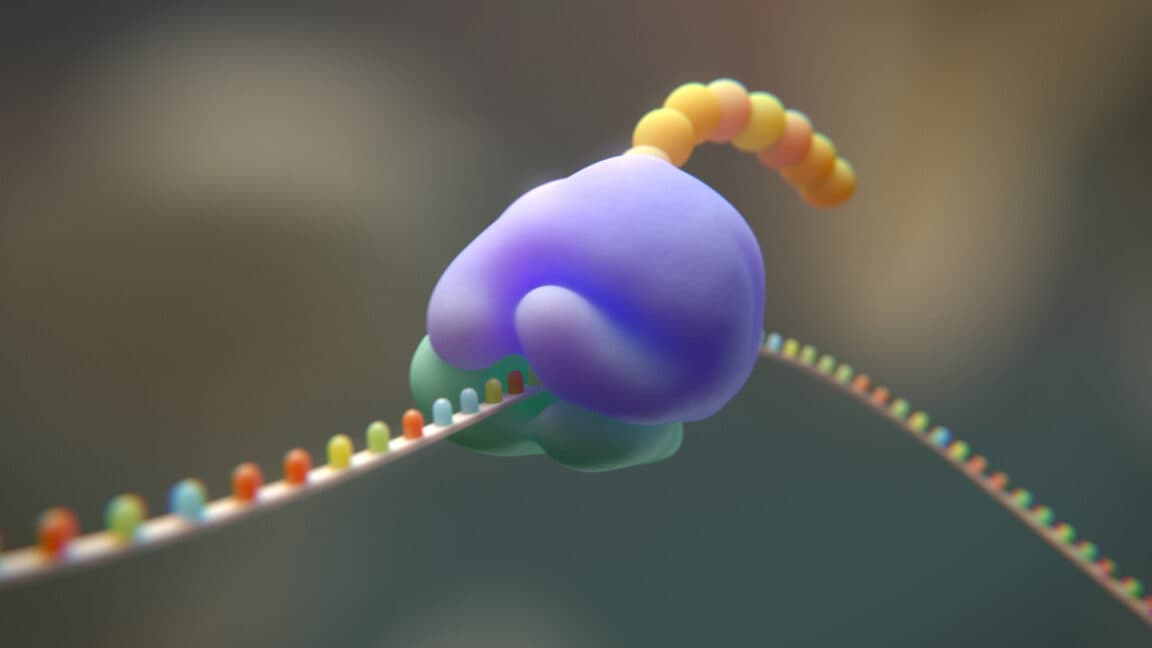
The team then zoomed in on one of biology’s most fundamental complexes: the ribosome, specifically the small subunit in E. coli. Using several AI-based protein design tools and AlphaFold 2 for structure checking, they systematically redesigned ribosomal proteins to remove every isoleucine. After many iterations – and some brute-force testing – they produced a strain whose small ribosomal subunit is completely isoleucine-free, yet still viable, though its growth rate is only around 60–70 percent of the unmodified bacteria.
Crucially, the redesigned proteins only function properly together – dropping a single one back into an otherwise wild-type cell is lethal.
3. Why this matters
On the surface, this looks like a cute proof-of-concept experiment in genetic minimalism. But the implications are much broader.
First, it is a stress test for AI in molecular design. This isn’t just predicting a protein’s shape; it’s redesigning an intricate, billionaire-year-old molecular machine – the ribosome – so that it works under completely new constraints. The fact that AI systems proposed viable replacements for an amino acid that life has conserved across essentially all species is a major milestone for "AI as co-designer" in biology.
Second, it chips away at the supposed immutability of the genetic code. For decades, we’ve treated the 20-amino-acid code as a fixed background assumption. Prior genome recoding projects changed which codons map to which amino acids, or freed up codons for synthetic chemistry. This work goes a step further: it asks whether some amino acids can be removed from the system altogether, at least in parts of the cell. That’s conceptually closer to rewriting life’s operating system than just adding a new API.
Third, there are practical consequences. A cell that runs on a restricted amino acid palette is harder to hijack. Viruses that expect the full 20-amino-acid machinery may struggle to replicate. That’s a long-term vision, but you can glimpse paths toward viral-resistant industrial strains or biological systems that are intrinsically less compatible with the wild.
Finally, there’s a big negative: the AI tools are powerful but opaque. The models sometimes redesigned entire structural elements of proteins for reasons even the authors can’t infer. That’s a warning sign for anyone who wants to deploy AI-designed biology at scale: you may get systems that work, but you won’t automatically understand why – or where the hidden failure modes are.
4. The bigger picture
This work slots into several converging trends in biotech and AI.
Over the last few years, we’ve seen:
- AlphaFold 2 and related systems make high-accuracy structure prediction routine.
- Generative protein models (from DeepMind, Meta, Salesforce and academic groups) that can propose entirely novel folds and sequences.
- Large-scale genome recoding projects (for example, E. coli strains with reduced codon sets and built-in viral resistance) and "minimal cell" efforts that strip genomes down to bare essentials.
The Columbia–Harvard study effectively layers these trends: generative design plus structure prediction plus ambitious genome editing, all pointed at the heart of translation itself.
Historically, radical genetic redesigns took many years and enormous manual effort. Now we’re watching the early version of an AI-in-the-loop foundry for life: specify constraints ("no isoleucine allowed"), let models search sequence space, then test a curated set in the lab. At the moment, that loop is slow and fragile – the resulting cells grow poorly, and a single protein (rplW) almost broke the whole project – but it will get tighter.
Compared to competitors, this work feels closer to the “hard science” edge than most current AI-in-biology hype. While big tech talks about "digital biology" platforms, this is a concrete demonstration that we can push an essential, ancient complex into a region of sequence space that evolution probably never visited – and keep it functional.
It also hints at where the field is heading: not just designing individual enzymes or antibodies, but re-architecting core cellular subsystems – ribosomes, polymerases, chaperones – to obey rules chosen by humans rather than by evolution.
5. The European / regional angle
From a European perspective, this kind of research lands right at the intersection of biotech sovereignty and AI governance.
The EU is already a heavyweight in structural biology and genomics (think EMBL, the European Bioinformatics Institute, Max Planck institutes, ETH Zurich). Those ecosystems are natural homes for AI-driven protein design. European startups are quietly emerging around enzyme design, computational antibody engineering and DNA synthesis. The next logical step is exactly what this paper showcases: AI-assisted redesign of entire cellular systems.
Regulators, however, are not ready. The EU’s GMO directives, framed in a pre-AI era, focus on what is changed (a gene, a trait) and how it’s contained. They say very little about how the design was generated, or how to audit an AI that spits out a viable but opaque ribosome variant. The incoming EU AI Act will impose transparency and risk-management requirements on high-risk AI uses, but biology-oriented models currently sit in a grey zone: immensely powerful, but not clearly categorised.
For European industry, there is a strategic opportunity: cells with constrained genetic codes could underpin safer biomanufacturing platforms for pharmaceuticals, food, and materials, aligning with the EU’s push for bio-based, climate-friendly production. A chassis organism whose genetic code is deliberately hard to recombine with wild strains could also ease public concerns around environmental escape.
The flip side: if Europe remains slower than the US and China in adjusting its regulatory and funding frameworks, the key IP and know-how for AI-guided genetic-code engineering may consolidate elsewhere – and European companies will be customers, not shapers, of this new layer of biology.
6. Looking ahead
Where does this go next?
Technically, there are several likely directions:
- Extending the isoleucine-free design beyond the ribosomal small subunit toward larger fractions of the genome, to test how far a 19-amino-acid organism can be pushed.
- Applying the same toolchain to other amino acids – perhaps starting with those that are chemically redundant – to systematically probe the "minimal useful alphabet" for life.
- Combining code reduction with code expansion: freeing up codons by dropping an amino acid, then reusing those codons for non-natural amino acids with novel chemistry.
On the AI side, expect more integrated platforms: generative models that not only propose sequences but also estimate fitness impacts, off-target interactions, and escape routes for evolution. That will make it easier to design cells that are both productive and constrained in pre-defined ways.
For readers, the signals to watch over the next 3–5 years are:
- First industrial partnerships that mention "AI-designed chassis organisms" or "recoded production strains" in pharma, chemicals, or food.
- Regulatory consultations in Brussels and national capitals that explicitly reference AI-assisted genome design.
- Early discussions about export controls on highly capable bio-design models, mirroring what we already see around advanced chips.
The unresolved questions are serious: How do we validate the safety of black-box-designed organisms? Who is liable if a subtle AI-introduced change leads to unexpected behaviour in a production strain? And how do we ensure that the same tools used to make safer cells aren’t quietly repurposed for more dangerous ones?
7. The bottom line
The isoleucine-free ribosome is less a window into ancient life than a proof that AI can help us renegotiate the basic rules of modern cells. That’s both exhilarating and unsettling. If we treat these models as mere oracles that "make things work", we risk building biological infrastructure we don’t truly understand. The real opportunity – especially for Europe – is to pair this new design power with equally serious investment in interpretability, safety, and governance. The genetic code is no longer sacred; what should we choose to write with that freedom?