Introduction
Google is quietly redrawing the AI hardware map. While the industry obsesses over Nvidia GPU shortages, Google is doing something more strategic: separating the silicon that learns from the silicon that serves. The new TPU 8t and TPU 8i are not just faster chips; they are a bet on what Google calls the agent era – AI systems that are long‑running, tool‑using and deeply integrated into business workflows.
This piece looks at what Google actually announced, why a split training/inference strategy matters, how it fits into the wider accelerator arms race, and what it means for European users and policymakers.
The news in brief
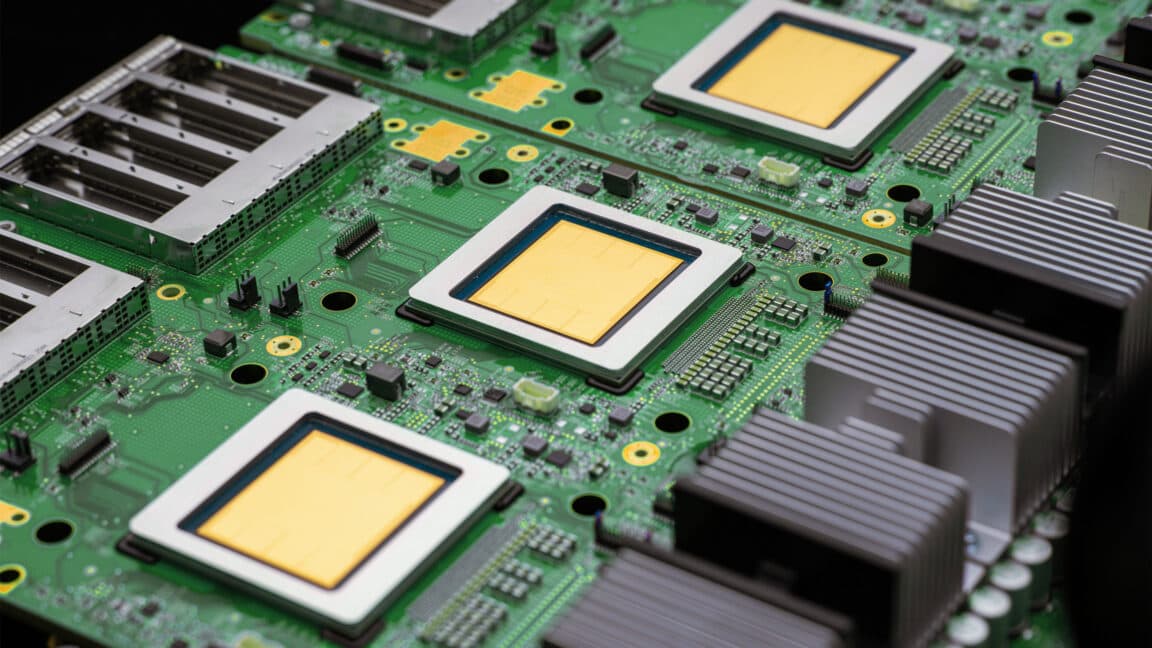
According to Ars Technica, Google has introduced its eighth‑generation Tensor Processing Units in two distinct variants: TPU 8t for training large models and TPU 8i for inference.
TPU 8t targets frontier‑scale training. A single pod can host 9,600 chips with around 2 PB of shared high‑bandwidth memory, delivering up to 121 FP4 exaFLOPS of compute. Google claims near‑linear scaling up to a logical cluster of one million chips and significantly higher hardware utilisation than the previous Ironwood generation.
TPU 8i is optimised for serving models, especially multi‑agent workloads. Inference pods now scale to 1,152 chips (up from 256 in Ironwood) and deliver about 11.6 exaFLOPS. Each chip reportedly has three times more on‑chip SRAM (384 MB), allowing larger key‑value caches and faster long‑context inference.
Both families are tied to Google’s new Axion ARM server CPUs, with one CPU assigned to every two TPUs. Google also highlights data‑center‑level improvements and claims roughly double performance per watt versus Ironwood, with support for popular frameworks like JAX, PyTorch, SGLang and vLLM.
Why this matters
The most important part of this announcement is not any single performance number. It is the admission that a one‑size‑fits‑all AI chip is no longer good enough.
By cleanly separating TPU 8t (training) and TPU 8i (inference), Google is optimising for two very different economics:
- Training wants extreme scale and utilisation; every percentage of better scheduling and fault tolerance translates into millions of dollars saved.
- Inference wants predictable latency and low cost per request; wasted cycles directly erode margins for SaaS products and APIs.
In the short term, the clear winners are:
- Google Cloud customers who are already bought into the TPU ecosystem; they get a more specialised platform for both fine‑tuning and serving.
- Google’s own Gemini roadmap; more efficient training plus cheaper inference is exactly what a company needs when it is giving away or heavily subsidising AI features across Search, Workspace and Android.
The relative loser – at least strategically – is Nvidia. Every hyperscaler chip generation that is even remotely competitive reduces dependence on Nvidia’s pricing power. Nvidia’s brief stock wobble after the announcement, mentioned by Ars Technica, is symbolic: the market understands that custom silicon is the only way hyperscalers protect their margins.
There is also an environmental and political angle. Power and water usage are quickly becoming the binding constraints on AI build‑out. Doubling performance per watt and introducing more granular cooling control does not make AI green, but it buys time before regulators or grid operators start saying no.
Finally, there is lock‑in. A vertically integrated stack – Axion CPUs, TPUs, Google frameworks, Google data centers – is extremely efficient. It is also extremely sticky. For enterprises, that efficiency vs. portability trade‑off is becoming the real architectural decision.
The bigger picture
Google’s TPU 8t/8i split is part of a broader industry pivot: hyperscalers are no longer simply Nvidia’s best customers; they are also its most serious competitors.
Amazon already has a dual chip strategy with Trainium (training) and Inferentia (inference). Microsoft is rolling out its Maia accelerators alongside custom ARM hardware. Meta is building its MTIA inference chips. Google’s move is therefore less an outlier and more confirmation that the GPU‑for‑everything era is ending.
The agent framing is also telling. Large language models are shifting from simple prompt‑in, text‑out interactions to long‑lived agents coordinating tools, browsing, code execution and workflows. That produces very different hardware stress:
- More random memory access patterns
- Larger context windows and key‑value caches
- Many parallel but small inference streams
TPU 8i’s expanded on‑chip memory and larger pods are clearly tuned for that world. This is complementary to the current rush toward longer context models; there is little point in having a one‑million‑token context window if the serving hardware chokes on memory bandwidth or cannot efficiently cache attention states.
Historically, we have seen this playbook before. In the early web, general‑purpose x86 servers eventually gave way to specialised appliances for databases, content delivery and video transcoding. AI is following the same pattern, just compressed into a few frenetic years instead of a decade.
What is new is the stack depth. Google is not only designing accelerators; it is co‑designing chips, networks, cooling and even data‑center layout. That is closer to how high‑frequency trading firms or supercomputing labs operate than how traditional cloud worked. The line between hyperscaler and supercomputer vendor is blurring.
The European and regional angle
For Europe, the TPU 8t/8i announcement is a reminder of both dependence and opportunity.
Dependence, because this is yet another critical layer of digital infrastructure controlled by a US platform. European AI labs, startups and enterprises wanting access to this class of hardware will most likely consume it via Google Cloud regions located in the EU, but operational control, roadmap and pricing remain in Mountain View.
Opportunity, because efficiency improvements intersect directly with European priorities:
- The EU AI Act introduces obligations that scale with model capabilities and, crucially, with the compute used to train them. More efficient training clusters could lower compliance thresholds for some projects – or, conversely, allow companies to push models further without ramping up declared compute too aggressively.
- The Green Deal and national climate targets are already forcing data‑center operators in countries like Germany, the Netherlands and the Nordics to justify every megawatt. Claims of 2x performance per watt and more intelligent liquid cooling will be used in those negotiations.
European cloud providers such as OVHcloud, Deutsche Telekom or smaller sovereign‑cloud players cannot realistically match TPU‑class silicon in the short term. But they can differentiate on data residency, contractual control and integration with national research networks. The more Google leans into a fully proprietary stack, the more oxygen there is for EU initiatives around open hardware, RISC‑V, and projects like SiPearl.
For European regulators, this is also a test case. When one company can field a million‑chip logical cluster tuned for frontier AI, questions around systemic risk, concentration and interoperability become much more concrete.
Looking ahead
Over the next 12–24 months, expect three things.
First, even more specialisation. TPU 8t and 8i are a coarse split. The logical next step is further segmentation: chips and pods tuned for retrieval‑augmented generation, on‑device agents, or specific workloads like code assistants. The economic pressure to squeeze every watt will push Google and others down this path.
Second, pricing and access will become the real battlefield. Raw FLOPS numbers make headlines, but what developers and enterprises actually see is: How much does a billion tokens of inference cost? How long does fine‑tuning a 70B model take, and what is the bill? If Google can undercut Nvidia‑based offerings on total cost of ownership while keeping margins, it will shift meaningful workloads onto TPUs.
Third, regulation will start to notice the hardware layer. The EU AI Act already hints at compute‑based thresholds. National regulators worried about grid stability or water usage will increasingly demand transparency not only about model behaviour, but about the underlying infrastructure. Google’s narrative of co‑designed, efficient data centers is pre‑emptive lobbying as much as engineering pride.
There are open questions. Will Google ever make TPUs available on‑prem or as part of sovereign‑cloud partnerships, or will they remain locked to its own data centers? Can enterprises hedge between Nvidia, TPUs and other accelerators without fragmenting their ML tooling and teams? And if the anticipated agent era fizzles or slows, will such aggressive hardware bets still look wise?
The bottom line
Google’s TPU 8t and 8i are less about beating Nvidia on benchmarks and more about rewriting the economics of large‑scale AI in Google’s favour. Splitting training and inference, tightening the ARM‑based stack and chasing every efficiency gain is exactly what you do when you expect AI agents to become background infrastructure, not flashy demos.
For developers and European organisations, the key question is simple: how much vendor lock‑in are you willing to accept in exchange for cheaper, faster AI? The hardware race is really a power race – in both the electrical and strategic sense.