1. Headline & intro
Mozilla has finally shown its hand in enterprise AI, and it’s not another chatbot in the cloud. With Thunderbolt, the company is trying something bolder: a universal, privacy‑first client for AI you run yourself. In a market obsessed with bigger models and stickier platforms, Mozilla is effectively asking, who should own the AI stack – you or your vendor?
In this piece, we’ll look at what Thunderbolt actually is, why it matters for enterprises and governments, how it fits into the wider shift toward local and open‑source AI, and whether Mozilla can realistically repeat its Firefox moment in a very different era.
2. The news in brief
According to Ars Technica, Mozilla has introduced Thunderbolt, a new cross‑platform AI client aimed at organisations that want to run their own AI infrastructure instead of relying on fully hosted cloud services.
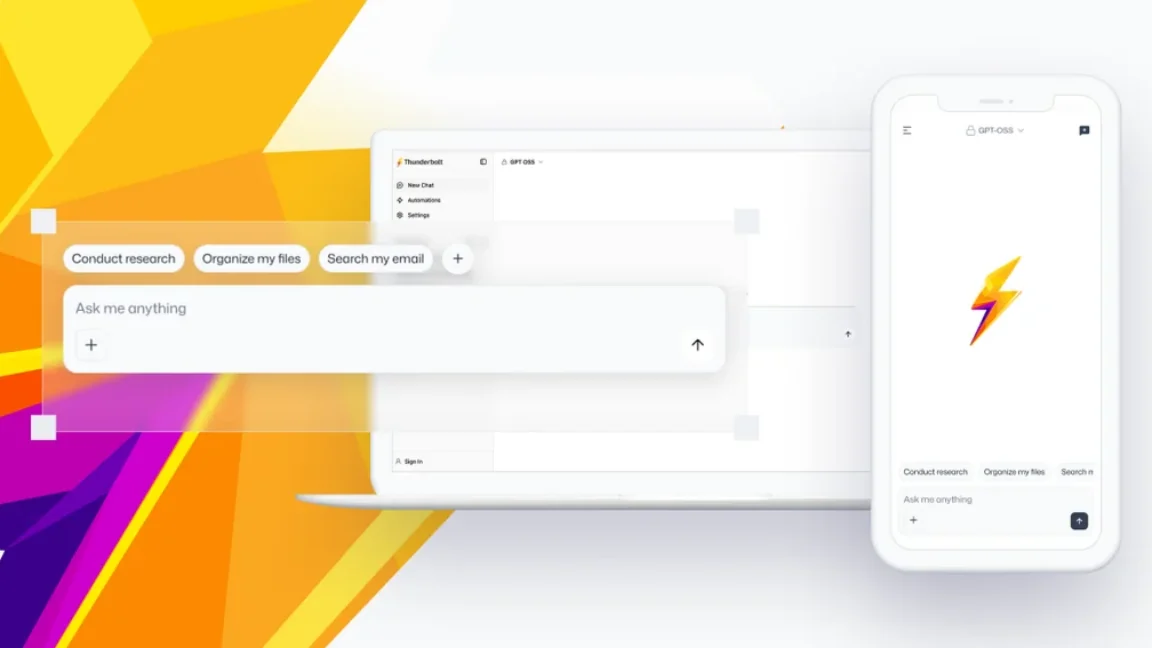
Thunderbolt is built on top of Haystack, an open‑source framework from German company deepset that lets developers assemble modular AI pipelines from different components. Mozilla positions Thunderbolt as a “sovereign AI client” on top of that stack: a user‑facing front end that can connect to ACP‑compatible agents and OpenAI‑compatible APIs, as well as locally deployed models.
The client can also hook into enterprise data via open protocols and use an offline SQLite database as a local knowledge source. Mozilla highlights optional end‑to‑end encryption, device‑level access controls, and support for familiar AI use cases such as chat, search, research, automation and cross‑device workflows.
Thunderbolt is funded by a Mozilla grant and operated by its MZLA Technologies subsidiary. It’s open source on GitHub, but still under security audit and being prepared for enterprise‑grade deployments and paid licensing.
3. Why this matters
Thunderbolt is important because it attacks one of the most uncomfortable truths of today’s AI boom: most so‑called “enterprise AI” is just sending your data to someone else’s servers and hoping the contract holds. Mozilla is offering a different bargain – control the whole stack, from model to data to client.
The clear winners, if this works, are organisations with strict compliance and sovereignty needs: banks, governments, hospitals, industrial firms, and any European company nervous about US cloud providers after Schrems II. For them, a client that is built for self‑hosted models and local data stores is not a luxury feature; it’s the difference between being able to use generative AI at all or being blocked by legal and risk teams.
Another beneficiary is the open‑source AI ecosystem. By building on Haystack and supporting multiple APIs rather than pushing a single proprietary model, Mozilla is effectively saying: the client experience is the product, not the model. That creates room for smaller model vendors and local LLMs to compete behind a common interface.
Who loses? Any vendor whose business model depends on locking customers into a vertically integrated AI stack. If Thunderbolt (or similar tools) gain traction, it becomes easier for enterprises to swap models the way they swap search engines in a browser. That erodes the moat of “AI as a sticky SaaS product” and pushes the market toward interoperability.
In the short term, the main problem Thunderbolt addresses is trust. It won’t magically make AI safe, but it lets security teams draw a much clearer line around where data goes, who can see it, and how it’s encrypted. That alone could unlock many stalled pilots.
4. The bigger picture
Thunderbolt sits at the intersection of several powerful trends.
First, there is the rise of local and hybrid AI. Over the last two years we’ve seen a wave of tools like Ollama, LM Studio, and various “AI desktop” apps that run models on workstations or company servers. Thunderbolt doesn’t try to replace them at the infra layer; instead, it wants to be the unifying user agent on top – the Firefox of this new stack.
Second, the architecture mirrors what happened with the web. In the early days, browsers were thin shells around proprietary plugins and backends. Over time, standards and open‑source engines made the browser the main control point. Mozilla’s own rhetoric – wanting to “do for AI what we did for the web” – is not accidental. Thunderbolt plus Haystack is a bet that we’ll standardise around open protocols for AI agents and retrieval pipelines, and that the client can be an opinionated but neutral gateway.
Third, it contrasts sharply with what big US players are doing. OpenAI, Anthropic, Google and Microsoft are racing to turn their models into platforms: hosted agents, app stores, proprietary orchestration. Even when they offer on‑prem or VPC deployments, the experience is designed first around their cloud. Thunderbolt inverts that: it assumes the centre of gravity is your infrastructure, with external APIs as optional extras.
We’ve seen similar moves before in other domains. In cloud, projects like Kubernetes abstracted away vendor specifics and became the de facto control plane. In messaging, Matrix tried (with partial success) to federate chat. Thunderbolt is an attempt to play that role for AI at the client layer – and if it gains enough mindshare, it could subtly shift power away from “Big AI” and toward those who control data and distribution.
5. The European / regional angle
For Europe, Thunderbolt is almost a textbook example of what regulators and policymakers say they want: AI that is open, interoperable and sovereign.
Because it’s built on Haystack – developed by Berlin‑based deepset – Thunderbolt naturally aligns with the European emphasis on open‑source tooling and vendor neutrality. Combine that with the EU AI Act, GDPR, and sector‑specific rules in finance and healthcare, and the pitch becomes clear: run your models where your data already lives, under EU law, without constant cross‑border transfers.
For EU institutions and governments pushing “digital sovereignty” strategies, a client that can sit on top of in‑house models, EU‑hosted clouds, or specialised national providers is attractive. It also gives smaller European AI companies a route to end users without forcing them to build their own UX layer for every customer.
From a cultural standpoint, European users – particularly in Germany, the Nordics and parts of CEE – are more privacy‑sensitive than their US counterparts. Mozilla already has brand recognition here from Firefox and Thunderbird as the “privacy‑friendly” options. If Thunderbolt is marketed smartly, it could become the default experimental client for European CIOs who want to test gen‑AI internally without sending everything to a US hyperscaler.
The opportunity goes down to the SME level as well. Many mid‑sized firms in Europe lack AI teams but do run their own on‑prem or regional cloud setups. A packaged client that integrates with their existing data and identity systems could make generative AI projects viable without a full‑blown platform migration.
6. Looking ahead
The big question is whether Thunderbolt can move from interesting open‑source project to boring, trusted enterprise standard.
To get there, Mozilla will need to do several things:
- Ship rock‑solid security. The ongoing audit is a start, but CISOs will want formal assurances, hardening guides and integrations with identity providers, logging and SIEM tools.
- Build an ecosystem. Firefox only became truly powerful once extensions and web standards flourished. Thunderbolt will need plugins, templates and reference architectures for common use cases: internal chat over documents, code assistants, research copilots and so on.
- Stay neutral on models. The temptation to promote “default” partners will be strong, especially to monetise enterprise deals. If Mozilla tilts too visibly toward a few vendors, it undercuts the whole sovereignty story.
In terms of timeline, expect the next 12–18 months to be about pilot projects: a few large organisations testing Thunderbolt on restricted datasets and local models. If those go well, we could see systems integrators and consultancies start to package Thunderbolt‑based solutions around 2027.
Unanswered questions remain. How will Mozilla monetise without recreating the very lock‑in it criticises? Will it commit to long‑term API stability so enterprises can bet on it as a control plane? And can it differentiate enough from the growing zoo of open‑source AI dashboards and orchestrators to avoid becoming “yet another client”?
For now, the risk is mostly on Mozilla’s side – investing in a product that may never crack the mainstream – while the upside for enterprises is asymmetric: they get another credible option to reduce dependence on hyperscalers.
7. The bottom line
Thunderbolt is Mozilla’s clearest statement yet that the future of AI doesn’t have to be a handful of cloud silos. By betting on a sovereign, model‑agnostic client built on open infrastructure, Mozilla is pushing the ecosystem toward more portability and genuine choice.
Whether it succeeds will depend less on fancy features and more on trust, integrations and ecosystem momentum. The real question for readers is simple: when your organisation adopts AI at scale, do you want a browser‑like client you control – or a black box you merely log into?