- Headline & intro
The AI boom has treated data centers as if they were abstract clouds, not concrete buildings that can burn, flood—or be hit by missiles. The recent drone and missile strikes on hyperscale facilities in the Gulf just ended that illusion. What looked like a straightforward trillion‑dollar bet on turning the Middle East into an AI super‑hub now carries a question investors hate: what if this infrastructure is literally uninsurable?
In this piece, we’ll unpack what happened, why physical war risk is suddenly a board‑level AI issue, how it may reshuffle the global map for hyperscale build‑outs, and why Europe—despite its own headaches—may quietly emerge as one of the few winners.
- The news in brief
According to Ars Technica, London‑based Pure Data Centre Group (Pure DC) has paused all new investments in the Middle East after one of its Abu Dhabi facilities was damaged by an Iranian missile or drone strike. The site on Yas Island currently provides around 20 MW of capacity for a large, unnamed hyperscaler and is part of a wider portfolio exceeding 1 GW across Europe, the Middle East, and Asia.
The pause comes after a series of Iran–US/Israel military escalations that began on 28 February 2026. As reported by Ars Technica, Iran has directly targeted critical cloud infrastructure, including two Amazon Web Services (AWS) data centers in the UAE and damaging a third facility in Bahrain. Structural and power‑delivery damage, as well as fire‑suppression incidents, caused widespread service disruption for banks, payment platforms, Careem, and Snowflake.
AWS reportedly waived all charges in its Middle East region for March 2026, a move estimated by The Register (via Ars Technica) to cost around $150 million in revenue, excluding repair costs. Iranian forces also claimed attacks on an Oracle data center in Dubai, later confirmed by local authorities as shrapnel damage after air defenses intercepted an incoming projectile.
- Why this matters
These attacks expose an uncomfortable truth: the AI revolution is built on physical infrastructure that can be placed on a target list. Cloud regions used to be discussed in terms of latency zones and redundancy; now they’re being discussed in terms of air‑defense coverage and missile trajectories.
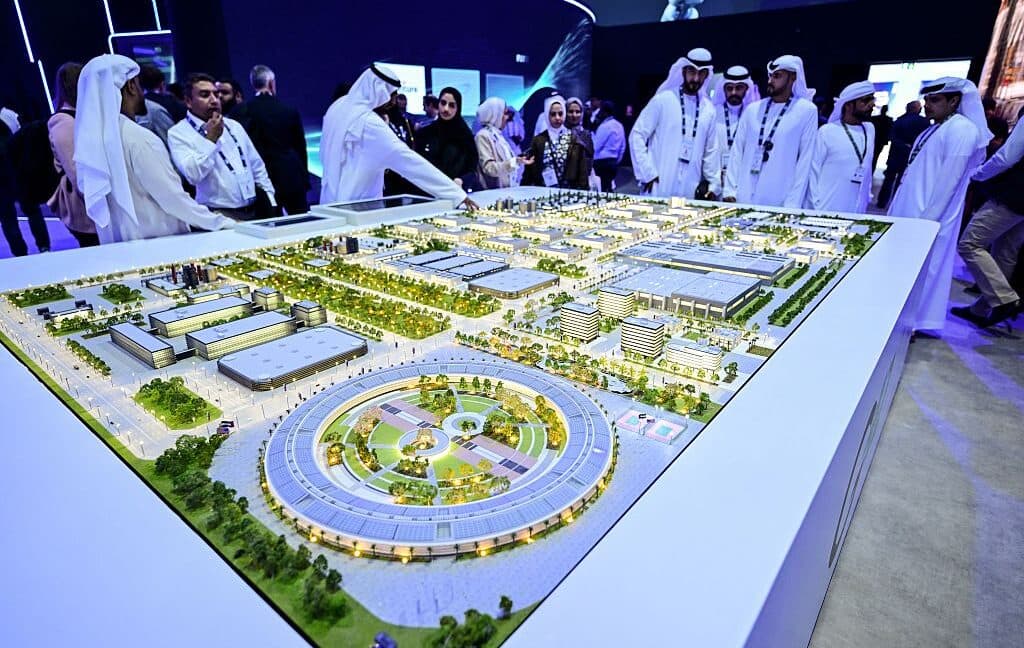
The immediate losers are obvious. Gulf states like the UAE and Saudi Arabia have pitched themselves as the third pole of AI infrastructure alongside the US and China, committing hundreds of billions of dollars to chips and data centers. If war risk makes large campuses effectively uninsurable—or only insurable at prohibitive premiums—financial models for hyperscale build‑outs stop working.
Hyperscalers are also taking a hit. According to Ars Technica’s summary of Tech Policy Press, legal frameworks in the region largely push war‑related service failures onto operators, not customers. AWS eating an estimated $150 million in fees for a single month in one region is not catastrophic, but it changes the conversation with boards and insurers. Waiving bills once is customer‑friendly; making it a recurring pattern would be ruinous.
Defence contractors, on the other hand, are early winners. Forbes reporting cited by Ars Technica describes rising interest in anti‑drone and air‑defense systems for data centers. "Tier IV" may soon imply not only extreme redundancy and uptime but also hardened roofs, blast‑resistant shells, and integration with national air‑defense networks.
Strategically, this forces a re‑evaluation of mega‑campus logic. For a decade, economics favored sprawling 100+ MW facilities clustered near cheap energy. Now that same concentration equals single‑point‑of‑failure risk under missile fire. The likely outcome: more distributed, regionally redundant architectures—technically feasible, but more expensive and complex to run.
- The bigger picture
This isn’t an isolated blip; it’s part of a wider recalibration of digital geopolitics.
In the last 24 months, three tensions have converged:
- AI‑driven capacity hunger. Foundation models, AI copilots, and GPU clusters are pushing hyperscalers to chase cheap power and favorable regulation. The Gulf’s offer—abundant energy, aggressive incentives, and geopolitical alignment with Washington—was irresistible on paper.
- Critical‑infrastructure targeting. From Ukraine’s power grid to subsea cables in the North Sea, physical infrastructure is now fair game in grey‑zone and open conflicts. The Iranian Revolutionary Guard publicly naming Google, Microsoft, Nvidia, Oracle, IBM, and Palantir as potential targets (as noted by Ars Technica) simply formalizes what strategists already knew: cloud is now strategic infrastructure.
- Insurance and legal gaps. Traditional war‑exclusion clauses were written for ships and factories, not globally integrated cloud fabrics. As Ars Technica notes via Tech Policy Press, current civil‑law frameworks in the region often leave operators holding the bill. That’s unsustainable when the same incident can simultaneously cause capex loss, opex spikes, SLA penalties, and reputational damage.
Compare this to previous tech‑in‑conflict moments. When Arab Spring protests disrupted networks a decade ago, the conversation was about censorship and shutdowns, not physical annihilation of compute clusters. Even attacks on undersea cables were largely clandestine and deniable. Missile strikes on branded hyperscale facilities in business hubs like Dubai and Abu Dhabi cross a psychological Rubicon.
Competitively, the advantage may tilt back toward "boring" jurisdictions: Nordic countries with stable politics and cool climates; central European hubs with strong rule of law; US regions far from coastlines and key targets. China will continue to build behind its own firewall, but for global workloads, "risk‑adjusted latency" becomes a new metric: slightly higher ping in exchange for much lower chance of being hit by shrapnel.
- The European / regional angle
Europe enters this moment with a paradoxical mix of weaknesses and strengths.
On the one hand, the EU has made data center expansion harder. Energy‑grid constraints, local opposition, and climate targets have slowed or reshaped projects in Ireland, the Netherlands, and parts of Germany. The EU’s regulatory stack—GDPR, the Digital Services Act, the Digital Markets Act, and soon the AI Act—adds compliance friction that investors like to grumble about.
On the other hand, Europe offers what the Gulf currently cannot credibly guarantee: geopolitical stability, mature legal systems, and a relatively low probability of direct missile strikes on commercial infrastructure. For risk‑averse enterprises, that matters more than another few milliseconds of latency to a Gulf region.
Under the NIS2 directive and sector‑specific rules like DORA for finance, EU member states are already treating cloud and data centers as critical infrastructure requiring resilience planning. The war in Ukraine has accelerated investment in grid hardening and cross‑border interconnects. Extending that thinking to physical security—anti‑drone measures, no‑fly zones around hyperscale sites, and civil‑military coordination—is a logical next step.
For European cloud challengers like OVHcloud, Deutsche Telekom, Orange, or smaller regional providers, this is a strategic opening. They can pitch themselves as not just "sovereign" but physically safer alternatives for workloads that today default to US hyperscalers in the Gulf.
For central and eastern Europe, there is a more nuanced picture. Proximity to Russia is a non‑trivial risk factor, but EU and NATO membership also mean integrated defense. Countries like Poland, the Czech Republic, and the Baltics are already becoming manufacturing and logistics hubs; becoming secondary cloud regions for risk‑sensitive workloads is a plausible next step.
- Looking ahead
Expect three streams of change over the next 12–36 months.
1. Contract and insurance rewrites. Hyperscalers will push to redefine force‑majeure clauses, SLAs, and liability for war‑related outages. Insurers will carve out new cyber‑physical products blending cyber risk with kinetic damage. Watch earnings calls: when CFOs start explicitly line‑iteming "war‑zone infra premium," you’ll know this has mainstreamed.
2. Architecture shifts. Large customers—banks, exchanges, critical SaaS providers—will quietly review where their "crown‑jewel" workloads run. Multi‑region and multi‑cloud strategies will no longer just be about resilience to software bugs or power failures, but to geopolitical events. That may drive more demand for EU regions and for secondary nodes in politically dull but physically safe places.
3. Security industrialization. Anti‑drone domes over data centers will go from glossy concept art to line items in RFPs. Expect partnerships between cloud providers and defence contractors, and potentially public funding where facilities are designated as critical infrastructure.
For Gulf states, the question is not whether they continue building—they will—but how they convince the market that their clouds won’t be routinely dragged into regional conflicts. That may require security guarantees from the US, new regional de‑escalation mechanisms, or even international norms treating data centers as semi‑protected objects, akin to hospitals or undersea cables. None of that will be quick.
The wild card is escalation. If a future strike causes not just downtime but loss of life for on‑site staff, public and political pressure on Western firms operating there will spike. Boards that can live with repair bills may balk at headlines about fatalities in branded facilities.
- The bottom line
The drone strikes on Gulf data centers mark a turning point: AI infrastructure is now openly part of the battlefield. That will make capital more cautious, architectures more distributed, and physical security a core design parameter for the cloud. Europe, despite its regulatory drag, is well‑positioned to win risk‑sensitive workloads—if it can solve its own energy and permitting puzzles. The uncomfortable question for every CIO is simple: in a world where missiles can hit regions, are you still comfortable with where your "cloud" really lives?