Headline & intro
AMD has just built the answer to a very specific question: what if we simply gave every core all the cache it could ever want? The new Ryzen 9 9950X3D2 “Dual Edition” crams 208MB of cache into a single consumer CPU and removes one of the strangest compromises in AMD’s high-end desktop line. For European PC gamers, streamers, and sim‑racing obsessives chasing triple‑digit frame rates, this chip matters less as a product and more as a signal: the desktop arms race is shifting from pure clocks and core counts to something subtler—latency, locality, and smarter silicon.
In this piece, we’ll skip the marketing slogans and look at who really benefits, what AMD is fixing, and what this tells us about the future of high‑end PCs.
The news in brief
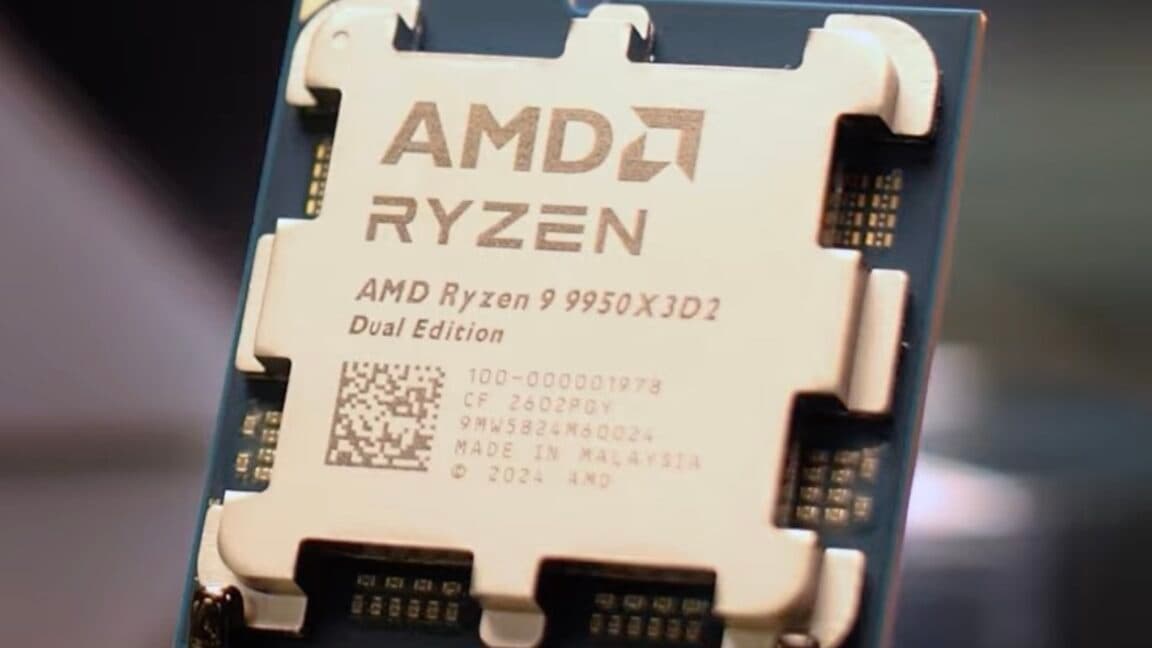
According to Ars Technica’s coverage, AMD has announced the Ryzen 9 9950X3D2 Dual Edition, a 16‑core desktop processor that puts 3D V‑Cache on both of its CPU chiplets for the first time. Previous 12‑ and 16‑core X3D models (like the 7950X3D and 9950X3D) only added 64MB of stacked L3 cache to one of the two dies, creating a hybrid design where some cores had massive cache and others did not.
The 9950X3D2 changes that by adding 64MB of 3D V‑Cache to each die, on top of the standard 32MB of L3 per die and 16MB of L2 overall, for a total of 208MB of cache. AMD claims up to around 10% higher performance versus the standard 9950X3D in games and cache‑sensitive workloads.
There are trade‑offs: peak boost clocks drop slightly to 5.6 GHz (from 5.7 GHz for the 9950X/9950X3D), and default TDP rises from 170 W to 200 W, implying more demanding cooling. Pricing was not disclosed at announcement; the regular 9950X3D currently sells near its $699 launch price. Availability is slated for April 22.
Why this matters
The 9950X3D2 is not about making everyone’s PC faster. It solves a very specific, slightly embarrassing problem in AMD’s high‑end lineup: hybrid X3D chips that required software contortions to behave properly.
On previous 12‑ and 16‑core X3D models, only one chiplet carried the extra cache. Windows and AMD’s drivers had to juggle threads so games ran on the “fat cache” cores and other workloads used the higher‑clocked, standard‑cache cores. Most of the time this worked; sometimes it produced odd stutters, weird core parking, or required OS tweaks and driver updates. For a halo product aimed at enthusiasts, “usually fine” is not good enough.
By giving all cores the same huge cache, AMD removes this complexity entirely. Every core is now a “preferred” core for cache‑sensitive workloads. That consistency is actually the key feature:
Winners:
- High‑FPS gamers at 1080p/1440p, especially in competitive shooters and large‑world titles that are CPU‑limited.
- Sim racing, strategy, and MMO players where frame‑time stability matters more than average FPS.
- Creators with specific workloads that love cache (certain compilers, EDA tools, some financial and scientific codes).
Losers:
- Anyone who doesn’t have a GPU and monitor fast enough to expose CPU bottlenecks.
- Small‑form‑factor builders and silence‑focused setups: 200 W CPU + a modern high‑end GPU is hard to cool quietly.
- Value‑oriented buyers, who will likely see far better returns from a cheaper CPU and more GPU.
Competitively, this is AMD leaning into its differentiation. Intel can match clocks and often single‑thread speed; cache‑stacking at this scale is something only AMD is shipping into the desktop today. The 9950X3D2 is a statement piece: if you want the absolute best CPU for certain games on a socketed desktop, you’ll probably be on AM5.
The bigger picture
The 9950X3D2 fits a broader industry shift: we’re running out of easy gains from clock speed and brute‑force core counts, so everyone is optimizing where data lives.
AMD’s own EPYC X‑series server chips use 3D V‑Cache for databases and HPC, with sometimes absurd gains on very specific workloads. Console SoCs from AMD pack sizable, tightly coupled caches to keep GPUs fed. Apple’s M‑series chips rely heavily on large, fast on‑chip caches and unified memory to feel “snappy” at modest clocks.
On the PC side, we’ve also seen the pain of increasingly complex hybrid designs. Intel’s P‑core/E‑core approach triggered a long saga of Windows scheduler updates, game patches, and occasional anti‑cheat breakage. AMD’s one‑chiplet‑with‑V‑Cache designs were cleaner but still required driver‑level wizardry.
The 9950X3D2 takes the opposite path: instead of more heterogeneity, it leans back towards uniform cores with differentiated memory hierarchy. Every core behaves the same, just with a fat cache slab underneath.
Historically, we’ve been here before. Think of the old Athlon 64 FX or Intel’s Extreme Edition chips: expensive, niche, often bought as much for bragging rights as for genuine need. This new Ryzen is the 2026 version of that idea—but with a twist. Instead of just adding more frequency, AMD is experimenting in an area (3D stacking and cache hierarchy) that’s highly relevant to future mobile and server chips too.
Viewed that way, the 9950X3D2 is partly a technology demonstrator. If the dual‑cache approach proves robust and profitable at the high end, expect it to trickle down to 12‑ and even 8‑core gaming SKUs in the next couple of generations.
The European / regional angle
For European users, the trade‑offs around this chip look different than in the US.
First, there’s power and heat. A 200 W CPU paired with a 300–400 W GPU is not exotic anymore. In parts of Europe with high electricity prices—Germany, Italy, the Nordics—that power draw translates directly into noticeable monthly costs, especially for heavy gamers or streamers. Many live in smaller flats where dumping 600+ watts of heat into a room for hours is… not fun.
Second, there’s a mature PC DIY and system integrator ecosystem. German and Polish boutiques, Nordic gaming brands, and UK custom builders will all be eyeing the 9950X3D2 as a flagship SKU for “ultimate gaming” builds. But they’ll also be the ones fielding support tickets from users whose game is still GPU‑bound and wondering why their €800+ CPU doesn’t feel wildly faster.
Third, regulation and culture. The EU doesn’t yet regulate CPU TDP directly the way it regulates, say, power supplies or standby consumption, but energy efficiency is a selling point. Many German‑speaking and Nordic buyers are acutely aware of power draw and noise. For them, the question isn’t just “Is it the fastest?” but “Is this sensible?”
Finally, Europe doesn’t have a native desktop CPU giant, but projects like SiPearl (ARM‑based HPC in France) and various RISC‑V efforts show a regional interest in differentiated architectures. AMD proving that 3D‑stacked cache is commercially viable in consumer products indirectly validates that broader direction.
Looking ahead
The 9950X3D2 raises a few practical questions for the coming year.
Pricing and positioning. If AMD adds “a couple hundred dollars” on top of the 9950X3D, as Ars Technica speculates, this CPU will live in a tiny niche. That may be fine: halo products rarely need volume to justify themselves, as long as they lift the perceived value of the whole platform.
Trickle‑down strategy. The real story will be whether AMD brings dual‑V‑Cache designs to more accessible SKUs. An affordable 8‑ or 12‑core with symmetrical V‑Cache could become the de facto recommendation for serious PC gamers, just as the 5800X3D did in its time.
Intel’s response. Intel has experimented with on‑package eDRAM and is aggressively using advanced packaging (Foveros) in mobile. If AMD’s cache‑heavy chips dominate gaming benchmarks, Intel will either need to counter with its own stacked cache solution or lean even harder into high‑frequency single‑thread and platform features.
Software and engines. Modern game engines are already being tuned to exploit large caches and many cores. Over the next few years, expect more titles that scale cleanly with CPU cache, especially large open‑world and simulation games. That would increase the real‑world value of chips like the 9950X3D2.
The risk is that by the time software truly catches up, many users will have moved to cloud gaming, consoles, or laptops where this exact SKU doesn’t matter. Enthusiast desktop may become an increasingly small—but highly profitable—segment.
The bottom line
AMD’s Ryzen 9 9950X3D2 is an elegant, if extravagant, fix for the quirks of its earlier X3D flagships. By putting 3D V‑Cache on every core, AMD trades a bit of frequency and a lot of power for cleaner behavior and a few extra percent of performance in the most cache‑hungry games.
For most people, this won’t be the smart buy. For a narrow slice of European and global enthusiasts, it will be the only CPU that makes sense. The real question is: are we entering an era where smarter memory hierarchies matter more than raw GHz—and if so, how much are you willing to pay to be early?