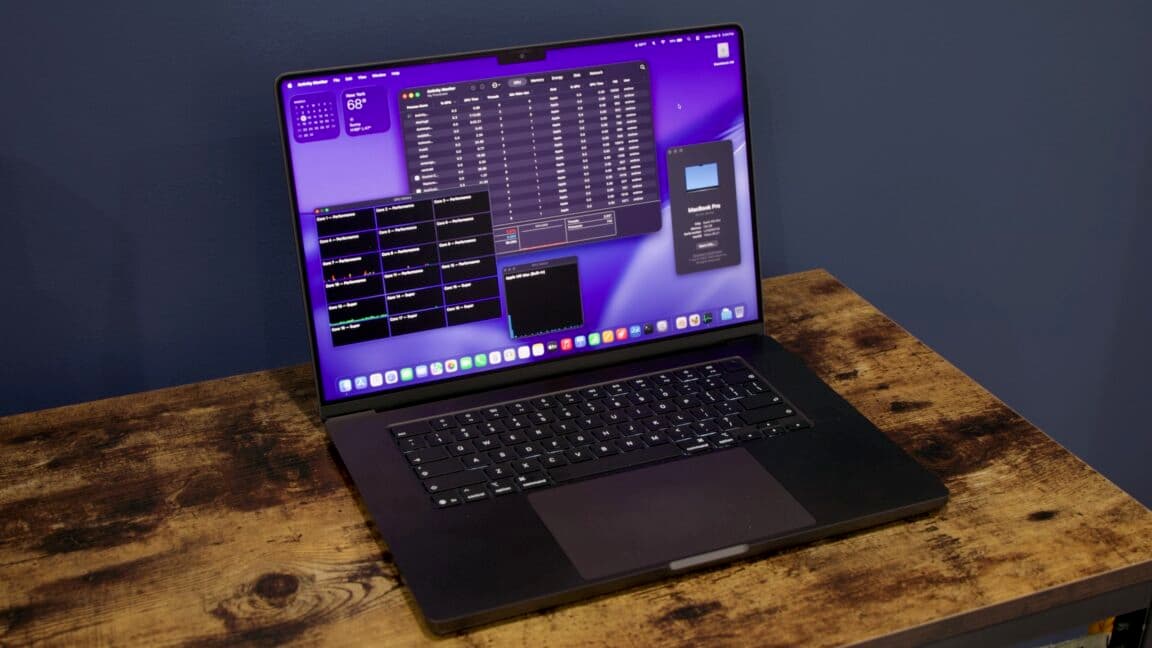
Apple’s M5 Max MacBook Pro: The Quiet Arrival of the “Middle Core” Era
Apple’s 2026 16-inch MacBook Pro looks boring on the outside and subtle on spec sheets, yet it quietly marks one of the biggest architectural shifts since the first M1. With the M5 Max, Apple isn’t just chasing another 10–20% bump; it’s redefining how high-end Macs scale performance with a new split CPU/GPU package and a three‑tier core hierarchy where “super” cores meet all‑new “performance” cores. Beneath the confusing naming is a clear strategy: make Macs denser, more scalable and more AI‑ready without destroying battery life. The question is whether this is merely an engineering optimization—or the foundation of Apple’s next decade.
The news in brief
According to Ars Technica’s in‑depth testing, Apple’s 2026 16‑inch MacBook Pro with the M5 Max chip delivers modest but real gains over last year’s M4 Max model.
The M5 Pro and M5 Max move to an “Fusion Architecture” package: one die for CPU‑related logic and another for GPU and memory controller, bonded together. Both chips share the same 18‑core CPU die (6 “super” high‑performance cores plus 12 new “performance” cores). The Pro ships with up to 20 GPU cores and 307 GB/s memory bandwidth, while the Max scales to 40 GPU cores and up to 614 GB/s bandwidth.
Ars’ benchmarks show roughly 10–12% higher CPU performance versus M4 Max in most tests, with some outliers, and around 20–35% higher GPU performance. Versus the standard M5 in the 14‑inch MacBook Pro, M5 Max delivers similar single‑core performance but up to roughly double the multi‑core speed and three to four times the graphics throughput. Power draw under heavy load rises by a bit more than 20%, but overall efficiency remains in line with previous Apple Silicon generations.
Why this matters
The M5 Max is important less for its benchmark deltas and more for what it reveals about Apple’s strategy.
First, Apple is formalizing a three‑tier core world on Macs:
- “Super” cores for peak single‑thread and latency‑sensitive work.
- New “performance” (medium) cores designed for sustained multithreaded workloads.
- Efficiency cores, now reserved for the base M5, not the Pro/Max line.
According to Ars Technica’s measurements, these medium cores are not just renamed efficiency cores: they clock much higher, have more L2 cache per cluster, and sit only about 300 MHz below the super cores. That changes the trade‑off for high‑end laptops. Instead of a classic big‑little design where small cores are clearly second‑class citizens, Apple is betting on a dense swarm of almost‑fast cores that can chew through renders, encodes and compiles while keeping thermals under control.
Who benefits? Video editors, 3D artists and developers running sustained CPU‑bound workloads get nearly “desktop‑class” throughput in a mobile machine, especially when scaling across 18 cores. GPU‑heavy users see a more noticeable 20–35% bump, plus a neural accelerator embedded in each GPU core that should help AI and compute workloads—assuming software actually targets it.
Who loses? Two groups. First, anyone who just bought an M4 Max: the uplift is incremental, not revolutionary. Second, users hoping Apple would chase higher peak clocks like Intel and AMD do on their flagship mobile CPUs. Apple is doubling down on many strong, reasonably fast cores instead of extreme turbo frequencies.
The other quiet loser is clarity. Calling the largest cores “super” and the middle tier “performance” invites confusion, even for technically literate buyers. Apple has always marketed around simplicity; this generation’s naming undercuts that, even if the silicon story is solid.
The bigger picture
Apple’s M5 Max fits into three wider trends in chip design.
1. The chiplet era arrives in Cupertino—on Apple’s terms.
Breaking the SoC into CPU and GPU dies looks a lot like the chiplet strategies AMD and, increasingly, Intel have adopted. But Apple is using its proprietary Fusion Architecture rather than industry‑standard interconnects. That gives Apple the usual upside—tight integration and control—while making it harder for anyone to mix, match or commoditize Mac components.
Practically, this split lets Apple scale GPU and memory bandwidth more flexibly while reusing the same CPU die across Pro and Max, and likely across desktops later. It’s a cost, yield and product‑planning play as much as a performance one.
2. Dense cores are the new small cores.
AMD’s Zen 4c/5c “compact” cores showed one path: reuse the same ISA and most of the microarchitecture, just pack more cores at lower clocks. Apple appears to be following a similar philosophy. Ars’ measurements show the new performance cores behaving thermally like the old efficiency cores—stable clocks under load—but at much higher frequencies and with more cache.
The result: the gap between “big” and “little” shrinks. That simplifies scheduling, helps multithreaded workloads scale more predictably, and sidesteps some of the messy OS behavior we’ve seen in early big‑little x86 laptops.
3. The GPU becomes the AI heart of the system.
Apple already had a dedicated Neural Engine, but tying a neural accelerator to every GPU core is a clear signal: future AI and compute workloads should land on the GPU side of the SoC. This parallels Nvidia’s CUDA dominance and AMD’s push around ROCm and AI‑centric GPUs.
Apple’s twist is that all of this is integrated into a power‑efficient laptop package. For long‑running, on‑device AI tasks—video upscaling, code generation, local assistants—M5 Max is more an AI workstation than a classic CPU upgrade. The hardware is there; the open question is whether Apple’s software stack and third‑party tools will exploit it.
The European angle
For European users and companies, M5 Max sits at the intersection of performance, regulation and digital sovereignty.
On one hand, Apple’s efficiency story still resonates strongly in Europe, where energy prices remain high and many countries incentivize low‑power devices in public procurement. A 16‑inch mobile workstation that can replace a desktop tower helps enterprises reduce both power bills and hardware footprint.
On the other hand, the EU’s regulatory pressure is intensifying. The Digital Markets Act (DMA) and Digital Services Act (DSA) are already forcing Apple to open parts of iOS; the EU AI Act will push for transparency and data protection around AI workloads. The M5 Max’s emphasis on on‑device compute and per‑core neural accelerators plays nicely with GDPR and the AI Act: European companies can process sensitive data locally instead of pushing it to US‑hosted clouds.
But lock‑in remains. Apple’s proprietary Fusion Architecture, closed GPU stack and tight coupling between macOS and Apple Silicon make Macs harder to integrate into heterogeneous, EU‑favored open ecosystems based on Linux and open standards. For universities, research labs and public agencies in Europe, this is a strategic trade‑off: premium performance and power efficiency in exchange for vendor dependence.
There is also a competitive dimension. European OEMs don’t really exist in the same way they do in, say, the automotive industry; instead, the region relies on global PC vendors using Intel, AMD and Nvidia silicon. As Apple pushes denser, AI‑ready laptops, expect Lenovo, Dell and HP to respond in the EU market with AMD Strix Point or Intel Lunar Lake designs that lean on NPUs and discrete GPUs to match Apple’s value proposition.
Looking ahead
The M5 Max feels like a transitional point rather than a destination.
Technically, the split CPU/GPU package and new middle cores look like the base layer for:
- Future dual‑package “Ultra” chips with far more GPU power.
- Even denser client CPUs where traditional efficiency cores quietly disappear from Pro‑grade Macs.
- A stronger pivot toward GPU‑centric AI and compute in macOS.
In the near term (the next 12–24 months), watch for three things:
Scheduling behavior. If macOS starts to expose per‑core telemetry or offers developers better controls over thread placement, it’ll confirm that Apple sees the M/M/P core distinction as strategically important, not just a silicon detail.
Pro app updates. Keep an eye on Final Cut Pro, Logic, Xcode, DaVinci Resolve and Adobe’s suite. When release notes start explicitly mentioning the M5 GPU neural accelerators or “optimized for M‑series performance cores,” you’ll know the software ecosystem is catching up.
Regulatory friction in Europe. As the EU AI Act is implemented, Apple will need to demonstrate how on‑device AI on M5‑class hardware complies with transparency and data‑handling requirements—especially if it ships system‑wide generative features.
Risks? If Apple underinvests in software tooling for its GPU and neural units, the hardware advantage could be squandered, leaving creators to rely mostly on CPU gains that are, at this point, evolutionary. There is also the danger that Apple’s confusing core naming muddies purchasing decisions for professionals who just want to know: “Is this faster for my workload?”
The opportunity, however, is substantial: if Apple gets the stack right, the M5 generation could be remembered as the moment Mac laptops quietly became compact AI workstations.
The bottom line
The 2026 16‑inch MacBook Pro with M5 Max doesn’t dazzle with headline benchmark jumps, but it quietly restructures how high‑end Macs are built and scaled. The move to split CPU/GPU dies and introduce genuinely new “middle” cores is a clear bet on dense, AI‑ready performance rather than brute‑force clock speeds. For European and global professionals, this machine is less about year‑on‑year percentage gains and more about whether you’re ready to buy into Apple’s increasingly self‑contained, GPU‑centric future. The real question: will the software—and regulation—keep pace with the silicon?