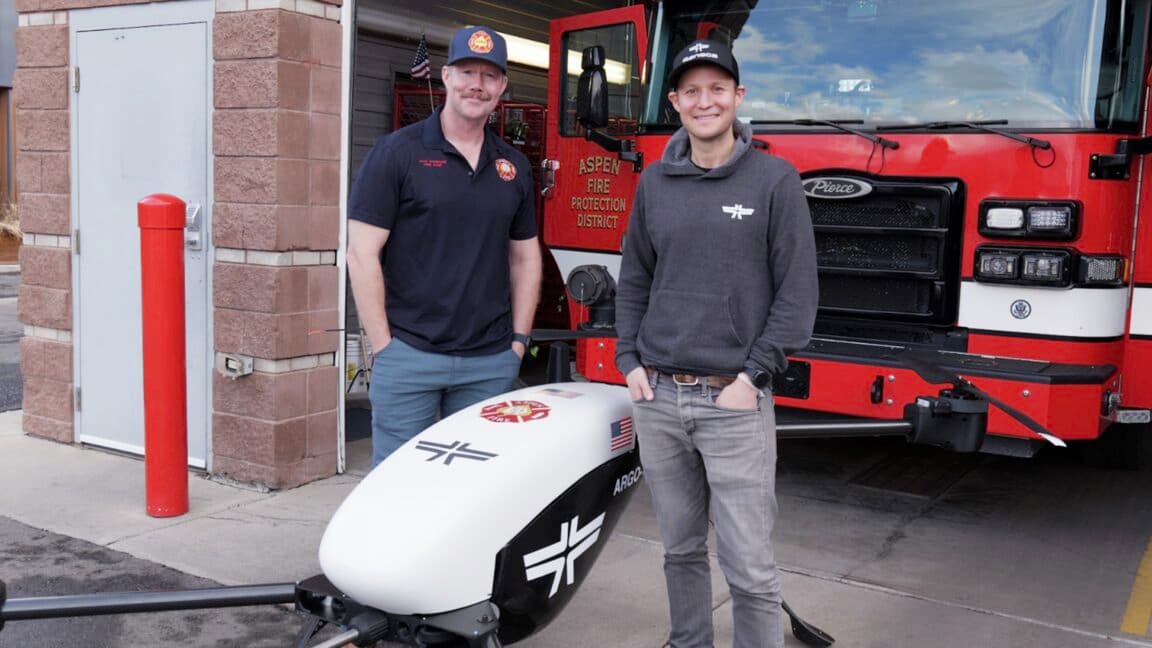
Aspen’s decision to send autonomous drones to its next wildfire is more than a flashy pilot project from a rich ski town. It is an early glimpse of how climate adaptation will actually look on the ground: robots rolling out of trailers at 3 a.m., spraying foam on a hillside long before a helicopter can get off the tarmac. For European policymakers and fire services watching from afar, the real question is not whether this works in Colorado—but how quickly similar systems should be regulated, funded, and deployed here.
The news in brief
According to Ars Technica, Bay Area startup Seneca has signed its first customer: the Aspen Fire Protection District in Colorado. Beginning this summer, Aspen will deploy a Seneca “strike team” of five drones dedicated to wildfire response.
As reported by Ars, each aircraft can carry enough agent to generate more than 50 gallons of firefighting foam, and has an operational range of roughly 3–5 miles. The drones are designed to be flown remotely and do not require a pilot on site. They are meant to team up with Aspen’s panoramic AI-powered camera network, which can detect potential fires in the surrounding terrain.
The goal, Ars notes, is early suppression: get a drone over a new ignition in minutes, slow or extinguish it with foam, and buy time until human crews can hike in or until conventional aircraft arrive from other agencies.
Why this matters
What Seneca and Aspen are really attacking is the most dangerous part of any wildfire: the first hour. That’s when a small ignition either dies quietly—or turns into a multi-million-euro disaster that burns for weeks.
In that window, today’s reality is brutally simple. Detection is getting faster thanks to cameras, satellites, and AI, but suppression is still bound to human limits: how quickly people can drive mountain roads, hike steep terrain, and safely fly aircraft in marginal conditions. Aspen’s chief told Ars he has AI cameras that can see smoke quickly, but not the people to be everywhere at once. That gap is the opportunity for drones.
The immediate winners are obvious: Seneca gets a high-profile reference customer, and Aspen gains round-the-clock aerial capacity it never had. Instead of waiting hours for shared helicopters or air tankers, the town can roll out a trailer, launch a drone, and at least slow a fire’s growth.
The losers may include operators of traditional crewed aircraft at the margins of the market. If drones can cheaply handle small and medium incidents, expensive water bomber sorties might be reserved for the worst days. But the more subtle shift is organizational: fire services begin to look less like seasonal manual labour forces and more like hybrid tech-operations organisations, with analysts watching camera feeds and drone pilots sitting in containerised control rooms.
There are hard limits. Ars points out that during major California fires, winds were at times so strong that no aircraft—drones or helicopters—could fly. Foam-carrying drones will not stop the biggest wind-driven events that dominate headlines. Their value is in preventing more fires from ever reaching that stage.
The bigger picture
Seen in isolation, five drones in Aspen are a curiosity. Seen in context, they slot into three converging trends.
First, the rise of “firetech”: companies building AI detection systems, fire behaviour models, mapping platforms, and now robotic suppression. In the US west, startups such as Pano AI (cameras) and others on the modelling side are already working with agencies. Seneca’s move is the logical next step: from seeing the fire to physically acting on it.
Second, the normalisation of autonomous systems in emergency response. Drones are now standard in search and rescue, traffic accidents, and disaster assessment. African countries use fixed‑wing drones to deliver medical supplies; Ukrainian and other militaries use loitering drones at massive scale. Firefighting was always going to follow, once payload, endurance, and regulatory frameworks matured enough.
Third, climate adaptation is shifting political priorities. For years, climate tech was mostly about mitigation: renewables, batteries, efficiency. Now, with longer fire seasons and towns burning almost every summer, voters are demanding adaptation: better warning systems, hardened infrastructure, and yes, tools that make firefighters more effective. In that context, the idea of spending hundreds of thousands of euros on a drone strike team may start to look modest compared to the cost of losing a village or a tourism season.
Historically, big shifts in wildfire tactics have been rare. The 20th century was dominated by boots, shovels, and later, water‑dropping aircraft. The move to robotic first responders will likely be just as significant as the arrival of Canadair planes over Europe decades ago—only this time, autonomy and AI are at the core.
The European angle
From a European perspective, Aspen is running an experiment that Mediterranean and Alpine regions will soon be forced to replicate—or consciously reject.
Southern Europe already lives with North American‑style seasons. Greece, Portugal, Spain, Italy, France, and the Balkans have endured record‑breaking fires in the last few years, while the Alps and central Europe are seeing longer and drier summers. The European Commission has responded by expanding the rescEU fleet of water bombers and helicopters, but that model is expensive and centralised.
Drone strike teams, by contrast, are decentralised and relatively small‑scale. A Slovenian valley, a Croatian coastal municipality, or a Bavarian district could, in theory, keep a trailer with several autonomous drones and integrate them into local volunteer brigades.
Regulation is the main brake. Under EASA rules, the kind of beyond‑visual‑line‑of‑sight (BVLOS) flights implied by Aspen’s 3–5 mile missions require specific authorisation and a strong safety case. Many EU countries still treat such operations as exceptional. Layer onto that GDPR and the upcoming AI Act: the same panoramic AI cameras that spot smoke also collect high‑resolution imagery of private land. Fire services will need clear legal bases, strict retention policies, and transparency to keep public trust.
Yet Europe is well positioned to lead in this space. The EU is already funding wildfire research, cross‑border early‑warning systems, and satellite‑based monitoring through Copernicus. German, French, Spanish, and Nordic drone startups are mature. What is missing is exactly what Aspen is providing: a politically visible, real‑world proving ground that forces regulators, unions, and citizens to decide how comfortable they are with robots as first responders.
Looking ahead
Over the next three to five years, expect three phases.
First, the “PR pilot” phase: wealthy or high‑risk communities in North America and, eventually, Europe will contract similar systems, often co‑funded by insurers or climate adaptation grants. Success metrics will be modest—number of early interventions, minutes saved compared to traditional dispatch—yet the images of drones over burning hillsides will travel fast.
Second, the “operational integration” phase: if early results look good, agencies will start designing doctrine around drones rather than bolting them on. That means new roles in control centres, new training pathways, and serious investment in secure communications and airspace coordination so that drones, helicopters, and water bombers can work together safely.
Third, the “scaling and standardisation” phase: international standards bodies and regulators will harmonise certification, data formats, and safety requirements. Vendors that can plug into national command‑and‑control systems and prove reliability across thousands of missions will survive; small niche players may not.
Watch three things in Aspen’s trial: reliability (how often the drones actually launch and complete missions), operator workload (how many staff are really needed to keep them running 24/7), and outcomes (how many fires were contained earlier than they would have been otherwise). Also watch for failure modes: airspace conflicts, cyber incidents, or simple maintenance headaches.
The greatest risk is not that the technology fails spectacularly, but that it half‑works—good enough for press releases, not good enough to materially change outcomes. The greatest opportunity is the opposite: that a relatively cheap, repeatable tool quietly becomes part of the standard wildfire toolkit, from Colorado to Catalonia.
The bottom line
Firefighting drones in Aspen are not a sci‑fi sideshow; they are the first iteration of a new layer in wildfire defence. If they prove reliable, Europe will have to decide whether to embrace similar systems, and under what regulatory and ethical conditions. The real debate is no longer if robots join the fire line, but how we integrate them without creating new risks, inequalities, or blind faith in technology that cannot, on its own, put out the climate crisis.