Google’s late YouTube bet on Vision Pro exposes the new XR platform war
Intro
Two years is an eternity in consumer tech. That’s how long it took Google to ship a proper YouTube app for Apple’s Vision Pro, a device sold largely on the promise of premium video and immersive experiences. The delay wasn’t just an annoying omission for early adopters; it was a live experiment in platform power, API control, and how fragile third‑party innovation can be when two giants are playing chess. In this piece, we’ll look at what this move really tells us about the state of XR, who wins and loses, and what it signals for Europe’s mixed‑reality future.
The news in brief
According to Ars Technica, Google has finally released an official YouTube application for Apple’s Vision Pro mixed‑reality headset, roughly two years after the first‑generation device launched in February 2024.
At launch and throughout the release of a second‑generation Vision Pro, there was no native YouTube client. Users were pushed to use YouTube via the web browser, which was adequate for flat 2D video but not for immersive formats. During that gap, independent developers stepped in with third‑party apps such as Juno, until Google requested that some of these apps be removed from the App Store on the grounds of API policy violations.
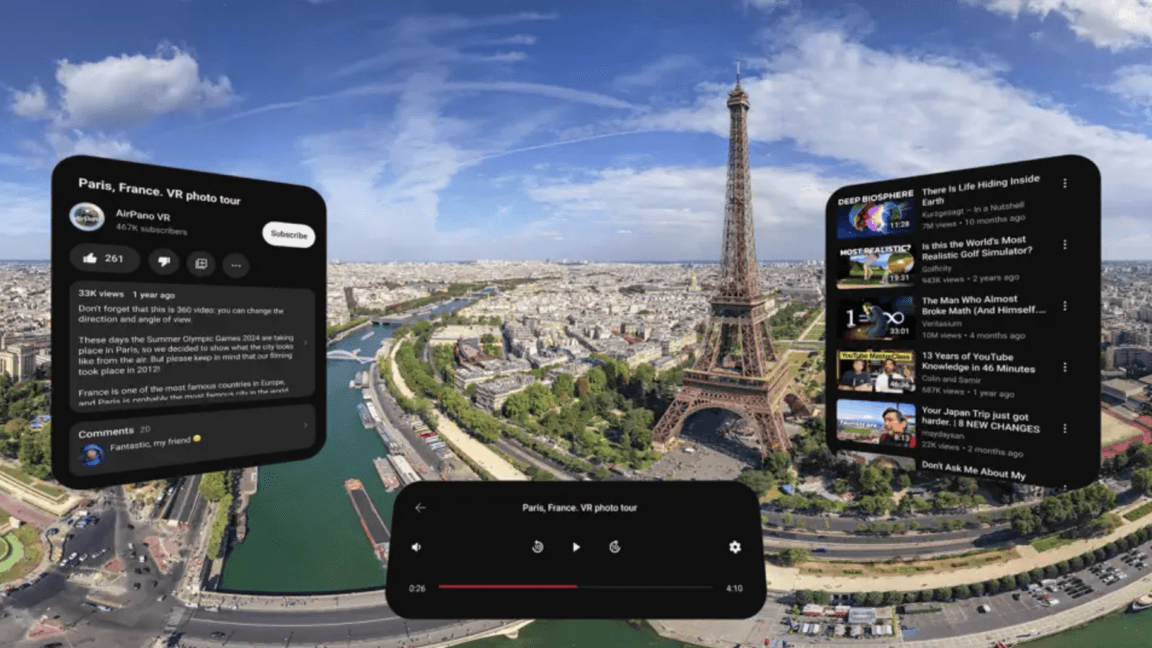
The new app is a spatial, visionOS‑native experience rather than a simple iPad port. As described in the App Store listing cited by Ars Technica, it supports 3D, 360‑degree and 180‑degree videos, offers a dedicated interface for Shorts, and includes the full signed‑in YouTube experience with history and personalisation. Netflix, in contrast, still has not committed to a dedicated Vision Pro app.
Why this matters
On paper this is just “an app finally ships.” In practice, it’s a strategic concession in the middle of a brewing XR platform war.
For Apple, YouTube is table stakes. YouTube isn’t just another video service; it is the de facto archive of web video and still the largest library of VR and 360‑degree content. A high‑end headset marketed around immersive cinema looks incomplete without it. The absence of a native app made Vision Pro feel like an expensive demo device rather than a fully‑fledged media platform.
For Google, the calculation is more complex. The company is simultaneously:
- A core app provider on Apple platforms,
- The owner of Android and the broader Google services ecosystem, and
- An emerging XR platform player, building its own mixed‑reality ambitions.
Delaying YouTube gave Google time to see whether Vision Pro would remain a niche toy or a meaningful new platform. When you control one of the few genuinely must‑have apps, withholding support is a form of soft leverage. If the device had flopped, Google could have saved resources and quietly walked away.
The losers in this story are the independent developers who tried to fill the gap. Apps like Juno proved there was real demand for a native YouTube experience, only to be removed after Google invoked API rules. This illustrates how dependent innovators are on the goodwill of platform and service owners. It also shows that “open” web APIs can be used as a strategic weapon: tolerated while they’re convenient, shut down when first‑party plans arrive.
The immediate implication: with YouTube on board, Vision Pro becomes a far more compelling media device, and Apple’s XR ecosystem gains a crucial validation signal. At the same time, Google has re‑asserted control over how and where its video content is consumed in spatial environments.
The bigger picture: XR, services and soft exclusivity
This move sits at the intersection of three broader trends.
1. XR as the next platform battleground
Meta’s Quest line, Apple’s Vision Pro, and upcoming Android‑based headsets from Samsung/Google all compete to define the default mixed‑reality experience. In this race, flagship apps matter more than raw hardware specs. YouTube VR has been available on Meta’s platforms for years; arriving this late on Vision Pro suggests Google is carefully rationing its support across rival ecosystems and prioritising headsets closer to its own camp.
2. Services now wield more power than operating systems
Fifteen years ago, the OS was the main moat. Today, a handful of cross‑platform services—YouTube, WhatsApp, Instagram, Netflix, TikTok—can make or break hardware. When one of these services hesitates or stays away (as Netflix still does from Vision Pro), it effectively throttles the perceived value of the device.
Google’s behaviour mirrors earlier smartphone era tactics: think of how long it took Amazon to meaningfully support Google’s Cast ecosystem, or how some services delay support for rival smart‑TV platforms. It’s not overt exclusivity, but a kind of temporal exclusivity: supporting your allies first, your competitors later, if at all.
3. The recurring story of third‑party pioneers being squeezed
We’ve seen this film before. Third‑party clients prove a use case—Twitter clients, email apps, YouTube front‑ends—only to be rate‑limited, API‑restricted or pushed out when the platform owner wants to control the experience and monetisation. The Juno takedown fits that pattern.
Google is within its rights to enforce API rules, but the timing is telling. As soon as its own spatial YouTube client was on the roadmap, tolerance for others shrank. For XR developers, the lesson is sobering: if your killer feature is “we integrate better with Big Tech service X,” your runway ends as soon as X cares enough.
The European angle: regulation meets mixed reality
From a European perspective, this saga is almost a case study for the EU’s new digital rulebook.
The Digital Markets Act (DMA) is explicitly aimed at “gatekeepers” controlling access between businesses and users. In an XR world, those gatekeepers are not just Apple and Meta as hardware vendors; they’re also Google as the owner of YouTube. When Google can both (a) ask Apple to remove a third‑party Vision Pro YouTube client, and (b) become the sole viable provider of that functionality later, regulators will inevitably ask whether this is fair, transparent, and non‑discriminatory.
Then there’s GDPR and spatial data. YouTube on a headset isn’t just another screen—it’s an application sitting in an environment that can track gaze, gestures, and physical surroundings. How those interaction signals are logged, combined with watch history, and potentially used for ad targeting will be a major concern in privacy‑conscious markets like Germany and much of the EU.
For European content creators and media companies, the arrival of a first‑party YouTube client is a double‑edged sword. On one hand, it finally gives immersive producers—from Berlin VR studios to Barcelona documentary teams—a mainstream channel to showcase 360° video to premium‑hardware audiences. On the other hand, it further entrenches dependence on a single US‑based distribution platform.
European policymakers increasingly talk about digital sovereignty. Mixed reality, with its intimate access to user surroundings and attention, raises that debate to a new level. With Vision Pro, Quest and upcoming Android XR devices all controlled by US giants, the EU’s best lever may be strict enforcement of interoperability, data‑access rights and competitive neutrality rather than trying to create a homegrown hardware rival.
Looking ahead: what to watch in the next 24 months
The YouTube app’s launch doesn’t close the story; it sets up the next chapter.
Expect Apple to lean heavily on YouTube in its Vision Pro marketing, especially for travel, sports and concert content where 180° and 360° video shine. If usage data shows strong engagement with immersive formats, that will encourage more European broadcasters, sports leagues and cultural institutions to experiment with XR‑first productions.
On Google’s side, the interesting question is feature parity. Will the Vision Pro app get the same capabilities as YouTube on Android‑based headsets—live chat overlays, social co‑watching, experimental formats—or will it lag behind? Any visible gap will signal how strategically Google wants to keep the best spatial experiences close to its own ecosystem.
Netflix’s absence will also become more glaring over time. If Vision Pro sales grow and YouTube usage looks strong, the pressure on holdout services will increase. Either they join, or they risk teaching users that in XR, YouTube plus a few key native apps are “good enough” for entertainment.
For developers, the main risk is platform dependency. The Juno episode is unlikely to be the last time an XR innovator is squeezed between service and hardware owners. Smart teams will:
- Avoid building businesses that rely purely on unofficial access to major content platforms,
- Focus on unique experiences (productivity, design, simulation, training) where they own the full stack, and
- Push for standards that let them move more easily between XR platforms.
Regulators, meanwhile, will be watching how app store rules, API access and data collection practices in XR align with the DMA, GDPR and, in future, the EU AI Act where AI‑driven recommendation and personalisation are central.
The bottom line
Google bringing YouTube to Vision Pro two years late is more than a belated feature drop; it’s a reminder that in XR, the real power lies with the few services users refuse to live without. Apple gains a stronger story for its headset, Google secures control over how its video empire appears in a rival’s world, and independent developers are once again reminded how fragile their position can be. As mixed reality moves from curiosity to computing platform, the key question for Europe and beyond is simple: who gets to set the rules of this new layer of reality—and who is merely renting space in it?