1. Headline & intro
LG’s unreleased Rollable phone has finally been opened up – not for launch, but for autopsy. The teardown of this prototype, surfaced by JerryRigEverything and covered by Ars Technica, is more than a curiosity for hardware nerds. It’s a time capsule from 2021 that explains why, in 2026, we still don’t have rollable phones in our pockets. Under the clever mechanics and tiny motors lies a bigger story: the limits of hardware stunts in a mature smartphone market, and why the future of phones is increasingly about software and AI rather than moving parts.
In this piece, we’ll unpack what the teardown showed, why rollables stalled, and what it reveals about the direction of the entire mobile industry.
2. The news in brief
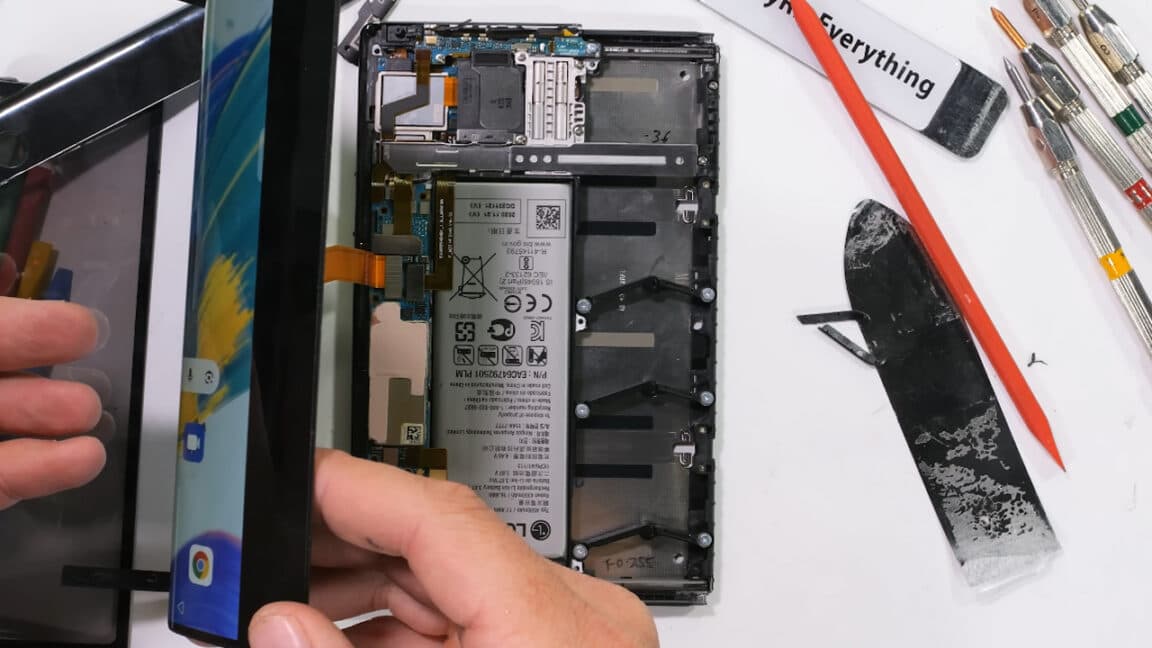
According to Ars Technica, a working prototype of LG’s Rollable smartphone – a device teased in early 2021 but never released – has been torn down on YouTube by creator JerryRigEverything. The phone looks like a conventional slab at first, but a motorized mechanism can extend the display sideways, increasing screen area by roughly 40% as an extra portion of OLED unrolls from the back.
Inside, the prototype uses two small motors, gear-like tracks, a system of spring‑loaded arms, and a sliding internal frame to keep the panel flat while the chassis expands. The back of the phone stretches to accommodate the rolled-up display, while the battery and mainboard sit in a movable tray. Ars Technica notes that this level of mechanical complexity would likely have made the device very expensive to build and potentially fragile in long‑term use, which may help explain why LG cancelled it and then exited the smartphone business entirely in 2021.
3. Why this matters
The LG Rollable teardown is not just about one cancelled phone; it’s a post‑mortem on a whole category that never made it out of the lab. Foldables escaped that fate – they’re now a visible, if niche, part of the market. Rollables did not. Seeing the insides of LG’s attempt clarifies why.
First, the economics are brutal. Every extra motor, spring arm and precision rail adds cost, assembly time and failure points. To make a rollable viable, LG would have needed to charge at least top‑tier foldable money. In 2021, that meant convincing buyers to pay well over €1,500 for an LG‑branded experiment at a time when the company’s phone division was already losing mindshare. That’s a hard sell even before talking about durability.
Second, reliability expectations for phones are unforgiving. Consumers can tolerate a mechanical lens in a camera or a hinge in a laptop that sits mostly on a desk. A phone lives in pockets full of dust, gets sat on, dropped, and used hundreds of times a day. Foldables already struggle with this reality; adding powered motors and gear trains multiplies the risk. One jam, and your screen no longer expands – or worse, gets damaged in the process.
The winners here are the companies that bet on simpler architectures – notably Samsung with its hinge‑based foldables, and Apple and Google with more conservative hardware but aggressive software and camera innovation. The losers are OEMs that burned scarce R&D budget on spectacular but commercially implausible hardware tricks.
4. The bigger picture
LG’s rollable belongs in the same museum wing as modular phones, 3D‑Touch displays, rotating cameras and slider selfie modules. All were ingenious, all solved a real problem for a subset of users, and almost all vanished once the cost and fragility outweighed the benefit for the average buyer.
Since 2019, foldables have slowly matured: Samsung has iterated its Galaxy Z series to better hinges and tougher ultra‑thin glass; Chinese brands like Huawei, Honor and Oppo have debuted lighter book‑style and flip devices; Google entered with the Pixel Fold, and OnePlus with the Open. Yet even in 2026, foldables remain a single‑digit percentage of shipments in most markets. That’s a clear signal: the mass market is not desperate for radically new form factors.
Rollables promised something different from foldables: no crease, no thick hinge, a device that feels like a normal phone until it silently expands. On paper, it’s elegant. In practice, LG’s internals show the price of that elegance: layers of tiny moving parts, more to seal against dust, and more that can break. It’s telling that companies which showed rollable concepts earlier this decade – Oppo, Motorola, TCL – have all focused instead on more conventional foldables or straightforward slabs with AI and camera upgrades.
There’s also a strategic shift underway. As hardware innovation hits physical constraints – battery chemistry, optics, pocket size – the differentiation frontier is shifting to software, services and silicon. Apple leans on its custom chips and ecosystem; Google pushes computational photography and on‑device AI; Samsung layers Galaxy AI on top of competent but familiar hardware. A motorized scroll‑phone simply doesn’t move the needle enough in that environment.
5. The European / regional angle
From a European perspective, LG’s rollable was almost destined to be a curiosity rather than a bestseller. The EU market is heavily shaped by regulation and cautious consumers who keep devices longer and pay close attention to durability and resale value.
Smartphones in the EU are already under the microscope of Ecodesign rules, repairability scores (pioneered in France), and upcoming right‑to‑repair measures. A device filled with proprietary motors and complex mechanics would almost certainly score poorly on repairability and spare‑parts availability. That alone makes carriers and retailers wary: handling warranty claims on a fragile €1,800 niche device is not an attractive proposition.
Europeans also tend to be more price‑ and longevity‑sensitive than buyers in some Asian markets where experimental designs sometimes catch on. In Germany, the Nordics or Central Europe, the dominant pattern is buying a solid mid‑range or flagship and using it for three to five years. For those users, a conventional phone with great battery life, strong camera and long software support beats an exotic form factor.
Finally, the EU’s broader digital policy – DMA, DSA, the EU AI Act – is pulling attention and investment towards platforms, interoperability and AI compliance rather than baroque hardware experiments. When you’re obliged to guarantee updates, security patches and transparency for years, the risk of fielding a mechanically fragile product goes up further.
6. Looking ahead
Does the LG Rollable teardown mean rollable displays have no future? Not necessarily – but their future might lie outside smartphones.
Rolling OLED is already commercially real in TVs, and there’s serious interest for laptops, tablets and monitors where thickness and weight budgets are looser and devices aren’t abused like phones. A rollable 15‑inch laptop screen that extends to 17 inches on a desk doesn’t have to survive sand, jeans pockets and subway doors.
In phones, rollables may reappear first in ultra‑niche industrial or enterprise contexts: ruggedized devices for field workers where a temporarily larger display is worth the complexity and cost. Another possibility is hybrid accessories – rollable companion displays that pair with a normal slab phone via USB‑C or wireless links, neatly avoiding motors inside the primary device.
For now, expect OEMs to keep showing rollable and sliding concepts at trade shows like MWC to signal innovation, while quietly channeling most real R&D into more pragmatic areas: custom NPUs, on‑device generative AI, better zoom systems, and materials that make foldables thinner and cheaper rather than stranger.
The real trend to watch is whether foldables can break out of their premium niche once prices drop closer to mainstream flagships and durability matches slabs. If that happens, it will further reduce the incentive to risk an even more complex form factor like a rollable.
7. The bottom line
The LG Rollable teardown is a rare look at an ambitious idea that hit the hard wall of economics and reliability before it ever reached stores. It confirms that, in 2026, the smartphone industry has little appetite for filling devices with tiny motors just to gain a few extra centimetres of screen. The next big shifts in mobile are far more likely to come from silicon and software than from moving parts. The question for readers is simple: would you trade reliability for spectacle – and at what price?