Headline & intro
Apple has finally built the €600-ish MacBook people have been begging for – but it did it by dropping an iPhone processor into a laptop and ruthlessly trimming features. The new MacBook Neo isn’t meant for Xcode builds or 8K timelines; it’s an answer to the chaotic world of cheap Windows machines and disposable Chromebooks. In this piece we’ll look beyond the spec list: what it means when an iPhone-class chip powers a Mac, how aggressively Apple is segmenting its lineup, and why this little yellow notebook could matter a lot more than its 8GB of RAM suggests.
The news in brief
According to Ars Technica’s in‑depth review, Apple’s MacBook Neo is a new 13‑inch entry‑level Mac notebook starting at $599 ($499 with education discount). Instead of an M‑series SoC, it uses the A18 Pro – the same chip as in the iPhone 16 Pro – paired with 8GB of unified memory and 256GB or 512GB of storage.
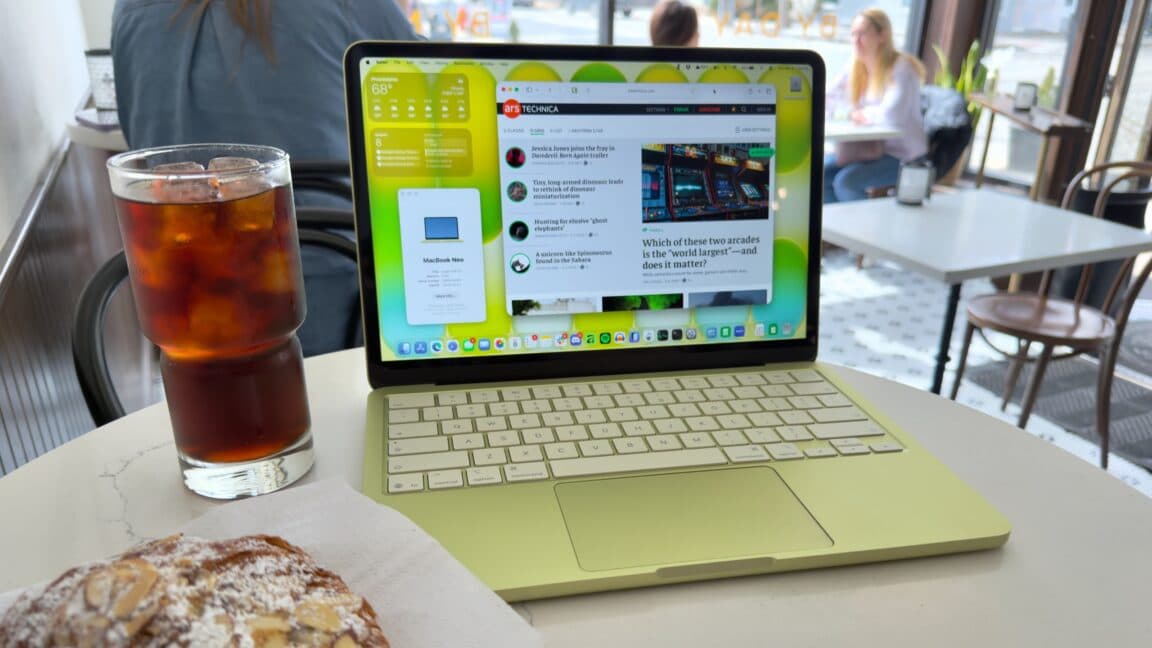
The Neo has a newly designed, flat aluminium chassis in four colours, a 500‑nit Retina‑class display (sRGB only), a non‑backlit keyboard, a smaller mechanical trackpad, and a 1080p webcam. Ports are two USB‑C: only the left port supports 10 Gbps and external 4K/60Hz display output; neither port is Thunderbolt and there’s no MagSafe. Battery is 36.5 Wh, with Apple claiming around 11 hours of web browsing.
Performance in benchmarks places the A18 Pro Neo below the original M1 MacBook Air in sustained workloads, though day‑to‑day tasks are reported as generally smooth. The big limitation: RAM is fixed at 8GB, with no higher option.
Why this matters
The MacBook Neo is important not because of what it can do, but because of what it makes simple. For the first time, there is a current‑generation Mac laptop that sits close to mainstream Chromebook and mid‑range Windows pricing. For parents, students and non‑technical buyers, that means: walk into an Apple Store, pay a mid‑range laptop price, get something that will feel premium enough and integrate perfectly with an iPhone.
The winners are obvious. Apple gets a new on‑ramp into its ecosystem at a moment when iPhone growth is flattening and Mac sales are cyclical. Schools and universities – especially in markets where Macs were previously out of reach – suddenly have a realistic Apple option without going to old refurbished Intel hardware. Many casual users who were limping along on decade‑old Airs now have a credible replacement.
The losers are less visible but very real. Windows OEMs have spent years trying to build decent €600 laptops and have mostly ended up shipping devices with at least one fatal flaw: dreadful screens, loud fans, awful trackpads, or batteries that die halfway through a lecture. Apple is effectively saying: we can do better at your price point, by reusing our phone silicon and being brutally disciplined about the extras. That puts pressure on the mid‑range PC business, where margins are already thin.
But Apple’s discipline is also strategic segmentation. The Neo is deliberately fenced off from the Air: 8GB only, weaker sustained performance, no Thunderbolt, no backlit keyboard, confusing ports. It’s the machine that gets you into macOS – and gently nudges power users to spend double on an Air.
The bigger picture
Seen in isolation, "MacBook with iPhone chip" sounds like a curiosity. In context, it’s part of three bigger trends.
First, the long‑promised ARM laptop era is finally materialising. Apple led with M1 in 2020, but now Qualcomm’s Snapdragon X Elite and X Plus are about to power a new wave of Windows on ARM PCs. Those chips chase high performance; the A18 Pro in Neo represents the opposite end: ultra‑low‑power silicon driving "good enough" productivity machines. ARM isn’t just about speed; it’s about cost structures and efficiency curves that let you build credible laptops at $599 without bargain‑bin components.
Second, this is Apple rediscovering the spirit of the old white plastic MacBook and, before that, the iBook: a consciously down‑market Mac that broadens the base. The difference is that in 2026 Apple is a segmentation machine. In the 2000s, cheap Macs often ate into sales of more expensive models. Today, Apple carefully carves capabilities: if you care about colour‑accurate displays, external monitors, or serious multitasking, you are meant to feel the Neo’s limits and walk straight to the MacBook Air shelf.
Third, the Neo exposes an uncomfortable truth about modern software: 8GB is no longer generous. Apple itself quietly acknowledged this by raising most Mac baselines to 16GB in 2024. Shipping a brand‑new Mac locked to 8GB is not a technical necessity, it’s a business choice – one that effectively time‑limits the device. For web, office work and media, it will be fine today; by 2029, with fatter Electron apps and heavier AI features, it may feel constrained.
The European angle
For European buyers, the Neo is a mixed blessing.
On the plus side, this is the first new Mac notebook that will likely land under the psychological €800 line in many EU countries, even after VAT. That matters in markets like Spain, Portugal, Central and Eastern Europe, where Apple has historically been an aspirational brand rather than a default laptop choice. Combined with aggressive education discounts, the Neo could realistically show up in classroom pilots that previously defaulted to Chromebooks or low‑end Windows PCs.
Regulation also plays in. The EU’s push for USB‑C as a common charger standard is fully embraced here; any decent USB‑C power brick will charge the Neo. Upcoming ecodesign and right‑to‑repair rules, however, highlight the flip side: 8GB of non‑upgradeable RAM and soldered storage mean that when the Neo hits its performance ceiling, it goes to the drawer or the secondary market, not the repair shop. That clashes with Europe’s sustainability rhetoric, even if Apple will point to the device’s energy efficiency.
There’s also the reality of pricing structures: Europeans are already used to paying noticeably more than the US sticker once VAT and regional pricing are added. When a refurbished M1 or M2 Air with 16GB RAM is often just €150–€200 more from local resellers, the Neo becomes a tougher call for anyone who plans to keep a laptop 5–7 years – which is common in Europe’s cost‑conscious households and SMEs.
Looking ahead
The Neo feels less like a one‑off and more like the first member of a family. Apple has now publicly crossed the line of putting A‑series chips in Macs. Once that taboo is gone, a roadmap almost writes itself: A19‑based Neo with 12GB RAM when that becomes standard in iPhones; maybe, eventually, an "A‑Max" variant tuned specifically for low‑cost Macs with slightly more I/O.
Two things are worth watching.
First, memory. Apple cannot ship an 8GB base Mac forever while simultaneously stuffing more on‑device AI and richer system features into macOS. Either the Neo moves to 12GB with a future iPhone chip, or Apple risks creating a class of users stuck on "works, but always struggling" hardware. The company’s own recent decision to standardise on 16GB elsewhere suggests the former.
Second, competitive response. If Snapdragon‑based Windows laptops deliver on efficiency and battery promises, we may see genuinely decent €600 Windows machines with 16GB RAM, 512GB SSDs and solid screens. At that point the Neo’s compromises – no Thunderbolt, odd USB‑C behaviour, single external display, 8GB ceiling – become harder to justify.
In education, expect pilots: a few universities and school systems will trial fleets of Neos in 2026–27. Their feedback on durability, battery, and RAM constraints will heavily influence whether this product line becomes a staple or a footnote.
The bottom line
MacBook Neo is the most aggressively priced Mac notebook Apple has ever shipped – and also the most deliberately constrained. It brilliantly solves the "I just want a decent, simple laptop" problem, while making sure anyone with heavier needs pays for an Air or Pro. If you were advising a friend or relative, would you tell them to buy a Neo now, or save a bit longer for a 16GB Air that might last twice as long? That’s the real question this little iPhone‑powered Mac forces us to confront.