1. Headline & intro
If you close your eyes and picture an early personal computer, chances are you are borrowing, consciously or not, from Robert Tinney. His surreal trains running across circuit boards and balloons made of code gave shape to a technology that, at the time, most people had never seen in person. Tinney’s death at 78 is not just the passing of an artist; it’s a reminder that the way we see technology shapes what we dare to build with it. In an era of AI-generated stock art and flat corporate gradients, his legacy is an uncomfortable question: who is painting our future now?
2. The news in brief
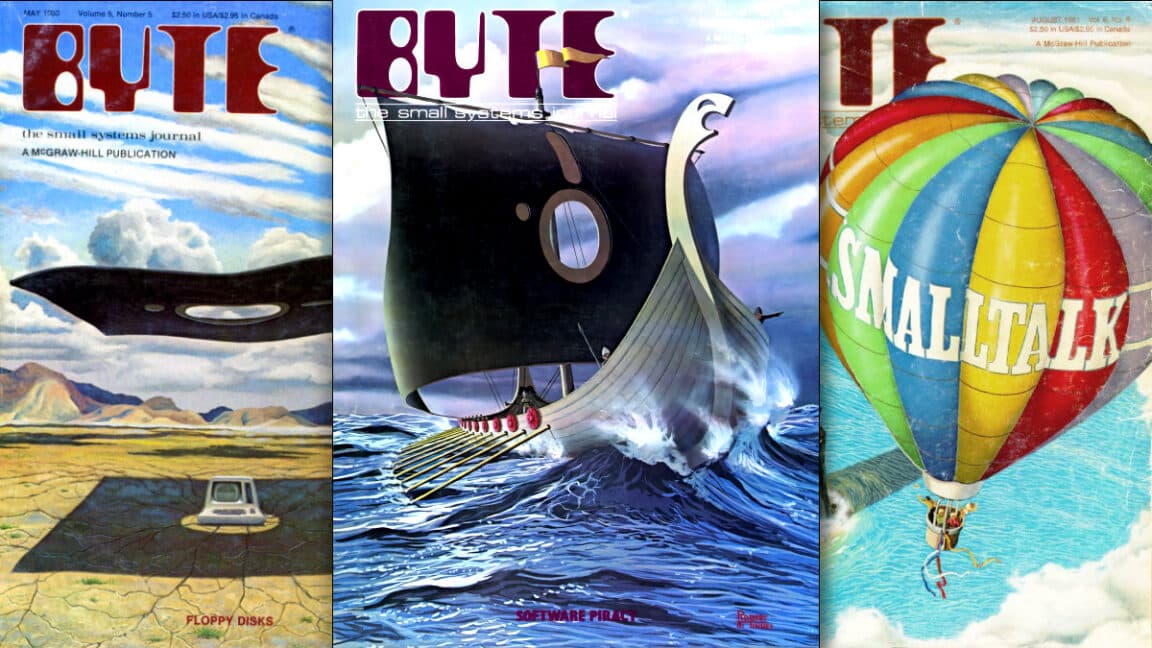
According to reporting from Ars Technica, illustrator Robert Tinney died on February 1, 2026, in Baker, Louisiana, at the age of 78. Tinney was the primary cover artist for Byte magazine from 1975 through the late 1980s, creating more than 80 covers that visually defined the early personal-computer era.
As Ars Technica recounts, he worked mostly with airbrushed Designers Gouache, chosen for its vivid, opaque colors and smooth finish. Each cover typically took about a week to paint after phone discussions with Byte editors about the upcoming issue’s theme. Influenced by artists like René Magritte and M.C. Escher, he used metaphor and surreal imagery to represent complex topics such as artificial intelligence, networking, and programming.
Byte gradually shifted away from commissioned illustration to product photography in the late 1980s, and Tinney’s final cover appeared on the magazine’s 15th-anniversary issue in September 1990. He later worked for electronics companies and software publishers, moved into portraiture, and eventually adopted digital tools like Photoshop. He is survived by his wife, three children, nine grandchildren, and one great-grandchild.
3. Why this matters
Tinney was more than a talented illustrator attached to a famous magazine; he was one of the first people to create a visual language for personal computing. Before sleek laptops and smartphone keynotes, computers were mysterious boxes. Tinney’s covers translated that mystery into playful, human-scale metaphors that people could instinctively understand.
That matters because visual metaphors are an on-ramp to new technology. A train running along a PCB; robots hatching from eggs; a hot air balloon symbolising a new programming paradigm — these images turned abstract ideas into stories. They told hobbyists and early adopters, “This is strange, but it’s also exciting, and you can be part of it.”
The winners from that kind of work were not just Byte’s circulation figures. Entire cohorts of engineers, programmers, and tinkerers grew up with Tinney’s art as the backdrop to their curiosity. His pictures lowered the psychological barrier to entry. Before you understood assembly language, you understood the feeling of what computing might become.
We lose something when tech representation becomes nothing but product shots and UI screenshots. Today, the dominant imagery around computing is transactional: app icons, dashboards, branding systems optimized for social thumbnails. The metaphors are gone; the sense of wonder is flattened into gradients and compliance with design systems.
Tinney also illustrates another uncomfortable truth for 2026: the people best equipped to explain a technology visually are often outsiders to it. He wasn’t a programmer and felt uneasy around Byte’s editors because he didn’t speak their jargon. Precisely for that reason, he filtered jargon into human imagery. In a moment when tech is again abstract — AI models, data centers, “the cloud” — we need more Tinneys, not fewer.
4. The bigger picture
Tinney’s passing lands in an industry that has radically changed how it visualizes itself.
In the 1970s and 1980s, magazines like Byte, Creative Computing, and later PC Magazine used illustration to interpret technology. On the European side, publications like c’t, Chip, and Personal Computer World also experimented with conceptual covers before photography took over. Those covers assumed readers were curious and imaginative — willing to decode symbols.
From the late 1980s onward, competition and advertising pressure pushed magazines toward literal product photos: beige boxes, later glossy laptops, now smartphone slabs. The message quietly shifted from “Imagine new worlds” to “Compare these SKUs.”
Fast-forward to today: the symbolic job Tinney once did with gouache is increasingly outsourced to generative AI. Need a “futuristic AI” illustration? Type “glowing brain made of circuits” into an image model and you’ll get a dozen versions indistinguishable from one another — and from everyone else’s.
This isn’t just an aesthetic gripe. When every article about AI, quantum computing, or cybersecurity is illustrated with generic blue light trails and floating locks, the public understands these topics as distant, opaque forces. That, in turn, shapes policy debates and investment. Tinney’s metaphors humanised the machine; our current clichés dehumanise it.
We’ve been here before, in softer form. Science-fiction pulp covers in the mid‑20th century wildly exaggerated rockets and robots, but they seeded the imagination of real engineers. Tinney did something similar for microcomputers: his covers were whimsical, but they told you computing could touch education, art, work, play.
Compared with today’s big tech players — Apple’s cinematic product demos, Microsoft’s productivity montages, Google’s pastel dashboards — Tinney’s work looks almost subversive. It suggested that users would shape the meaning of computers, not just corporations. That’s a useful lens as we negotiate who will shape AI: hyperscalers, regulators, or the communities who actually use it.
5. The European / regional angle
For European readers, it’s easy to dismiss Byte as an American phenomenon, but Tinney’s art travelled far beyond US newsstands. Byte circulated internationally; its covers were reprinted, photocopied, and pinned to lab walls from Munich to Madrid. Even where it wasn’t widely available, its imagery influenced local designers and editors.
European computer magazines of the 1980s — c’t and Chip in Germany, Microhobby in Spain, Acorn User and PCW in the UK — wrestled with the same challenge: how do you make abstract computing topics accessible to non‑engineers? Many leaned on illustration and playful mascots before moving, like Byte, to product photos.
Why does that matter now? Because Europe is positioning itself as the regulator of the digital world: GDPR, the Digital Services Act, the Digital Markets Act, and soon the EU AI Act. Yet the visual culture around these policies is, frankly, dreadful — clip‑art padlocks, silhouetted hackers in hoodies, bland stock shots of servers. The continent that treasures its design heritage often communicates technology with the imagination of a cheap PowerPoint template.
Tinney’s approach should resonate in Europe, where there is strong public sensitivity to privacy, autonomy, and human agency in tech. His work showed that you can talk about complex systems through images that invite participation rather than resignation.
For European illustrators and publishers, his career is also a counterpoint to the current rush to replace commissioned art with AI‑generated images to cut costs. Under the upcoming EU AI Act and ongoing copyright debates, Europe has a chance to protect human visual storytelling as a strategic asset, not a nostalgic luxury.
6. Looking ahead
Tinney’s death will almost certainly spark a wave of nostalgia in the vintage‑computing and retro‑design communities — expect reprints, exhibitions, and, inevitably, AI models trained to emulate his style. But if the response is only nostalgic, we will have missed the point.
There is a real opportunity here for tech companies, media outlets, and policymakers to rethink how they visualize the next wave of computing. AI, synthetic biology, quantum hardware, climate tech — all of these are now where microcomputers were in 1975: powerful, poorly understood, and wrapped in mystique.
A few concrete things to watch:
- Media: Which tech publications will invest again in conceptual illustration instead of defaulting to stock or AI‑generated filler? Smaller, independent outlets may move first.
- Big tech branding: Will any major player dare to break from the polished 3D/gradient aesthetic and commission metaphor‑driven art to explain AI or privacy in a more human way?
- Policy communication: As the EU AI Act and national AI strategies roll out, will governments treat visual explanation as part of digital literacy, or continue to rely on generic imagery?
There are risks, of course. Commissioned illustration costs money and time. It doesn’t A/B‑test as easily as an optimized stock photo. But the reward is deeper: users who feel they understand what’s happening, rather than feeling that technology is an alien force.
If the early PC era needed a Tinney to turn silicon into stories, the AI era needs its own generation of visual translators — people who may not be model‑builders, but who can turn models into metaphors.
7. The bottom line
Robert Tinney helped a generation imagine what personal computers could be before they were commonplace. His passing underlines how impoverished our current tech imagery has become — and how badly we need new visual storytellers who can do for AI and data what he did for microchips. As you scroll past yet another blue‑tinted “AI” stock image, ask yourself: if this is how we picture the future, what possibilities are we failing to see?