Headline & intro
Rubik’s Cube has survived 50 years without a battery, firmware update, or Bluetooth pairing screen. Now Cubios’ Rubik’s WOWCube marches in with 24 color displays, an app store, and a €400-class price tag, promising to reinvent the classic puzzle as a tiny modular game console.
The question isn’t whether WOWCube is clever – it clearly is – but whether it understands what made the original so enduring. In this piece we’ll look past the gadget hype: what this device says about the “smartification” of toys, how sustainable its platform ambitions are, and why European parents and educators should pay close attention to the fine print, not just the flashing LEDs.
The news in brief
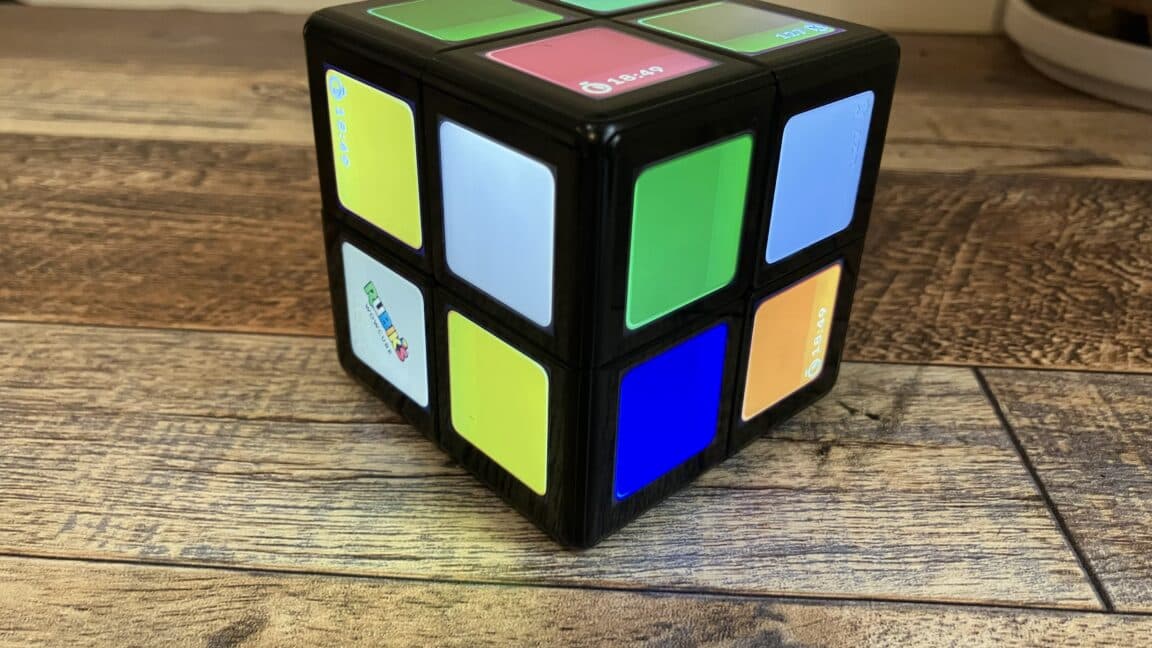
According to Ars Technica’s hands‑on review by Scharon Harding, Rubik’s WOWCube is a licensed Rubik’s product built from eight individual cubes, each with its own processor, sensors, and small IPS displays on every outward face. Put together, they form a 2×2 cube rather than the traditional 3×3.
The device can run around 15 mini‑games and experiences at launch, Ars reports. One is a simplified Rubik’s‑style color puzzle; others range from arcade‑like titles controlled by twisting and tilting, to visual toys like an animated aquarium. Most games are free, while some, such as a Space Invaders variant and other titles, are sold as paid add‑ons.
WOWCube connects to iOS and Android via a companion app for managing games and configuring widgets that can show time, temperature, and limited notifications. The reviewer notes that using the iOS app required accepting tracking, that battery life is quoted at up to five hours of continuous use, and that interaction relies on gestures such as knocking, shaking, and tilting – which did not always behave predictably during testing.
Why this matters
On the surface, WOWCube is “just” a premium toy. Strategically, it embodies a much bigger bet: that every successful analog object can be turned into a software platform.
For Cubios and the Rubik’s brand owner, the upside is obvious. A €399 connected cube with optional paid games is not a margin‑profile you get from selling €10 plastic puzzles. If they can keep users engaged with new software, they own a micro‑ecosystem: hardware, storefront, and recurring revenue.
But that same logic collides with what makes Rubik’s timeless. The classic cube is cheap, indestructible, and cognitively deep while being technically simple. WOWCube inverts that: technically complex, cognitively shallower as a puzzle (because of the 2×2 format), and 40× more expensive. The trade is simplicity and physical elegance for versatility and spectacle.
Different audiences will feel that trade‑off differently. Casual players and children who find a 3×3 cube intimidating may love a more approachable puzzle plus animated games. Neurodivergent users might find the sensory feedback motivating or overwhelming, depending on implementation.
Hardcore cubers, though, are likely to see a downgrade: fewer stickers to permute, no path to the deeper 3×3 or 4×4 challenges, and new points of failure (batteries, sensors, software bugs) in what used to be a purely mechanical object.
Then there’s friction. Needing to charge a puzzle, manage Bluetooth pairing, and learn gesture vocabularies like “knock twice to select, shake three times to exit” is the opposite of the “pick up and fiddle” magic that made the original cube globally addictive. WOWCube is a reminder that just because you can inject microcontrollers into a toy doesn’t mean you should – at least not without rethinking the core experience from first principles.
The bigger picture
WOWCube arrives into a market littered with ambitious smart toys that failed to become habits.
Think of Sphero’s app‑controlled robots, Anki’s adorable Cozmo, or earlier smart cubes like GoCube and Rubik’s Connected. They sparked huge launch buzz, real educational potential, and then, for many households, drifted into the drawer of forgotten chargers. The pattern is always similar: initial novelty, dependency on a companion app, and a fragile link to a cloud service or content roadmap that may not survive the next funding round.
WOWCube pushes the idea further by making the entire object a cluster of displays and processors. In that sense it also echoes broader computing trends: spatial computing, mixed reality, and tangible interfaces. Apple Vision Pro, Meta Quest, and even Nintendo Switch joy‑cons all explore more embodied, physical interactions. WOWCube is a tiny, self‑contained take on that movement – a handheld, reconfigurable pixel sculpture you manipulate in three dimensions.
The question is whether it’s a product or merely an experiment. The decision to restrict the main puzzle to 2×2 because every sub‑cube carries silicon is telling. The architecture prioritises electronic symmetry over the traditional mechanical challenge. That makes sense for certain game concepts (like labyrinths you build by rotating the whole device), but it also illustrates a common trap: engineering constraints quietly redefining the user value.
We have seen similar trade‑offs in other categories. E‑ink notepads that become worse notebooks the moment their cloud sync shuts down. Smart speakers that can’t set a timer offline. If WOWCube’s long‑term appeal rests on an app store and cloud‑linked companion, buyers are not purchasing a cube – they are renting an ecosystem whose durability is unproven.
The European / regional angle
From a European perspective, WOWCube sits at the intersection of three sensitive areas: children’s products, data protection, and digital markets.
The Ars Technica review notes that the iOS companion app refused to proceed unless the user allowed activity tracking. Under the GDPR’s principles of data minimisation and freely given consent, that’s a red flag – especially for a toy that is likely to be used by children or teenagers. EU data protection authorities have repeatedly warned that “take it or leave it” tracking consent is not compatible with the law.
For EU distributors, this isn’t just a theoretical debate. A connected toy that requires tracking to function may invite scrutiny from national regulators, consumer protection bodies, and organisations like BEUC. We have already seen enforcement actions around children’s smart watches and connected dolls that leaked or misused data.
There’s also the Digital Services Act and the Digital Markets Act in the background. If WOWCube relies on mobile app stores for distribution, the new rules around transparency of ranking, in‑app purchases and dark patterns apply. If Cubios ever reaches scale, questions around interoperability and sideloading may arise.
For European families, price and longevity are the other big issues. €350–€400 is beyond the impulse‑buy range in most EU markets, especially in Central and Eastern Europe. For that money, parents could buy a laptop for schoolwork plus a stack of traditional STEM toys from Ravensburger, Kosmos, or local brands – all of which work perfectly without firmware support.
In short, WOWCube can absolutely find a niche among collectors, tech‑enthusiast parents, and schools experimenting with novel interfaces. But in a region that values durability, repairability, and privacy, it must work much harder than in the US to justify its existence.
Looking ahead
WOWCube’s fate will be decided less by its hardware – which is already distinctive – and more by three things: ecosystem, trust, and iteration.
Ecosystem means content. Fifteen launch titles are a proof of concept, not a sustainable library. Unless Cubios invests heavily in new games and, crucially, opens up development to indies with a clear SDK, revenue model, and moderation policy, early adopters will soon exhaust the novelty.
Trust means fixing the privacy story and interaction quirks. For a European audience, the companion app’s tracking requirement is a liability, not a feature. A strong move would be a transparent, GDPR‑friendly mode: local Bluetooth management, no analytics by default, and clear parental controls. On the UX side, the company will need to show it can tune gesture recognition and fall back to simple, unambiguous controls – even if that means adding a few physical buttons in a second‑generation device.
Iteration is perhaps the most important. Many smart‑toy startups treat hardware as a one‑off splash. The more sustainable approach looks like Nintendo’s: learn from v1, refine, cut costs, and iterate. A future WOWCube Mini, cheaper and positioned explicitly as an educational or accessibility tool, could reach classrooms and makerspaces across Europe. Conversely, if Cubios keeps the platform closed and the price high, WOWCube risks joining the museum of beautiful but short‑lived gadgets.
For readers, the practical advice today is simple: unless you are a collector, developer, or educator itching to explore new interaction concepts, this is probably a device to watch rather than to buy.
The bottom line
Rubik’s WOWCube is one of the most intriguing reinterpretations of the classic puzzle in years – and also a sharp reminder of how easily technology can smother the elegance of a simple object. As a design experiment in modular, tactile computing, it’s valuable. As a replacement for the €10 cube that lives in millions of homes, it isn’t convincing yet. The deeper question for all of us: when we upgrade our toys with screens and sensors, are we actually improving play – or just adding another battery to our lives?