1. Headline & intro
Windows’ new AI era keeps running into a very old problem: once data exists, it will leak. Researcher Alexander Hagenah’s new TotalRecall Reloaded tool doesn’t smash Microsoft’s upgraded Recall “vault” – it simply rides along once you unlock it. For anyone watching the rise of “AI PCs” that constantly watch and remember everything you do, this is an inflection point. In this piece, we’ll unpack what Hagenah actually found, why Microsoft is calling it "not a vulnerability," and what this says about the future of Windows, corporate IT, and privacy in an age where your desktop is turning into a surveillance device you bought yourself.
2. The news in brief
According to reporting by Ars Technica, security researcher Alexander Hagenah – author of the original TotalRecall proof-of-concept – has released TotalRecall Reloaded, a new tool targeting Microsoft’s Recall feature in Windows 11 on Copilot+ PCs.
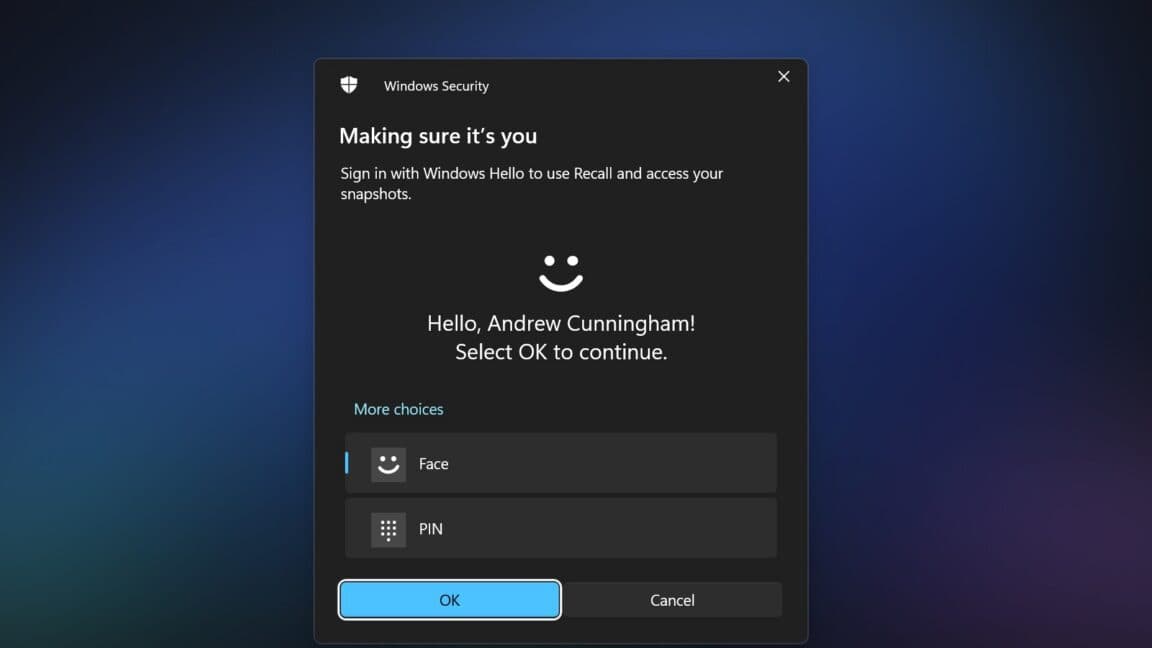
After public backlash over Recall in 2024, Microsoft delayed launch and rebuilt the feature so its screenshot database is encrypted and only accessible after Windows Hello authentication. Hagenah confirms that the encrypted Recall store is now, in his words, effectively “rock solid.”
The weak spot is what happens after decryption. Once a user authenticates Recall with Windows Hello, Windows passes data through a process called AIXHost.exe, which doesn’t enjoy the same protection. TotalRecall Reloaded injects code into this process (without needing admin rights), waits for the user to authenticate, and then siphons off screenshots, OCR text, and metadata as Recall operates. Some limited actions – like grabbing the latest screenshot or wiping the Recall database – are apparently possible even without Windows Hello.
Microsoft’s security team reviewed Hagenah’s report and, as Ars Technica reports, officially classified it as “not a vulnerability,” saying the behavior matches the intended security model.
3. Why this matters
The technical nuance here masks a simple reality: any malware that can run in your user session can now potentially piggyback on Recall to obtain a highly structured, searchable diary of your digital life.
Microsoft is technically correct that TotalRecall Reloaded doesn’t “break” Recall’s encryption or bypass Windows Hello. But users don’t think in terms of Microsoft’s internal security-boundary taxonomy. They think in terms of, “If I turn this on, can something on my PC secretly see everything I’ve done?” The honest answer remains: yes, much more easily than before.
Who benefits?
- Attackers and data thieves get a goldmine. Instead of scraping caches, browser histories and app folders, they can query a single feed that already contains OCR’d text, website content, emails, chats and filenames, neatly time-stamped.
- Microsoft still gets to ship Recall, a flagship Copilot+ feature, without re-architecting it again. By calling the issue "not a bug," it dodges another high-profile delay.
Who loses?
- End users who don’t fully understand the risk profile and may leave Recall enabled because it’s presented as a productivity helper.
- Corporate IT and CISOs, who now have to decide whether to ban or heavily lock down Recall on managed machines to remain compliant and sane.
The core problem is incentive misalignment. AI-memory features like Recall are designed around maximal capture – the more they see, the more magical their demos look. Security and privacy design, especially in regulated environments, is about minimal capture and strict separation of concerns. TotalRecall Reloaded exposes that Windows Recall still leans far more toward the former than the latter.
4. The bigger picture
Recall is not an isolated oddity; it’s a glimpse of where mainstream computing is heading. Both Microsoft and its competitors are trying to turn personal devices into continuous context collectors that fuel on-device AI.
We see the same pattern in:
- Smartphone ecosystems adding “AI summaries” of your day, your messages, your photos.
- Productivity suites promising automatic meeting notes, action-item extraction and “catch me up” feeds built from your documents and chats.
Historically, whenever platforms captured more user activity – browser histories, search logs, location timelines – we eventually saw abuse, overreach, or unexpected risk. Think of:
- Location history used in legal investigations or stalkerware.
- Cloud photo backups accidentally indexing highly sensitive images.
Recall turns this pattern into an OS-level constant: screenshots of nearly everything, processed by OCR, stored, indexed, and cross-searchable. It’s effectively keylogging plus screen logging plus app logging – productized and normalized.
Competitively, Microsoft needs something like Recall to justify Copilot+ PCs and their NPU hardware against Apple’s push toward "on-device intelligence" and Google’s AI Chromebook branding. But Apple, for example, has publicly leaned hard into a privacy-first narrative: on-device processing, explicit scoping of what’s analyzed, and clear opt-ins. Whatever you think of Apple, it has spent a decade training users to expect visible guardrails.
Microsoft, by contrast, keeps ending up in the same place: launch something powerful-but-creepy, react to backlash, bolt on protections, then argue that anything not strictly breaking a coded security boundary is “by design.” That might work for enterprise admins, but it erodes consumer trust – and gives regulators ammunition to say, "This company still doesn’t get data minimization as a principle, only as a compliance checkbox."
TotalRecall Reloaded is less of a devastating new exploit and more of a stress test of this philosophy. The test results are not flattering.
5. The European / regional angle
From a European perspective, Recall is almost a case study in what GDPR tried to prevent: collecting far more personal data than necessary, for a fuzzy purpose, with unclear risk boundaries.
Key EU principles Recall runs into:
- Data minimization: Do you really need near-continuous screenshots of everything to help users “remember” past activity? Regulators could easily argue this is disproportionate for the stated benefit.
- Purpose limitation and transparency: Users must clearly understand what is captured, how long it’s retained, and who can access it – including local apps and malware, not just Microsoft.
- Privacy by design and by default: Microsoft has already moved Recall to “off by default,” which helps. But TotalRecall Reloaded suggests that internal process boundaries and threat models weren’t designed from a hostile local software standpoint.
For European enterprises, especially in heavily regulated sectors (finance, healthcare, public administration), allowing Recall on corporate Windows images looks risky. Works councils in countries like Germany and Austria, and unions elsewhere in the EU, are unlikely to accept an OS feature that can effectively monitor employee screens retroactively.
There’s also the upcoming EU AI Act to consider. While Recall itself isn’t an AI model, its logs can feed AI assistants and monitoring tools. In workplace contexts this inches toward AI-based worker monitoring, an area where the Act is particularly strict. Even if Recall never leaves the device, organizations may feel compelled to disable it to avoid the optics – and legal exposure – of excessive monitoring.
Expect European data protection authorities and national cybersecurity agencies to issue guidance or soft bans on Recall in sensitive environments. And don’t be surprised if some EU public tenders for PCs explicitly require Recall to be disabled or unavailable.
6. Looking ahead
The likely near-term trajectory looks something like this:
- Enterprise lockdown: Large organizations will either disable Recall via group policy, or only allow it in tightly controlled pilot programs. Many CISOs will decide the theoretical productivity benefits do not justify the audit and compliance headache.
- App-level pushback: We’ve already seen, as Ars Technica notes, apps like Signal, Brave and others using flags to exclude themselves from Recall captures. Expect more applications – especially banking clients, password managers and health-related tools – to follow suit.
- More research on AIXHost and friends: Security researchers now have a clear target: the post-decryption data path. We’ll almost certainly see more proof-of-concepts that show how malware can quietly siphon Recall data in real time.
- Microsoft’s second rethink: Even if Microsoft insists this is not a vulnerability, enough bad headlines and enterprise pushback could force a redesign of how Recall exposes data to system processes, or at least much stricter session scoping and user-visible indicators.
Longer term, the question is whether “AI memory” becomes a standard OS primitive or remains a niche feature people turn off. A privacy-respecting version would need:
- Much narrower capture scopes, with app-level consent as the norm.
- Short default retention windows.
- Stronger isolation of the “AI memory” from untrusted local code.
Watch for three signals over the next 12–18 months: Windows policy changes for business SKUs, explicit guidance from EU regulators, and whether OEMs continue to heavily market Recall – or start quietly downplaying it on European shelves.
7. The bottom line
TotalRecall Reloaded doesn’t prove Microsoft’s new Recall encryption is broken; it proves that the whole idea of logging nearly everything you do is inherently dangerous in a hostile-software world. By treating Hagenah’s finding as "not a vulnerability," Microsoft is drawing a line that might satisfy its own threat models but won’t reassure regulators, CISOs or privacy-conscious users. Before we normalize AI-powered total recall on our PCs, we should decide whether the convenience is worth gifting attackers, employers and even law enforcement such a perfect, ready-made dossier of our digital lives.