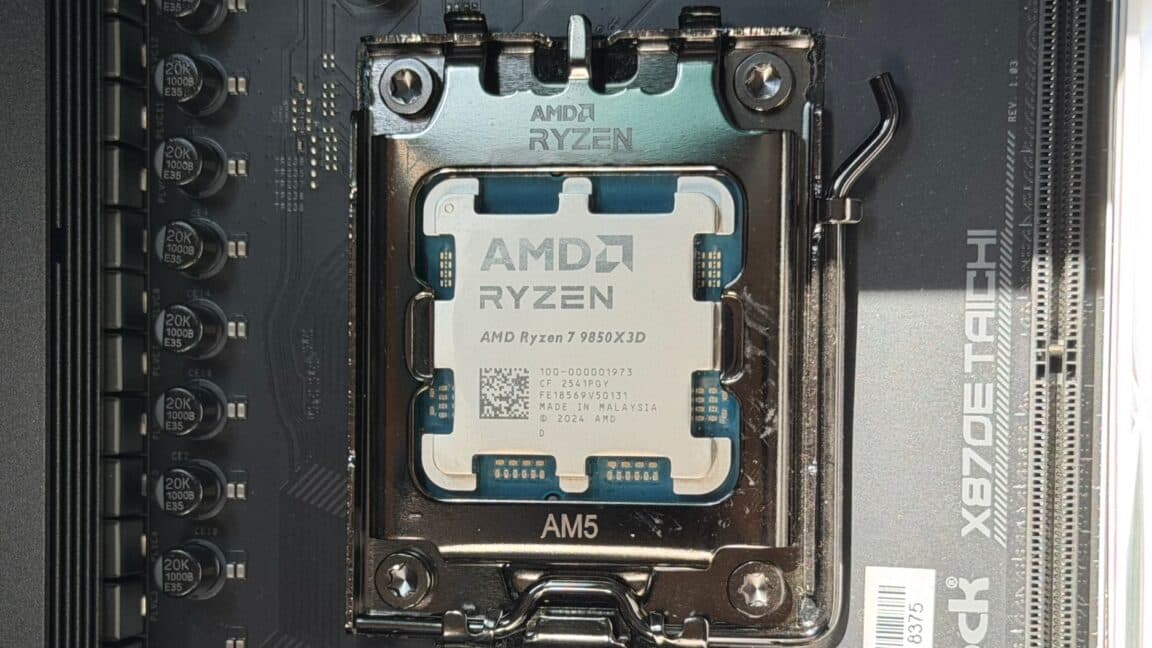
AMD’s Ryzen 7 9850X3D: When “fastest” stops being interesting
If you only read the box, AMD’s new Ryzen 7 9850X3D looks like the ultimate flex: the company’s top gaming CPU, now a little faster. But read the power charts, not the marketing slides, and the story is less glamorous. According to Ars Technica’s review, AMD has squeezed out a few more frames per second mostly by burning significantly more watts. That’s a pattern we’ve seen across the PC industry: performance still climbs, but efficiency — and value — often get sacrificed. In this piece, we’ll unpack what the 9850X3D really says about AMD, about desktop gaming in 2026, and about where high‑end CPUs go from here.
The news in brief
As reported by Ars Technica, AMD is launching the Ryzen 7 9850X3D, a $499, eight‑core Zen 5 desktop CPU with 3D V‑Cache that targets high‑end gamers. Technically, it’s a very small update: it’s essentially last year’s Ryzen 7 9800X3D with a 400 MHz higher boost clock.
The chip keeps the same 3D V‑Cache concept introduced in 2022 with the Ryzen 7 5800X3D: an extra 64 MB of L3 cache stacked on the CPU die to accelerate cache‑sensitive workloads, especially games. The 9850X3D gives all eight cores access to this cache, unlike the 12‑ and 16‑core Ryzen 9 X3D models where only one chiplet has it.
Ars’ testing shows multi‑core performance is essentially the same as the 9800X3D, while single‑core performance improves and gets closer to non‑X3D Zen 5 chips like the Ryzen 7 9700X and Ryzen 9 9950X3D. However, gaming power consumption rises by roughly 25–30 W compared to the 9800X3D, for only single‑digit performance gains.
Why this matters
The 9850X3D is a textbook example of diminishing returns in desktop CPUs. Technically, it is the “better” product: it’s a bit faster in single‑threaded workloads and games, and AMD has now erased almost all of the historical trade‑offs between X3D and non‑X3D Ryzen chips.
But the way AMD got there matters. According to Ars Technica, the 9850X3D behaves more like a standard non‑X3D Zen 5 chip: higher boost clocks, higher voltages, and as a direct consequence, higher power draw. During gaming, that translates into tens of extra watts for a performance bump that is often inside margin‑of‑error territory.
Who benefits? A very small slice of the market: people chasing the absolute highest frame rates on high‑end GPUs like an RTX 4080/5080 at 1080p or 1440p, who are also willing to ignore efficiency, noise and thermals. For everyone else, the losers list is longer:
- Value‑focused builders: The older 9800X3D is nearly as fast, cheaper, and cooler.
- Energy‑conscious users: You pay more up front and more on your electricity bill, for almost no visible gain.
- The industry’s efficiency narrative: This launch signals that, at least in the desktop halo tier, watts are once again the easiest knob to turn.
The immediate implication for buyers is simple: "fastest" is no longer a synonym for "best choice." The smarter play is often to buy one step below the flagship and invest the savings in a stronger GPU, larger SSD, or better monitor.
The bigger picture
The 9850X3D sits at the intersection of three wider trends.
1. Performance gains are getting expensive
Across CPUs and GPUs, each new generation delivers smaller real‑world gains unless vendors are willing to increase power. Intel’s high‑end desktop chips have been there for years; now AMD is flirting with the same trade‑off in a product line — X3D — that originally stood out for its efficiency in games.
The original 5800X3D was compelling because it delivered a huge gaming uplift on a mature, power‑efficient AM4 platform. The 7800X3D carried that reputation into AM5. With the 9850X3D, the performance story is incremental but the efficiency story is clearly worse.
2. Cache is now a strategic weapon
3D V‑Cache has forced Intel onto the defensive in gaming benchmarks. Ars Technica notes that Intel still doesn’t have a desktop gaming CPU that consistently matches X3D chips. That’s shaping the competitive landscape: AMD can afford small, iterative updates like the 9850X3D because it still leads where marketing matters — FPS charts.
But that lead is also a trap. When you already dominate, the temptation is to chase another 3–5% just to keep the “world’s fastest” headline, even if the engineering trade‑offs make less and less sense for customers.
3. The GPU is still the bottleneck
For most gamers, especially at 1440p and 4K, the GPU is the limiting factor. Ars’ review underlines this: if you’re not pairing a chip like the 9850X3D with a top‑tier GPU, you simply won’t see the benefit. That makes 500‑dollar gaming CPUs look increasingly like status symbols rather than rational upgrades.
The European angle
For European readers, there are two additional layers: energy prices and regulation.
Electricity remains more expensive in much of Europe than in the US. An extra 25–30 W under gaming load may not sound like much on paper, but over years of use — and considering many European households still have smaller, less aggressively cooled cases — it translates into more fan noise, higher ambient heat in small flats, and a non‑trivial cost.
EU policy is also slowly nudging manufacturers towards better efficiency. The bloc’s long‑standing eco‑design rules already shape power supplies and monitors; the broader climate agenda is unlikely to look kindly on ever‑rising desktop TDPs. While there is no direct cap on enthusiast CPUs yet, the direction of travel is clear: hardware that wastes power for marginal gains will be harder to justify in the long run.
On the upside, AMD’s message that the 9850X3D loses very little performance with slower DDR5‑4800 is almost tailor‑made for European builders facing inflated RAM prices. If you can pair a mid‑range memory kit with a slightly older X3D CPU and still get top‑tier gaming performance, that’s a genuinely consumer‑friendly story.
Finally, Europe has a strong culture of keeping platforms alive. AM4 parts like the 5800X3D remain attractive upgrades here exactly because they offer “good enough” gaming without a full platform replacement. The 9850X3D, by contrast, is a poster child for the opposite philosophy: spend big, swap often, and don’t ask too many questions about the electricity bill.
Looking ahead
The Ryzen 7 9850X3D is unlikely to be a long‑term reference point in the way the 5800X3D or 7800X3D were. More likely, it becomes a brief halo product that:
- Grabs the “fastest gaming CPU” headline for a cycle,
- Sells modest volumes to enthusiasts,
- Then quietly drops in price as AMD prepares a genuinely new generation.
There are a few things worth watching from here:
- Price movement: If the 9800X3D stays significantly cheaper while being almost as fast and more efficient, it will be the de facto recommendation — and may force AMD to adjust 9850X3D pricing sooner than it would like.
- An efficiency pivot: There is room — and demand — for official “Eco” profiles or SKUs that prioritize performance per watt, not absolute peak FPS. AMD already exposes Eco controls in firmware; formalizing that into product positioning would resonate strongly in Europe and other high‑energy‑cost regions.
- Intel’s response: Intel still has no 3D‑cache equivalent in its desktop line. Whether it chooses to imitate AMD’s approach or attack from another angle (e.g. hybrid architectures tuned more intelligently for games) will shape the next few years of CPU design.
The big unanswered question is philosophical as much as technical: do we keep rewarding vendors for +3% benchmark wins that cost +30% power? Or do buyers start to punish that pattern by voting with their wallets for slightly slower, much more efficient parts?
The bottom line
The Ryzen 7 9850X3D proves AMD can still stretch its gaming lead — but only by leaning harder on the power socket. For almost everyone, the smarter choice is a cheaper X3D or a non‑X3D chip paired with a better GPU. If we keep buying on bragging rights alone, we’ll keep getting products like this. The open question for the PC community is simple: have we finally reached the point where “fastest” is no longer worth paying — and powering — at any price?