1. Headline & intro
For the first time in years, buying an Intel laptop might actually be simple again. Panther Lake – sold as Core Ultra Series 3 – is the first mobile generation in a long time where Intel isn’t asking you to trade battery life for speed, or graphics for CPU grunt, or AI features for everything else. According to early independent testing, it’s fast, efficient and feature-complete. The question isn’t whether Panther Lake is good – it clearly is – but whether Intel can turn this into a stable platform era rather than yet another chaotic detour in its troubled laptop roadmap.
In this piece we’ll unpack what Ars Technica’s review really means for buyers, for AMD and Qualcomm, and for a European market that has become wary of betting on any one chip vendor.
2. The news in brief
According to Ars Technica’s detailed review, Intel’s new Panther Lake mobile platform – branded as Core Ultra Series 3 – is the company’s strongest laptop showing in at least half a decade.
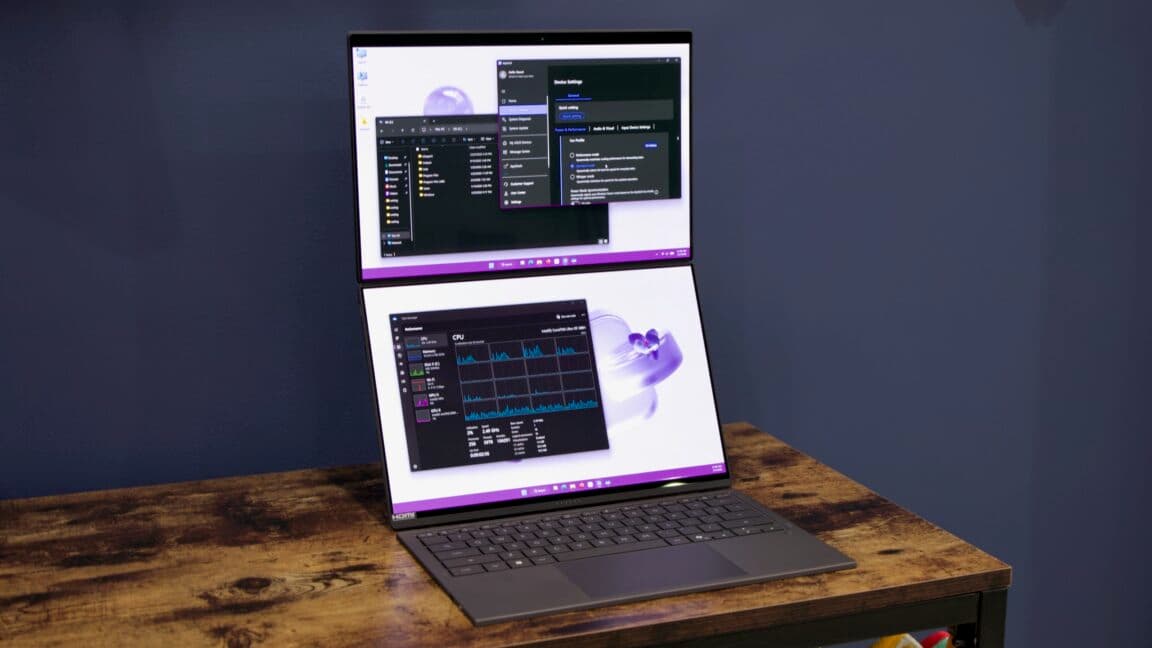
The flagship chip tested, a Core Ultra X9 388H, was evaluated inside Asus’ dual‑screen Zenbook Duo UX8407. In CPU benchmarks, the processor reportedly outpaces AMD’s Ryzen AI 9 HX 370 by roughly 10–40% in multi‑threaded workloads, while maintaining around 10% single‑core advantage over AMD, Intel’s own Lunar Lake parts and Qualcomm’s Snapdragon X Elite. Only Apple’s latest M‑series chips clearly lead in single‑threaded speed.
On the graphics side, the integrated Arc B390 GPU is said to be almost twice as fast as Intel’s previous laptop generations and AMD’s Radeon 890M, especially in ray‑traced titles. Battery life in this particular Asus design is described as very good, especially considering the dual‑screen form factor, with estimated runtimes that remain competitive even against lower‑power platforms.
All Core Ultra Series 3 chips include a sufficiently fast NPU to meet Microsoft’s Copilot+ PC requirements. The main caveats are external: a severe RAM supply crunch and indications that Intel may struggle to manufacture enough chips to meet demand.
3. Why this matters
Panther Lake matters because it fixes three of Intel’s biggest laptop problems at once: inconsistent performance, fragmented feature sets and muddled messaging.
Recent Intel generations forced buyers into uncomfortable trade‑offs. Meteor Lake improved graphics but often lost to older CPUs in raw compute. Lunar Lake delivered excellent efficiency and decent GPU performance but weaker CPU throughput and strict power envelopes. Arrow Lake swung back toward CPU muscle but cut back on graphics and AI capability. The result: reviewers could rarely give a simple yes/no recommendation to “just buy the new Intel.”
Panther Lake changes that dynamic. For OEMs, it’s finally a platform where every SKU shares the modern GPU architecture, a Copilot‑class NPU and broadly similar capabilities. That simplifies product planning and marketing. For consumers, it moves Intel closer to the Apple model: buy this year’s chip and you can reasonably assume it’s better in almost every way than the last one.
The winners are:
- PC makers, who can standardise on one Intel generation for premium Windows laptops without puzzling spec sheets.
- Gamers and creators on a budget, who get a legitimately capable integrated GPU for 1080p gaming and GPU‑accelerated workloads.
- Enterprises planning “AI PC” rollouts, because every Panther Lake configuration can run on‑device Copilot features.
The main losers, at least in the short term, are AMD and Qualcomm. AMD squandered momentum with a mild refresh this year, and Qualcomm’s first‑wave Windows‑on‑ARM laptops suddenly look much less compelling outside ultra‑mobility niches.
But there’s a risk: Panther Lake sets expectations high. If Intel falls back into half‑steps and confusing segmentation next year, the reputational damage could be worse than before.
4. The bigger picture
Panther Lake lands at the intersection of three major industry shifts: the “AI PC” marketing wave, the battle between x86 and ARM laptops, and Intel’s attempt to reinvent itself as a serious foundry player.
First, AI PCs. Microsoft’s Copilot+ initiative effectively set a floor for NPU performance in Windows laptops. Lunar Lake met that bar only in some SKUs; Arrow Lake didn’t. Panther Lake makes things simple: every chip qualifies. That matters less for today’s slightly gimmicky AI features and more for what’s coming – local transcription, image generation, real‑time translation and security workloads that cannot always go to the cloud for legal or bandwidth reasons.
Second, architecture. Qualcomm’s Snapdragon X Elite proved that ARM laptops can deliver excellent battery life and acceptable performance, but Windows‑on‑ARM software maturity is still uneven. Panther Lake, with its strong perf‑per‑watt at x86 compatibility, narrows the advantage ARM enjoyed. At the same time, Apple’s M‑series remains the efficiency gold standard, reminding everyone – especially regulators in Europe – how far x86 still has to go on energy use.
Third, manufacturing. Panther Lake is the first laptop line where Intel’s much‑hyped 18A process really needs to deliver at scale. Technically, early signs are positive: high clocks, good efficiency, competitive GPU, acceptable thermals. Commercially, it’s more delicate. Any supply hiccups – combined with the current memory shortage – could push OEMs toward AMD or Qualcomm simply because they can ship.
Historically, Intel’s last truly “clean” mobile uplift was Tiger Lake, which combined new cores, better graphics and solid efficiency. The years between Tiger Lake and Panther Lake were defined by compensation strategies and stopgaps. If Panther Lake becomes the new baseline for predictable, iterative improvement, it could mark the end of that lost half‑decade.
5. The European / regional angle
For European buyers and IT departments, Panther Lake is less about raw benchmark numbers and more about predictability and efficiency.
Electricity prices in much of Europe remain structurally higher than in the US. A platform that delivers solid performance at roughly 25–30 W for serious workloads is attractive not just to road warriors but to organisations running thousands of laptops. The EU’s push for greener ICT – from eco‑design rules to public‑sector sustainability tenders – will increasingly favour platforms that can demonstrate better performance‑per‑watt.
The unified NPU story also aligns with the EU AI Act and longstanding privacy culture, particularly in DACH and Nordic countries. On‑device inference reduces the need to send sensitive data to US‑based clouds for every AI feature. That’s attractive for sectors like healthcare, public administration and finance, where data residency is politically sensitive.
There’s also a competitive angle. European‑focused OEMs such as Tuxedo, Schenker/XMG, Slimbook and smaller regional assemblers now have an Intel platform that can credibly go up against AMD’s Strix designs for Linux‑friendly, locally supported laptops. Intel’s integrated Arc graphics still have rough edges on Linux, but if driver maturity continues to improve, we could see more European niche vendors standardise on Panther Lake for their higher‑end configs.
The downside is availability and pricing. The global RAM shortage and potential Intel supply constraints will hit Europe hard, especially in price‑sensitive Southern and Eastern markets where AMD had started to gain share. If Panther Lake systems arrive late or priced significantly above Ryzen‑based competitors, Intel’s technical win may not translate into market share on this side of the Atlantic.
6. Looking ahead
Over the next 12–18 months, expect Panther Lake to become the default choice for premium and upper‑midrange Windows laptops from every major OEM, from ultrabooks to mobile workstations. The first wave – halo designs like the Zenbook Duo – will be followed by more conventional business and education machines once supply and RAM pricing stabilise.
The key things to watch:
- Mid‑tier SKUs: Does Intel maintain the same GPU and NPU architecture across cheaper Panther Lake chips, or do we slide back into confusing feature gaps?
- Thermals in thin‑and‑lights: The X9 388H looks great with generous cooling. In 14 mm business ultrabooks, sustained performance will be the real test.
- Linux and pro‑app drivers: If Intel can smooth out Arc graphics on Linux and in creative suites, it gains a real niche in the European developer and creator community.
- AMD’s response: The next genuinely new Ryzen mobile platform – not this year’s minor refresh – will tell us whether AMD is content to be “good enough” or intends to retake the performance crown.
- Windows on ARM maturity: Qualcomm’s upcoming X2 generation and Microsoft’s software work could yet re‑tilt the field toward ARM, particularly in ultra‑mobile form factors.
There are also open questions. Will Microsoft’s AI features mature into something enterprises actually deploy at scale, justifying the NPU arms race? Will Intel’s 18A foundry bet stand up under the pressure of multiple big product lines, not just laptops? And will the next generation after Panther Lake be a straightforward refinement, or another architectural curveball?
7. The bottom line
Panther Lake is Intel’s best laptop platform in years and, more importantly, the first one in a long time that tells a coherent story: fast CPU, strong integrated GPU, solid battery life and a capable NPU in every SKU. That doesn’t erase a decade of zig‑zagging, nor does it dethrone Apple on efficiency, but it gives OEMs and buyers a reason to trust Intel laptops again. The real question is whether you believe Intel has finally rediscovered steady iteration – or whether this is just one very good stop on another unpredictable journey.