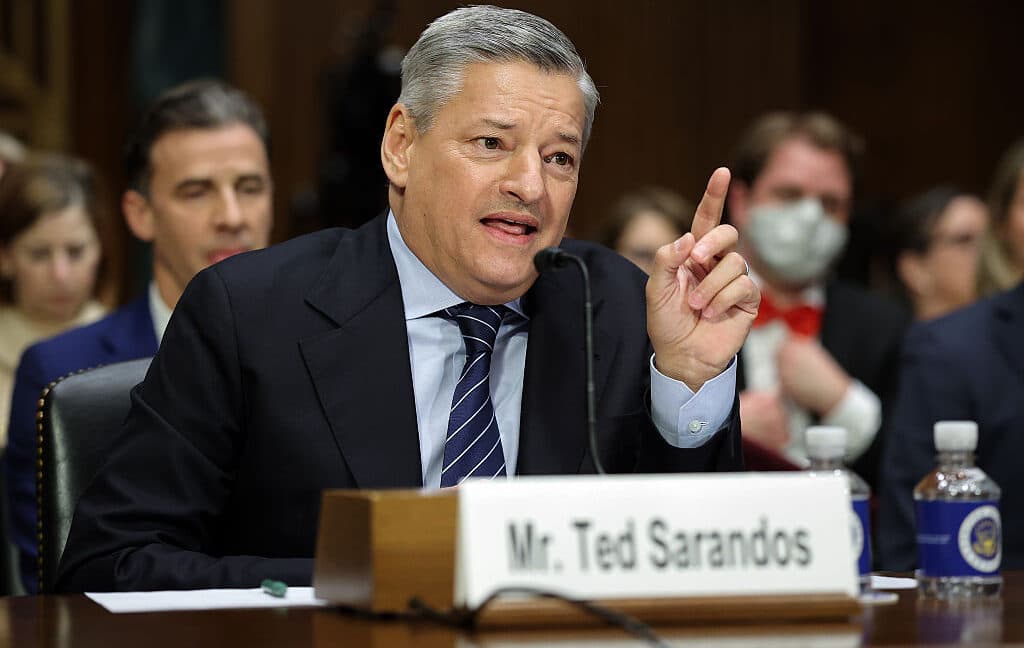
Netflix is trying to convince Washington that its proposed acquisition of Warner Bros. Discovery’s streaming and studio assets will be a win for viewers. At a Senate antitrust hearing, co‑CEO Ted Sarandos pushed a simple message: more content for less money, and if prices ever feel too high, users can cancel with a single click. That sounds reassuring—but it also neatly dodges the deeper question. The real issue isn’t whether you can cancel Netflix; it’s how much meaningful choice will remain if you do. This deal is about power, not user interface design.
2. The news in brief
According to reporting by Ars Technica, Netflix co‑CEO Ted Sarandos appeared before the US Senate Judiciary Committee’s antitrust subcommittee to defend Netflix’s plan to acquire Warner Bros. Discovery’s (WBD) streaming and movie studio businesses, including HBO Max. Netflix is currently the world’s largest subscription video‑on‑demand (SVOD) service with about 301.6 million subscribers as of January 2025; WBD sits in third place with around 128 million streaming customers across HBO Max and Discovery+.
Sarandos argued that the two services are “complementary,” noting that roughly 80 percent of HBO Max subscribers also pay for Netflix. He claimed the combined service would deliver more content at a lower effective cost per hour viewed and said Netflix users pay about $0.35 per hour of watched content, compared to a much higher figure for Paramount+. He also downplayed monopoly concerns, pointing to YouTube’s larger share of TV viewing and calling Google, Apple and Amazon powerful competitors. Netflix has put forward an all‑cash offer valued at $72 billion (enterprise value roughly $82.7 billion) for WBD assets, while Paramount is pursuing a rival, hostile bid worth about $108.4 billion for the entire WBD group.
3. Why this matters
The core of Netflix’s argument rests on a seductive but shallow idea: if you don’t like the price, just cancel. In classic antitrust thinking, low switching costs are supposed to protect consumers. But in streaming, the real switching cost is not the cancel button—it is the loss of cultural access.
Owning both Netflix and HBO’s output would give one company extraordinary control over the shows and films that dominate public conversation. That is soft power: the ability to decide what gets funded, how long it stays online, in which regions it is available, and on what terms creators get paid. Even if users can opt out month‑to‑month, the gravitational pull of a combined catalogue makes "choosing to leave" far more painful.
Sarandos’ own statistic—that 80 percent of HBO Max subscribers already have Netflix—cuts both ways. Yes, it shows the services are complements today. But it also means that the merger would immediately reduce choice for the industry’s most valuable segment: heavy streamers willing to pay for multiple platforms. Once you control their must‑watch content from two leading brands, the temptation to steadily ratchet up prices is obvious.
There is another, quieter casualty: bargaining power on the other side of the table. Writers, actors, independent studios and even device manufacturers lose leverage when a single buyer controls so much of the premium content pipeline. That can depress creative diversity and push more risk onto smaller players. In the long run, consumers don’t just pay more; they get fewer weird, experimental, non‑algorithm‑friendly projects—a loss that isn’t captured in per‑hour price statistics.
4. The bigger picture
This proposed deal lands in the middle of streaming’s second great consolidation wave. The first wave was about building direct‑to‑consumer services (Disney+, HBO Max, Paramount+, Peacock). The second is about cleaning up the mess those launches created: too many apps, too much debt, and subscriber growth that has slowed sharply since the pandemic peak.
Warner Bros. Discovery has already gone through one brutal integration after the AT&T spin‑off. We saw aggressive cost‑cutting, content removals and licensing shifts that confused users and angered creators. A Netflix acquisition would be another turn of the consolidation screw—this time fusing the world’s biggest SVOD platform with one of Hollywood’s deepest libraries.
We have been here before. When cable giants merged with content companies (think Comcast–NBCUniversal), regulators were promised lower prices, better bundles and innovative offerings. In reality, US pay‑TV bills kept rising, carriage disputes remained common, and consumer satisfaction stagnated. Streaming was supposed to be the escape hatch from that model; instead, it is quietly re‑creating it in app form.
Competitors are not standing still. Disney is re‑bundling Disney+, Hulu and ESPN+; Amazon is weaving Prime Video ever deeper into its core subscription; Apple is subsidising Apple TV+ through device profits and its Apple One bundles, while YouTube grows its share of living‑room viewing with ads and YouTube TV. Against that backdrop, Netflix’s message—"we’re the underdog because YouTube is bigger"—rings hollow. The platforms are converging towards a handful of vertically integrated giants, each with their own walled garden.
The Netflix–HBO Max deal would accelerate that trend. It is less about surviving competition and more about locking in a future where a small club of tech‑media conglomerates sets the terms of global entertainment.
5. The European angle
From a European perspective, the most important question is not just price, but pluralism. Europe has spent years building a regulatory framework to avoid exactly this kind of cultural concentration. Under the Audiovisual Media Services Directive, streamers must invest in European works and promote local content. Under the Digital Markets Act (DMA) and the upcoming EU AI and media debates, Brussels is signalling it will not simply trust global platforms to “self‑regulate.”
A merged Netflix–HBO operation would instantly become the default gatekeeper for premium series and films in many EU countries, where both brands are already strong and local alternatives are relatively small. That could mean fewer serious buyers for European rights, tougher contract terms for local producers in Berlin, Madrid or Warsaw, and more pressure on public broadcasters and regional streamers competing for talent.
At the same time, such a giant could have the capital to commission more ambitious European originals, from Slovenian crime dramas to Spanish genre films, and to market them globally. The risk is that editorial decisions become even more driven by global algorithms and US market logic rather than regional cultural priorities.
Crucially, even if US regulators approve the deal, Brussels and national competition authorities would still get a say based on the combined company’s turnover in the EU. They can demand remedies: commitments on carriage of European channels, minimum investment levels, data sharing for regulators, or even structural conditions. Netflix is already under scrutiny in several EU states over taxation, local funding and perceived dominance; adding HBO’s catalogue will only intensify that debate.
6. Looking ahead
Several scenarios are now in play. The most dramatic would be regulators in Washington or Brussels blocking the deal outright, arguing that the combination of the largest SVOD platform with a top‑three rival and a major studio crosses a red line. That outcome is possible but far from guaranteed, especially as Netflix leans heavily on the argument that YouTube, Amazon and TikTok are the real giants of screen time.
More likely is a long negotiation resulting in a conditional approval. Expect talk of behavioural remedies—promises about maintaining separate pricing tiers, commitments not to pull HBO content from rival platforms in Europe for a defined period, or pledges around data use and recommendation neutrality for third‑party titles. Structural remedies, such as spinning off certain cable channels or regional assets, would be harder for Netflix to swallow but might surface in Europe.
For viewers, the near‑term impact will be confusion rather than savings. Rebrands, app changes, catalogue reshuffles and new bundle offers are almost inevitable. The promised "more for less" is unlikely to materialise quickly; historically, major media mergers have coincided with, not prevented, gradual price increases.
The key metrics to watch over the next 12–24 months: average revenue per user (ARPU) on Netflix’s ad‑free tiers, the frequency of price hikes across markets, and how aggressively Netflix leverages exclusivity on HBO catalogue titles. Also important is what happens if Paramount’s higher all‑equity offer somehow prevails; a different owner would bring its own consolidation logic, potentially triggering yet another reshaping of the streaming landscape.
7. The bottom line
Netflix’s defence of the HBO Max deal leans on a convenient truth—cancelling is easy—and ignores the harder one: genuine choice is shrinking. Combining the world’s largest streamer with one of its strongest studios will strengthen a single gatekeeper in a market already tilting toward a few giants. Regulators in the US and Europe should treat the “one‑click cancel” mantra as a distraction and focus instead on long‑term diversity, pricing power and cultural pluralism. The real question for viewers is simple: how many companies should be allowed to own our evenings?