Western Digital’s consumer SSD shelf is about to look very different.
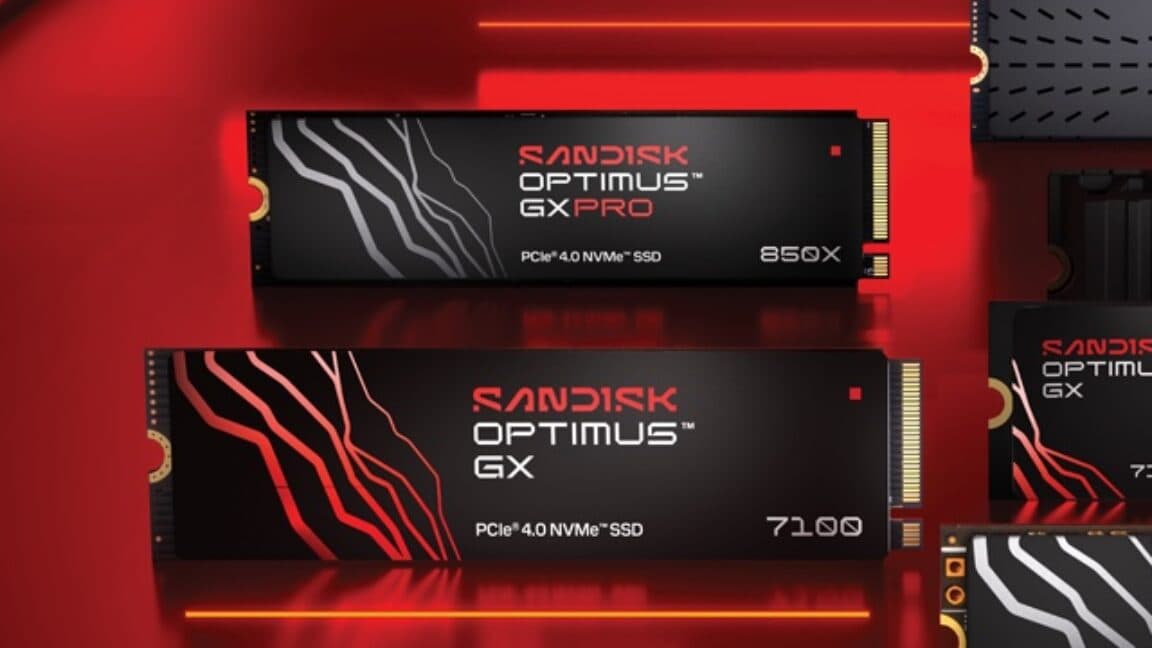
SanDisk, now the company’s dedicated flash and SSD business, is retiring the WD Blue and WD Black branding on mainstream SSDs and replacing it with a new family called SanDisk Optimus, while keeping the same model numbers.
WD splits — and then unwinds a $19 billion deal
Back in late 2023, Western Digital said it would split into two companies:
- Western Digital: spinning hard drives for NAS and data centers.
- SanDisk: solid-state storage, including consumer SSDs.
That move essentially unwinds Western Digital’s own acquisition of SanDisk a decade ago, a deal then worth $19 billion. The branding shift we’re seeing now is the first big consumer-visible consequence.
Goodbye WD Blue and Black, hello Optimus
SanDisk’s plan is simple: same SSDs, new names, same model numbers.
WD Blue SSDs → SanDisk Optimus
- WD Blue SN5100 becomes SanDisk Optimus 5100.
Mid-tier WD Black → SanDisk Optimus GX
- WD Black SN7100 becomes SanDisk Optimus GX 7100.
High-end WD Black → SanDisk Optimus GX Pro
- WD Black SN850X becomes SanDisk Optimus GX Pro 850X.
- WD Black 8100 becomes SanDisk Optimus GX Pro 8100.
For a while you’ll see WD and Optimus versions of the same drive on shelves and in online listings. The model numbers stay identical, which should help anyone trying to match reviews or specs while the branding transitions.
SanDisk also tried to make the naming a bit more logical this time: the more words in the name, the higher-end the drive is meant to be.
What actually changes under the hood? Not much
Functionally, these are the same products you already know — this is a rebrand, not a new generation.
The differences between models are the same as before:
Optimus 5100 (ex–WD Blue SN5100)
- Uses QLC (quad-level cell) NAND.
- QLC is slower and less durable than TLC, but cheaper per gigabyte.
Optimus GX 7100 (ex–WD Black SN7100)
- Uses TLC (triple-level cell) NAND, the mainstream performance/durability sweet spot.
Optimus GX Pro 8100
- Jumps to PCIe 5.0 for maximum throughput.
- Includes a dedicated DRAM cache.
Optimus GX Pro 850X
- Still has dedicated DRAM, but tops out at PCIe 4.0 speeds.
The lower tiers — 5100 and 7100 — don’t have their own DRAM. Instead, they borrow a bit of your system RAM as a Host Memory Buffer (HMB), which is standard practice in budget and mid-range NVMe drives.
For most people, all of these are "fast NVMe SSDs." As Ars Technica notes, many users will struggle to tell the difference in everyday use between the low-end Blue/Optimus and high-end Black/Optimus GX Pro, even though there are clear technical distinctions.
Software: WD Dashboard is dead, long live SanDisk Dashboard
On the software side, Western Digital has already flipped the switch. The WD Dashboard utility was formally discontinued a year ago.
Going forward, owners of both WD-branded and SanDisk-branded SSDs are expected to use SanDisk Dashboard for firmware updates, health checks, and drive maintenance.
What about WD Green and Red SSDs?
One conspicuous omission: WD Green and WD Red SSDs, which target entry-level systems and NAS storage.
SanDisk’s press release didn’t mention them at all. When Ars asked about their fate, SanDisk spokesperson Robyn Pagulayan said the company had nothing to announce regarding those lines.
So for now, only WD Blue and Black SSDs are officially moving into the Optimus universe.
A branding shake-up in a volatile SSD market
All of this is happening against a backdrop of serious volatility in the memory market:
- SSD prices have been spiking, driven partly by demand from AI data centers.
- Concerns about further price hikes are pushing companies and consumers to buy ahead of time, adding more pressure.
- Shortages of both RAM and NAND flash are expected to keep prices elevated in the short to medium term.
SanDisk isn’t alone in rethinking its consumer portfolio. Micron announced last month that it would discontinue its Crucial-branded consumer SSDs and RAM sticks entirely, exiting that part of the market.
For buyers, the takeaway is straightforward: expect the WD logo to quietly disappear from a lot of SSD boxes, replaced by SanDisk Optimus branding. If you care about what you’re actually getting, follow the model number, not the badge on the sticker.