1. Headline & intro
Imagine a TV that costs nothing up front but permanently turns part of your living room into a live billboard and data-harvesting machine. That’s the bet LA‑based startup Telly is making—and early numbers suggest the economics are surprisingly strong, even as the business itself struggles to get hardware through the door.
In this piece, we’ll look beyond the hype: what Telly’s real-world performance says about the future of ad-subsidised hardware, why its logistics problems matter as much as its ARPU, how this model would collide with European regulation, and what it reveals about where the smart TV market is heading.
2. The news in brief
According to Ars Technica, citing a report from newsletter Lowpass based on a Q3 2025 investor update, Telly has only around 35,000 of its “free” dual‑screen TVs active in people’s homes, despite promising hundreds of thousands of units in 2023 and “millions” more in 2024.
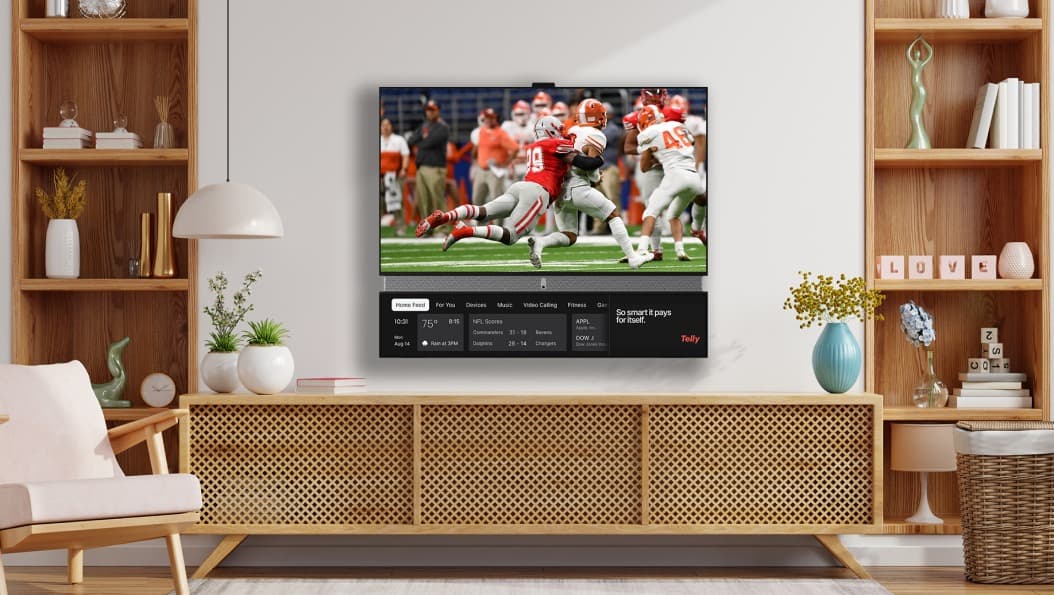
The sets feature a 55‑inch main panel and a secondary strip underneath dedicated largely to advertising and informational widgets. Users don’t pay for the hardware, but must complete detailed surveys, accept extensive tracking, and keep the ad screen visible—or face a fee for the TV’s stated $1,000 value.
The investor note reportedly says Telly generated about $22 million in annualised revenue in Q3 2025, which works out to roughly $52 in advertising revenue per active TV per month—far higher than what Roku and Vizio report per user. The same note indicates Telly has raised $350 million in debt and plans to order 100,000 additional TVs from manufacturer Foxconn after fixing earlier shipping damage problems.
3. Why this matters
The headline isn’t that Telly shipped fewer TVs than promised; startups over‑forecast all the time. The real story is that, with just 35,000 devices, the company appears to be monetising each household at a rate traditional TV makers can only dream of.
At roughly $52 in monthly revenue per active TV, Telly is operating in a completely different economic universe from Roku and Vizio, who report annual—not monthly—ARPU in the $37–$41 range. Even allowing for investor‑deck optimism and small‑sample distortion, the order of magnitude is striking.
Who wins in such a model?
- Advertisers and ad‑tech intermediaries, who gain a more immersive, measurable canvas in the living room.
- Telly (if it can scale), which effectively becomes an attention broker rather than a low‑margin hardware vendor.
Who loses?
- Consumers, who trade not just viewing data but detailed personal profiles and a permanent second screen of ads inside the home.
- Traditional TV OEMs, whose own ad‑supported smart TV strategies suddenly look tame—and potentially under‑monetised—by comparison.
This also exposes a core tension of the smart TV market: hardware margins are collapsing, but any bolder attempt to monetise attention risks crossing the line into overt surveillance and user hostility. Telly is that tension in its purest, most extreme form.
And then there’s the operational angle. Telly’s issues—broken shipments, limited scale, reliance on a small team and direct‑to‑consumer logistics—show that even if the ad economics work, building a hardware pipeline and field‑support organisation is a completely different game from running an ad network or streaming app.
4. The bigger picture
Telly isn’t an isolated curiosity; it sits at the intersection of three larger trends.
1. The “zero‑price” hardware playbook. We’ve seen versions of this before: free dial‑up ISPs in the 90s, subsidised Kindles with lock‑screen ads, operator‑locked smartphones given away on contracts. The difference now is the intensity of data collection and the permanence of the ad surface: a dedicated second screen that never fully goes away.
2. Smart TV makers pivoting into ad businesses. Samsung, LG, Roku, Amazon’s Fire TV, and Google TV all increasingly treat the home screen as an ad inventory grid. They inject sponsored rows, pre‑installs and tracking IDs, because that’s where the margin is. Telly pushes this logic to its endpoint: if the TV is really an ad surface, why charge for it at all?
3. The living room as the new cookie. As browsers clamp down on third‑party cookies and mobile platforms restrict tracking, connected TV has become one of the few remaining environments where identity, viewing behaviour, and household context can be stitched together. A company that controls both the panel and a mandatory ad strip sits on top of premium, high‑signal data.
Historically, extreme ad‑subsidy models have had mixed outcomes. Free PCs for agreeing to on‑device ads and monitoring, for instance, flared up around the dot‑com boom and then collapsed under user irritation and low ad yields. The difference today is that CTV ad budgets are real and growing, measurement is far more sophisticated, and the average household is used to pervasive tracking from phones, streaming sticks, and consoles.
Telly’s numbers hint that, in 2026, the economics finally line up. The question is whether user tolerance—and regulation—will keep pace.
5. The European / regional angle
Right now Telly is a US‑focused story, but the model has obvious implications for Europe.
Under GDPR, devices that depend on rich profiling and constant tracking can’t simply bundle consent into a 50‑page terms screen. The idea of forcing users to keep an ad display visible, under threat of a four‑figure hardware fee, would attract scrutiny around “freely given” consent and the concept of data as counter‑performance under EU consumer law.
The Digital Services Act (DSA) and the upcoming EU AI Act add more pressure. If the integrated camera and mic are ever used for gaze tracking, emotion detection, or household profiling, that drifts into high‑risk AI territory and potentially biometric data processing—areas where European regulators are far less forgiving than their US counterparts.
Europe has already seen backlash against much milder practices: HbbTV tracking controversies, German data protection probes into smart TV telemetry, and legal challenges against “cookie paywalls” that tie access to data surrender. A literal “pay or watch this extra ad screen forever” TV would test those boundaries.
There’s also a competitive dimension. European operators like Sky, Deutsche Telekom, or Orange already subsidise set‑top boxes and sometimes TVs, but they do so within a regulated telco framework and without such aggressive, always‑on ad surfaces. If Telly’s economics prove durable, expect pressure on European OEMs and telcos to squeeze more value out of their installed bases—while regulators try to ensure that “more value” doesn’t mean “less privacy.”
6. Looking ahead
Telly now faces a classic startup fork in the road.
One path is vertical scale: fix logistics, harden the hardware, expand manufacturing with Foxconn, and try to get hundreds of thousands of TVs into homes. If the reported ARPU holds even partially at scale, this becomes a sizeable media business with a hardware front end.
The risks here are brutal. Hardware is capital‑intensive, field failures are expensive, and user goodwill can evaporate quickly if devices arrive broken or feel spammy. A $350 million debt load does not leave infinite room for trial and error.
The other path is horizontal expansion: license the Telly ad experience and data stack to other manufacturers or operators, turning the company into a software and monetisation layer for mid‑tier OEMs and ISPs that lack strong ad‑tech capabilities. That would dilute the “free TV” brand, but could dramatically reduce logistics and support risk.
For readers, a few signposts to watch:
- Engagement, not just installs. How many households actually keep the Telly plugged in and the ad screen unobstructed six or twelve months later? ARPU is meaningless if users quietly defect.
- Regulatory probes. In the US, the first privacy complaint or class action will be a canary in the coal mine. In Europe, any attempt to launch a similar model will immediately run into GDPR and DSA test cases.
- Copycats. If Telly’s revenue per device is even half as good as claimed, expect larger TV brands—or streaming players like Netflix and Amazon—to experiment with more aggressive hardware subsidies.
The key open question: is there a stable equilibrium where consumers accept an always‑on ad strip and deep tracking in exchange for “free” hardware, or is this another short‑lived arbitrage that collapses under its own intrusiveness?
7. The bottom line
Telly’s early numbers don’t just validate an unusual startup—they put a concrete price tag on the modern living room. If a few tens of thousands of households can yield tens of millions in annualised ad revenue, “free” hardware is no longer a gimmick but a viable, if uncomfortable, business model. The real battle over the next few years won’t be about who makes the best panel; it will be about who controls the attention and data that panel mediates—and what trade‑offs we’re willing to tolerate in return.