AMD’s $899 Ryzen 9 9950X3D2 Shows How Weird High-End CPUs Have Become
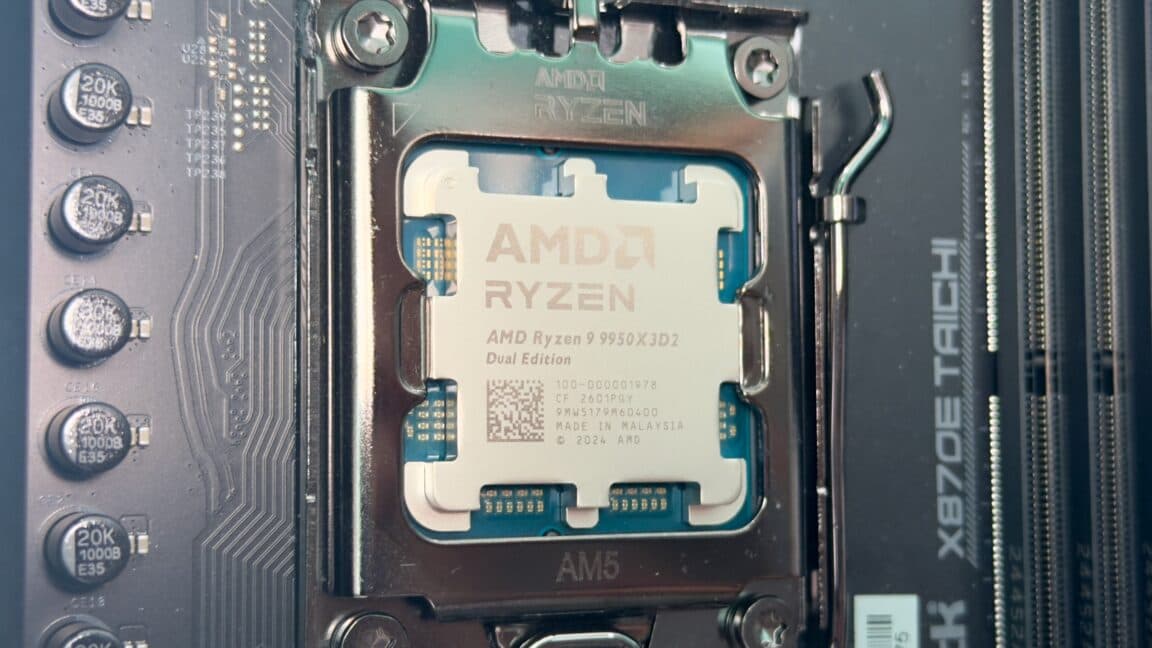
If you ever needed proof that desktop CPUs have entered the era of extreme niche products, AMD’s new Ryzen 9 9950X3D2 Dual Edition is it. On paper it’s spectacular: 16 Zen 5 cores, over 200 MB of cache and gaming performance at the absolute top of the charts. In practice, it’s a very expensive way to gain a sliver of performance over a much cheaper sibling. In this piece we’ll skip the benchmark charts and dig into what this launch really tells us about AMD’s strategy, the state of high-end PC hardware, and what European buyers should — and shouldn’t — do about it.
The news in brief
According to Ars Technica’s review, AMD is launching the Ryzen 9 9950X3D2 Dual Edition on 22 April with a list price of $899. It’s a 16‑core Zen 5 desktop processor for the AM5 platform. Unlike the existing Ryzen 9 9950X3D (MSRP $699, often selling around $660), both eight‑core chiplets in the 9950X3D2 carry an additional 64 MB of stacked 3D V‑Cache. That brings total cache to 208 MB.
Ars reports that in general‑purpose CPU tests, video encoding and gaming, the 9950X3D2 is only slightly faster than the standard 9950X3D. Despite a higher default TDP of 200 W versus 170 W, measured power draw in games is similar, and a bit lower in video encoding. Both X3D chips generally beat Intel’s $350 Core Ultra 7 270K Plus in gaming, while Intel keeps up in multi‑core productivity at somewhat higher power use.
The big practical difference is architectural simplicity: all 16 cores in the 9950X3D2 have 3D V‑Cache. That removes the need for AMD’s software logic that steers games to cached cores and other tasks to non‑cached ones in the mixed‑chiplet X3D designs.
Why this matters
On the surface, the 9950X3D2 is a classic halo product: technically impressive, priced beyond rationality for most people, and built as much for marketing as for volume sales. But it exposes some uncomfortable truths about the current desktop CPU market.
First, performance scaling at the very high end is hitting diminishing returns. You’re paying roughly 36% more than a 9950X3D’s street price for gains that Ars Technica describes as marginal across typical workloads. The silicon is clearly capable, yet today’s mainstream gaming and creator applications rarely exploit 16 heavily cached cores. For most enthusiasts, the real question is no longer “what’s the fastest CPU I can buy?” but “how much money am I willing to burn for bragging rights?”
Second, AMD is quietly admitting that its hybrid X3D approach — one cached chiplet, one standard — is good enough almost all of the time. If duplicating cache on both chiplets barely moves the needle, that validates the existing 9950X3D, 9900X3D, 7950X3D and 7900X3D design choices. The Dual Edition is essentially a product for people who either don’t trust AMD’s software scheduling layer, or have very specific cache‑bound, highly parallel workloads.
Third, this chip underscores AMD’s confidence in pricing power at the very top of the stack. Intel’s best mainstream desktop part in this comparison is less than half the price, yet close in multi‑core apps and not embarrassing in games. AMD isn’t targeting value buyers here. It’s aiming at boutique builders, over‑the‑top gaming rigs and a small group of workstation users who want one CPU that “just works” without having to understand core topology.
The bigger picture
The 9950X3D2 sits at the intersection of three bigger trends in PC hardware.
The first is the rise of cache as a differentiator. Since the original Ryzen 7 5800X3D proved how much extra L3 cache could help games, AMD has leaned heavily on 3D V‑Cache to claim the gaming crown without blowing up clock speeds or power. Intel, by contrast, has focused on hybrid P‑core/E‑core designs and higher memory speeds. With the 9950X3D2, AMD is testing the upper limit of “how much cache is still useful” in a consumer platform — and the answer seems to be: less than marketing would like.
The second trend is software’s slow adaptation to increasingly complex CPU architectures. AMD’s earlier X3D chips rely on Windows and AMD’s own tools to place workloads on the right cores. Intel’s hybrid Core designs have their own scheduling quirks, especially in older games and anti‑cheat systems. By making all cores identical again, the 9950X3D2 sidesteps this fragility at the cost of silicon area and price. It’s a reminder that hardware has, in some ways, outpaced the sophistication of the average Windows application.
Third, we’re watching the halo desktop market shrink into a lifestyle category. Ten years ago, high‑end CPUs also drove workstation and prosumer workflows in a fairly direct way. Today, a lot of that work has moved to the cloud, MacBooks, or specialised accelerators. The 9950X3D2 looks less like a tool for professionals and more like an enthusiast luxury item — the mechanical keyboard of CPUs, but with an $899 entry ticket.
It also marks a quiet victory lap for AMD’s AM5 platform philosophy. If you bought into AM5 early, you can drop this monster into an existing board and call it a day. Intel’s LGA 1700 to 1851 transition makes such upgrades more disruptive and gives AMD a narrative of longer‑term platform stability.
The European / regional angle
For European buyers, the 9950X3D2 lands in particularly awkward territory. By the time you add VAT and retailer margins, a $899 US MSRP tends to translate into something closer to €950–€1,000 in many EU markets. That’s the price of an entire competent gaming PC for a lot of households, not just a CPU.
At the same time, electricity prices in parts of Europe remain well above US levels. Ars Technica’s measurements show that gaming power draw is comparable to the cheaper 9950X3D and that encoding can even be a bit more efficient, which is good news. But you’re still buying a 200 W‑class part in a region where efficiency regulations, green positioning and noise‑sensitive small apartments matter more than in sprawling US suburbs.
Then there’s the ecosystem question. System integrators in Germany, the Nordics and Central Europe will absolutely offer pre‑built rigs with this chip, but volume will be tiny compared with Ryzen 7 and Ryzen 5 configurations. For most European gamers — especially in Central, Eastern and Southern Europe — the sweet spot remains a mid‑range GPU paired with a reasonably fast eight‑ or twelve‑core CPU.
Finally, EU policy is slowly but surely pushing manufacturers to be clearer about repairability, longevity and power use. AMD’s argument for AM5’s multi‑generation lifespan aligns well with that direction. But ultra‑niche parts like the 9950X3D2 raise the question: how much engineering effort should go into exotic SKUs versus making the mainstream 65 W chips even better?
Looking ahead
The 9950X3D2 is unlikely to be a big seller, and that’s fine — it’s not designed to be. The more interesting question is what AMD learns from it.
If sales are modest but the existing 9950X3D continues to perform well in reviews and real‑world feedback, expect AMD to double down on the mixed‑chiplet formula for future X3D generations. In that scenario, the Dual Edition becomes a one‑off experiment that reassures a few edge‑case users and demonstrates engineering prowess.
If, however, AMD sees a surprising number of workstation buyers gravitating to the 9950X3D2 for cache‑sensitive simulations, EDA, or finance workloads, it could inspire a small but stable class of “all‑cache” desktop parts sitting between consumer and Threadripper lines.
For consumers, the smart move is probably to wait. New platforms from both AMD and Intel are on roughly 12–18‑month cadences; discounts on the 9950X3D and standard 9950X are almost guaranteed once the initial rush of 9950X3D2 stock has moved. Watch retail pricing, not just launch MSRPs, and keep an eye on microcode and Windows scheduler updates — these have historically improved X3D behaviour over time.
The open questions are mostly strategic. How far can AMD push cache‑heavy designs before they stop making sense outside a few benchmarks? Will Intel respond with its own cache‑centric parts, or continue betting on hybrid core counts and AI accelerators? And at what point will gamers realise that the real bottleneck in most modern titles is still the GPU, not the CPU?
The bottom line
AMD’s Ryzen 9 9950X3D2 is an engineering flex and a pricing experiment, not a sensible upgrade for most people. It proves that AMD’s mainstream X3D strategy was already close to optimal and that adding more cache delivers rapidly shrinking real‑world gains. If you’re a European gamer or creator with a finite budget, the smarter question isn’t “Can I afford this?” but “What else could I build with the €300–€400 I’d save by not buying it?”